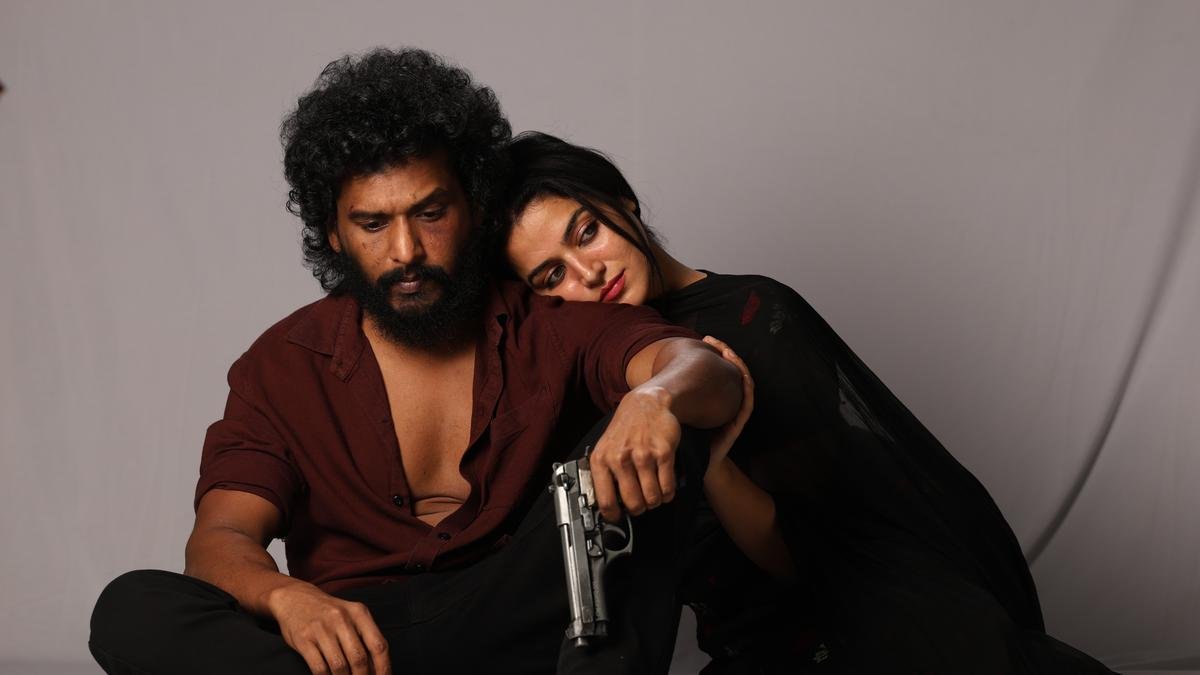
DC movie review:Arun Matheswaran’s DC arrives as the kind of Tamil action film that understands exactly how violence can look and sound spectacular on a big screen. Led by Lokesh Kanagaraj in his first major lead role and Wamiqa Gabbi, the film combines gangster drama, revenge, exploitation and literary reinterpretation with an unusually aggressive audiovisual style. Anirudh Ravichander’s music supplies much of its thunder, while the action staging gives the film several sequences that are likely to remain its strongest talking points.
Yet DC is more interesting as an experiment than as a completely satisfying drama. Its central conceit — reshaping the emotional framework of Devdas around a violent gangster named Devadas and replacing the conventional romantic trajectory with a relationship involving Chandra, a woman who has survived years of sexual exploitation — has genuine potential. It gives Matheswaran an opportunity to examine desire, trauma, masculinity and redemption through characters who exist far outside respectable society.
The problem is that the film repeatedly chooses spectacle over introspection. The violence is meticulously staged; the emotional consequences are considerably less developed. When the guns stop firing, DC does not always have enough dramatic material to sustain the intensity that its technical craft generates.
What is DC about?
At its centre are Devadas, known as Das, and Chandra, two damaged people whose lives have been shaped by radically different forms of violence. Das is a gangster operating within a criminal network headed by Arasu, a former policeman who has crossed into the underworld. Chandra is a sex worker who was sold to pimps as a child and has spent much of her life confined within an environment where exploitation has become routine.
The film places these characters on intersecting trajectories rather than presenting a conventional romance. Das is already capable of extreme violence, while Chandra has been forced to endure violence for years. Their eventual connection therefore becomes less about discovering love and more about two survivors recognising something of themselves in each other.
That distinction is important. DC is at its best when it treats its protagonists as products of environments that have denied them ordinary emotional lives. Neither character is presented as morally pure. Both kill. Both survive through violence. Both carry the scars of systems larger than themselves.
The film’s most compelling question, consequently, is not whether Das and Chandra will fall in love. It is whether two people shaped by brutality can find a form of human connection without reproducing the same cycle of brutality around them.
Arun Matheswaran’s cinema has always been fascinated by violence
Matheswaran’s filmmaking has consistently explored the relationship between trauma and extreme violence. His debut, Rocky, announced a filmmaker interested in turning brutality into visual language. Subsequent films continued to push that interest into increasingly stylised territory.
With DC, that fascination becomes even more pronounced. Violence is not merely an occasional component of the plot; it is almost the film’s grammar. Characters communicate through threats, confrontations and killings, while action sequences frequently function as punctuation marks between narrative developments.
There is undeniable skill in that approach. Matheswaran knows how to stage physical conflict so that the geography of a scene remains legible. He understands anticipation, rhythm and impact. A shootout does not simply become a collection of people firing weapons; movement, location and escalation are carefully arranged.
But the success of an action scene can also expose the weakness of a screenplay. When the choreography is more emotionally persuasive than the characters involved, the audience may begin watching the mechanics of violence rather than caring about its consequences.
Lokesh Kanagaraj’s Das is more than a conventional gangster hero
Lokesh Kanagaraj’s casting is one of DC‘s most intriguing elements. As a filmmaker associated with contemporary Tamil action cinema, his presence as an actor creates an immediate layer of meta-cinematic curiosity. Here, he is not simply playing a hero; he is playing a man whose identity is inseparable from violence.
Das is not constructed as an invincible action hero in the conventional sense. He is emotionally stunted, impatient and capable of cruelty. His relationship with the criminal world is complicated by his awareness that the system is itself unequal and corrupt.
That contradiction could have made Das a fascinating antihero. He participates in the violence of the world while also recognising the injustice that produced it. This is where the film’s Robin Hood-like dimension enters the picture.
However, the screenplay sometimes makes his social consciousness feel more like a character description than a fully developed moral conflict. If Das despises inequality, the audience needs to understand the precise limits of his rebellion. Does he redistribute wealth? Protect vulnerable people? Challenge specific forms of exploitation? Or does he simply use a critique of society to justify his own violence?
DC raises those questions without always exploring them deeply enough.
Wamiqa Gabbi gives Chandra the film’s emotional centre
If Das represents the external expression of violence, Chandra represents its internal cost.
Her backstory is disturbing precisely because the film presents exploitation as something that has consumed almost her entire life. Sold to pimps as a child and kept within the same oppressive environment for years, Chandra has been denied the ordinary experiences through which people build identity, trust and independence.
That makes her fundamentally different from many revenge-driven female characters in action cinema. She is not simply introduced as someone seeking payback for a single traumatic incident. Her trauma is systemic and prolonged.
Wamiqa Gabbi brings vulnerability and intensity to the role, and the character’s presence gives DC an emotional dimension that the gangster storyline sometimes lacks. Chandra’s rage is not merely cinematic fury. It emerges from a life in which her agency has repeatedly been taken away.
The film’s strongest gender-related idea lies here. Das is a man who has chosen violence as a language of power. Chandra is a woman who has been subjected to violence as a language of control. Their meeting creates the possibility of comparing these two experiences rather than treating them as identical.
Unfortunately, the film does not always take this comparison as far as it could.
DC’s Devadas twist is clever but underexploited
One of the film’s most interesting structural ideas is its reinterpretation of the classic Devdas template associated with Sarat Chandra Chattopadhyay.
The familiar emotional architecture of Devdas involves longing, loss and self-destruction. Matheswaran takes that framework and asks a different set of questions: What happens if Devadas is a gangster? What if Parvathy disappears from his life before the conventional romantic relationship can fully develop? What if another woman, carrying an entirely different history of suffering, becomes the person who changes him?
This is more than a literary Easter egg. It potentially changes the meaning of the original tragic-romantic archetype.
Instead of a privileged man destroying himself because he cannot reconcile desire and social expectations, DC places its central male character in a world of crime and structural violence. Chandra then introduces a completely different form of suffering into his story.
The strongest version of this idea would make the two characters transform each other’s understanding of survival. Das could discover that violence does not automatically equal freedom, while Chandra could discover that survival need not remain defined entirely by the people who imprisoned her.
The film approaches this territory but often moves away from emotional development to return to action.
The action choreography is DC’s biggest strength
There is little doubt that DC knows how to stage an action sequence.
The film’s set pieces have an unusual confidence. A shootout at a wedding hall, for instance, demonstrates how an ordinary social setting can be transformed into an arena of chaos. The contrast between celebration and sudden violence creates immediate visual tension.
Other action passages operate through mini-revenge arcs, allowing Das and Chandra to encounter traitors, predatory men and corrupt officials while gradually moving through their respective conflicts.
These sequences demonstrate Matheswaran’s command of physical staging. The camera, editing and sound design work together to create momentum rather than simply documenting violence.
There is also a clear understanding of escalation. The best sequences do not begin at maximum intensity. They create anticipation before allowing the violence to explode.
For action-film audiences, this is likely to be one of DC‘s strongest attractions.
But too much violence eventually becomes dramatically weightless
The film’s greatest strength eventually becomes its biggest weakness.
When almost every major problem is solved through another gunfight, another chase or another killing, violence loses its narrative value. The first shootout can shock. The fifth may still be technically impressive, but its emotional effect diminishes if the story does not introduce meaningful consequences.
DC sometimes falls into this trap. Das and his associates repeatedly find themselves surrounded by danger, only to escape through another burst of extraordinary violence. The pattern becomes predictable.
This creates an important distinction between action intensity and dramatic intensity. A film can increase the number of bullets without increasing the emotional stakes.
For violence to remain meaningful, something needs to change after it occurs. A character should lose trust, suffer guilt, change strategy, become more isolated or realise that revenge has produced an unexpected cost.
In DC, those consequences are not always proportional to the scale of the violence. Characters can appear to absorb extraordinary levels of brutality without the emotional world around them changing enough.
Anirudh Ravichander almost becomes a character in the film
If the action is the body of DC, Anirudh Ravichander’s music is its nervous system.
The soundtrack is deliberately enormous. It amplifies the film’s aggression, gives the action sequences additional velocity and frequently tells the audience how intensely it should respond to what is happening onscreen.
This works spectacularly during certain sequences. The combination of editing, action choreography and music creates the kind of theatrical experience that can make a familiar plot feel fresh for a few minutes.
But there is also a danger in allowing music to do too much emotional work.
If the score tells us that a moment is tragic, powerful or cathartic before the characters themselves have earned that response, the audience can feel the manipulation. DC occasionally comes close to that problem. Anirudh’s music can make a scene feel larger than the writing underneath it.
This is why the film’s emotional undercurrents do not always match its sonic ambition. The music is spectacular; the psychology is comparatively restrained.
The film’s treatment of trauma needs greater emotional precision
Chandra’s backstory gives DC an opportunity to discuss sexual exploitation without reducing it to an action-film motivation. That requires sensitivity because prolonged trauma changes the way people relate to safety, intimacy and choice.
The film understands that Chandra is psychologically imprisoned even when the physical circumstances change. However, it sometimes approaches trauma through the familiar vocabulary of revenge cinema, where suffering ultimately becomes fuel for spectacular retaliation.
That can be emotionally satisfying, but it is also limiting.
A more nuanced film would have allowed Chandra to experience contradictory emotions: anger alongside fear, strength alongside vulnerability, desire for freedom alongside uncertainty about what freedom actually means. Such contradictions would have made her transformation feel less like an action arc and more like a human journey.
Why the first half works better than the later stretches
The first half benefits from discovery. The audience is learning who Das is, how his criminal world operates, what happened to Chandra and how these seemingly separate stories may eventually intersect.
There is mystery in the structure because the film withholds some of its connections. The Devadas reinterpretation also gives the narrative a conceptual hook.
As the story progresses, however, the mechanism becomes clearer. The repeated pattern of confrontation, escape and retaliation begins to reduce uncertainty. Once the audience understands that Das and his associates are likely to survive another confrontation, the action loses some of its suspense.
This is a common problem in revenge cinema: the protagonist becomes so formidable that danger stops feeling dangerous.
The solution is not necessarily to make the hero weaker. It is to create consequences that cannot be solved with a gun.
DC compared with contemporary Tamil action cinema
DC belongs to a Tamil action tradition that increasingly treats violence as a major component of cinematic identity. But it occupies an unusual position because it is less interested in the polished heroism of a conventional commercial action film and more fascinated by damaged, morally ambiguous people.
That places it closer to Matheswaran’s earlier work than to straightforward mass cinema. The difference is that DC pushes the visual and sonic scale much further.
The comparison reveals what the film gains and loses. It gains spectacular set pieces and theatrical energy. It loses some of the raw intimacy that made a smaller-scale exploration of damaged characters more emotionally persuasive.
In other words, DC has become bigger without always becoming deeper.
The performances beyond the leads
Lokesh Kanagaraj and Wamiqa Gabbi naturally dominate the film, but the supporting cast helps populate its violent ecosystem. Thalaivasal Vijay plays Arasu, the former policeman who now occupies a position within the criminal world, while Krish Dayal appears as Inspector Bhojraj, whose pursuit of Das and his associates provides another source of conflict.
Sanjana Krishnamoorthy’s Parvathy is especially significant to the film’s reinterpretation of Devdas. Her presence establishes an emotional possibility that is deliberately interrupted, allowing the narrative to redirect Das toward Chandra.
The supporting characters, however, primarily serve the machinery of the plot. More developed relationships outside the central pair could have made the world feel less like a sequence of confrontations and more like a functioning society.
What DC gets right — and what it leaves unfinished
DC gets several things right. It has a clear visual identity, confident action choreography, a powerful soundtrack and a central female character whose backstory gives the film genuine emotional potential. The decision to reinterpret the Devadas archetype through a gangster also provides an intelligent conceptual framework.
Its limitations are equally clear. The screenplay often treats character development as a bridge between action scenes. The violence becomes repetitive, the criminal world is not always sufficiently grounded, and the emotional consequences of extreme events are weaker than the events themselves.
Most importantly, the film occasionally mistakes intensity for depth. A character screaming louder does not necessarily reveal more about them. A larger gunfight does not automatically produce greater stakes. A powerful musical cue cannot substitute for a psychological turning point.
Final verdict: Slick, savage and frustratingly shallow
DC movie review verdict: Arun Matheswaran’s DC is a technically accomplished action film that comes tantalisingly close to becoming something more substantial. Lokesh Kanagaraj brings a volatile presence to Das, while Wamiqa Gabbi gives Chandra the vulnerability and anger required to become the story’s emotional anchor.
The film’s reinterpretation of Devdas is its most promising idea, and its treatment of Chandra offers an opportunity to examine violence from both sides — as something wielded by men and something endured by women. Yet the screenplay does not consistently exploit either idea.
Anirudh Ravichander’s music frequently makes the film feel bigger than it is, while the action choreography demonstrates why Matheswaran remains such a distinctive stylist within contemporary Tamil Cinema. But spectacle cannot indefinitely compensate for thin emotional development.
The irony of DC is that its filmmaker appears to understand violence extremely well but does not always understand what should happen emotionally after the violence ends. The film knows how to make blood spill. It is less interested in showing what that blood leaves behind.
Ultimately, DC is a stylish bloodfest with flashes of genuine psychological and literary ambition — an impressive action showcase that would have been considerably more powerful had its emotional storytelling been as daring as its violence.
:::
For breaking news and live news updates, like us on Facebook or follow us on Twitter and Instagram. Read more on Latest Entertainment on thefoxdaily.com.






COMMENTS 0