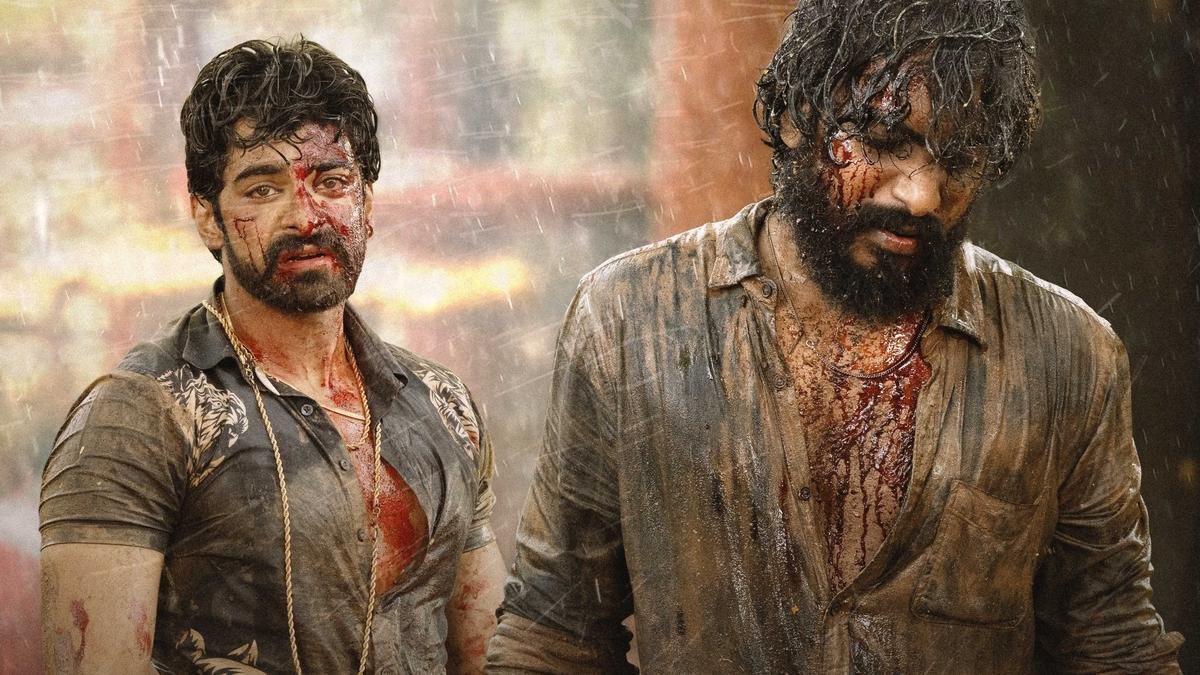
KJQ (King Jackie Queen) movie review: Kiran Kumar Meenuga’s Telugu crime drama arrives with an intriguing premise about destiny, social circumstances and the choices people make when they are denied a conventional path in life. Released as a 110-minute film, KJQ follows Partha, Jackie and Bhargavi, three characters whose lives intersect through friendship, crime, ambition, attraction and violence. Dheekshith Shetty plays Partha, Shashi Odela portrays Jackie and Yukti Thareja plays Bhargavi.
At first glance, KJQ appears to be a familiar gangster romance involving two friends who eventually become adversaries because of their differing relationships with power and a woman. But the film attempts something more ambitious. It wants to examine whether people become criminals because of their circumstances, whether power eventually consumes the person who acquires it, and whether someone raised without emotional security can understand love without confusing it with possession.
Those questions could have produced a sharp psychological crime drama. Instead, KJQ frequently chooses the language of conventional gangster cinema: threats, guns, revenge, loyalty, dramatic speeches and larger-than-life male characters. The result is a film whose central ideas are more interesting than the screenplay built around them.
KJQ’s central idea: Are people shaped by birth or by choice?
The film begins by raising a provocative question about destiny and upbringing. Its opening argument suggests that circumstances surrounding a person’s birth can influence the road they eventually take. This is an important starting point because crime stories often simplify criminality into either individual evil or social deprivation. KJQ tries to occupy the complicated space between those explanations.
The question becomes particularly relevant to Partha and Jackie. Their difficult teenage years create a bond that later determines the direction of their adult lives. They do not simply become friends; they become dependent on one another’s understanding of survival. As adults, however, that shared history produces very different ambitions.
Partha wants control. Jackie initially appears willing to become the mechanism through which Partha’s ambitions are achieved. This creates one of the film’s most promising relationships: two men who begin with emotional dependence but gradually discover that loyalty, obedience and friendship are not necessarily the same thing.
That distinction could have been the emotional foundation of the entire film. Instead, KJQ often moves too quickly from one dramatic development to another. The characters are given big moments before the audience has enough time to understand the smaller experiences that made those moments inevitable.
Partha is the film’s strongest character because his contradictions are visible
Dheekshith Shetty gives KJQ its most compelling performance through a character who is difficult to like but easy to watch. Partha is not simply a conventional gangster seeking territory or money. His obsession is psychological. He needs to feel powerful because power compensates for insecurity.
This is where Shetty’s performance becomes more valuable than the writing. His physicality, restless energy and flashes of anger communicate the instability underneath Partha’s confidence. The character can appear dominant in one scene and emotionally exposed in another, creating the impression of a man who has constructed an intimidating personality because he does not know how to deal with vulnerability.
The irony is that the film’s strongest character study is also where its biggest missed opportunity becomes obvious.
Partha’s rise to power is insufficiently developed. A gangster becomes powerful in a convincing crime narrative because the audience understands the machinery behind that power: money, political connections, fear, information, territory, alliances, charisma or strategic intelligence. KJQ largely presents Partha’s dominance as an established fact.
That weakens the stakes. If nobody can seriously challenge Partha, his victories do not feel earned. Violence can make a character frightening, but repeated violence alone does not explain an empire.
The film needed a stronger crime-world architecture
This is perhaps the biggest technical weakness in KJQ. Gangster dramas work best when their criminal worlds have rules. The audience should understand who controls what, why rival groups fear a particular person, how law enforcement responds, and what makes loyalty valuable.
Films such as classic gangster dramas often make power visible through relationships rather than merely through body counts. A kingpin may have influence because politicians depend on him, businesses need him, rivals owe him favours or ordinary people believe opposing him is impossible. Such details transform a criminal protagonist from a man with guns into a believable power structure.
KJQ does not consistently provide that foundation. Partha’s men kill, threaten and intimidate, but the consequences of those actions rarely create a sufficiently complex political or social ecosystem.
This matters because the film wants Partha’s eventual emotional collapse to mean something. A powerful man’s fall becomes dramatic only when the audience understands exactly what he has built and what he stands to lose.
Jackie represents the film’s most underused psychological possibility
If Partha represents the pursuit of power, Jackie could have represented the cost of surrendering one’s identity to another man’s ambition.
That is an extremely fertile idea. A person who calls himself a loyal soldier may eventually discover that loyalty has prevented him from becoming a complete human being. Jackie has spent years helping Partha build his world, yet his own emotional life remains incomplete.
The film does gesture towards this emptiness after a violent incident involving a politician’s house and the loss of someone close to Jackie. That event encourages him to question the life he has helped create. Unfortunately, his internal conflict is conveyed more through dialogue than through behaviour.
Shashi Odela consequently has less material to work with than Dheekshith Shetty. Jackie often appears emotionally distant because the screenplay does not give him enough distinctive actions through which his inner transformation can be understood.
A stronger version of KJQ would have allowed Jackie to make choices that gradually contradicted Partha’s worldview. Instead of simply explaining that he wants something more from life, the film could have shown him refusing violence, protecting someone without expecting loyalty in return, or questioning the meaning of the empire he helped construct.
Bhargavi should have been the film’s moral and emotional centre
Bhargavi, played by Yukti Thareja, is introduced as an actress carrying the consequences of her past. She enters the lives of the two men and becomes important to their emotional trajectories. The problem is not that the story places a woman between two male characters; the problem is that it rarely allows her to escape that narrative function.
Bhargavi has the potential to challenge both men’s understanding of relationships. Partha approaches love through possession and control, while Jackie approaches it through protection. Those two attitudes appear different, but they can become equally restrictive when the woman’s own agency is pushed aside.
This distinction is crucial to understanding KJQ. Protection is not automatically the opposite of control. A man can claim to be protecting a woman while still deciding what she should do, where she should go and whom she should trust. A sophisticated crime drama could have explored that contradiction with considerable force.
Instead, Bhargavi’s agency remains inconsistent. Her character sometimes suggests independence, but the larger narrative repeatedly returns control to the men.
KJQ’s portrayal of women is its most troubling weakness
The film surrounds Bhargavi with several other female characters whose stories are also shaped by male violence, exploitation or betrayal. A single mother struggles against unwanted advances from a police officer. Another woman is involved in a sex-trafficking operation and involves her daughter in it. Elsewhere, marital betrayal contributes to a wife’s suicide.
Individually, these story elements could have been used to expose different forms of abuse and power. Together, however, they create a pattern in which women are repeatedly positioned as victims, objects of desire, instruments of conflict or casualties of male decisions.
The handling of Partha’s relationship with his wife is especially problematic because the narrative treats sexual violence within marriage as part of the beginning of a relationship that later develops into care. That framing creates a serious storytelling problem: affection cannot retrospectively erase coercion.
For a film ostensibly interested in the psychology of power, this is a major missed opportunity. The most revealing question should have been what happens when a man who believes power gives him the right to control others is forced to confront a boundary he cannot cross.
Instead, the narrative sometimes appears to confuse possession with intimacy. That weakens the film’s supposed critique of male ego because the story does not always distance itself clearly enough from the behaviour it presents.
The real subject of KJQ is fragile masculinity
Despite its gangster setting, KJQ is ultimately less interested in crime than in male identity.
Partha’s obsession with dominance, Jackie’s devotion to another man’s ambition and the competition surrounding Bhargavi all point towards the same underlying issue: men who struggle to accept rejection, vulnerability or emotional dependence without interpreting those experiences as threats to their identity.
That makes the film’s title particularly interesting. The three names suggest a hierarchy or game of power, but the characters do not really occupy equal positions within it. The men control the terms of conflict, while the woman is frequently expected to react to decisions made around her.
The most revealing interpretation of KJQ, therefore, is not as a conventional love triangle but as a study of how insecurity can disguise itself as masculinity. Partha does not become powerful because he has achieved emotional stability. He becomes obsessed with power precisely because emotional stability remains beyond his reach.
This is also why the film’s strongest scenes are those in which its macho surface cracks. The more vulnerable Partha becomes, the more interesting he is. The more invincible he appears, the more generic the gangster framework feels.
KJQ and the shadow of classic gangster cinema
The film clearly operates within a tradition of Indian crime dramas in which friendship, loyalty, violence and moral compromise eventually collide. Its concluding stretch also recalls the emotional architecture associated with Mani Ratnam’s Nayakan, particularly in its use of long speeches, tragedy and the collapse of a powerful man’s world.
The comparison is revealing because Nayakan understood that the power of a gangster narrative comes from contradiction. The central figure could be feared and loved, morally compromised and emotionally protective, criminal and socially useful. His rise affected an entire community.
KJQ reaches for similar emotional territory but does not build enough social depth around its protagonists. Its men have personal histories, but their criminal world does not always feel like a living ecosystem.
The distinction is important for modern crime dramas. Audiences have become increasingly familiar with gangster stories, so simply adding violence and dramatic monologues is no longer enough. The genre now demands psychological specificity, believable systems of power and consequences that extend beyond the hero’s immediate circle.
Dheekshith Shetty becomes the film’s biggest reason to stay invested
Among the performances, Dheekshith Shetty makes the clearest impression. He does not attempt to make Partha conventionally heroic. Instead, he embraces the character’s unpleasantness and insecurity.
That commitment gives Partha an unpredictability that the screenplay sometimes lacks. His anger does not always feel calculated, and his need for control frequently appears to come from emotional immaturity rather than strategic brilliance.
Shashi Odela’s Jackie is more restrained, but the character’s emotional ambiguity is not explored deeply enough. Yukti Thareja shows flashes of the personality and energy that could have made Bhargavi a more substantial character, although the screenplay repeatedly limits her scope.
Guru Somasundaram is underused, while Muralidhar Goud and Surekha Vani make comparatively measured contributions. The younger actors portraying Partha and Jackie also help establish the foundation of the central friendship.
Music and visual treatment do not fully strengthen the drama
Poornachandra Tejaswi’s music does not consistently add momentum to the crime narrative. The Tillana fusion stands out as an imaginative exception, but the soundtrack overall does not become a defining part of the film’s identity.
The cinematography similarly does not transform the criminal world into a distinctive visual environment. This is another area where the film could have gained individuality. A story about power should ideally have a visual language that changes as its characters gain or lose control.
Imagine, for example, a film beginning with cramped spaces and gradually opening into grand locations as Partha’s influence expands, only to reverse that progression as his world collapses. Such visual storytelling can communicate character development without requiring another speech.
What KJQ could have been
The most frustrating thing about KJQ is that its shortcomings are connected to its strengths. The film clearly wants to say something about masculinity, social circumstances and the psychology of power. It also has an actor capable of giving those ideas a volatile human face.
But the screenplay repeatedly chooses the easier dramatic route.
Instead of building Partha’s empire patiently, it largely assumes his dominance. Instead of allowing Jackie to discover his humanity through actions, it explains his conflict through dialogue. Instead of making Bhargavi a force capable of changing the direction of the story through her own decisions, it frequently uses her as the point around which the men’s conflict revolves.
That imbalance prevents the film from becoming the alternative crime saga it occasionally threatens to be.
Verdict: A promising crime drama trapped inside an outdated power fantasy
KJQ movie review verdict: Kiran Kumar Meenuga’s final film has ambition, a committed lead performance and the raw material for a psychologically rich crime drama. Its best idea is the connection between male insecurity and the desire for power. Unfortunately, the film does not examine that idea with the consistency or sensitivity required to make it truly transformative.
Dheekshith Shetty’s performance gives the film its pulse, particularly when Partha’s intimidating exterior gives way to insecurity and emotional confusion. Jackie and Bhargavi, however, are not given equally persuasive character arcs, and the underdeveloped crime-world construction makes Partha’s rise less convincing than it should be.
The larger problem is ideological as much as structural. A film about men obsessed with control has to understand the difference between portraying toxic behaviour and unintentionally normalising it. KJQ does not always maintain that distance, particularly in its treatment of women and intimate relationships.
There is still something worthwhile in its failure. The film demonstrates that Telugu crime cinema does not need another gangster who is powerful simply because everyone says he is powerful. The more interesting protagonist is the insecure man who mistakes domination for strength, and the more interesting story is the one that shows how that mistake destroys everyone around him.
Ultimately, KJQ is a film with the skeleton of a compelling gangster tragedy but without enough psychological flesh on its bones. Its wasted potential is made more apparent by Dheekshith Shetty, whose performance suggests how much stronger the film could have been if its screenplay had trusted character complexity more than familiar crime-drama gestures.
For breaking news and live news updates, like us on Facebook or follow us on Twitter and Instagram. Read more on Latest Entertainment on thefoxdaily.com.






COMMENTS 0