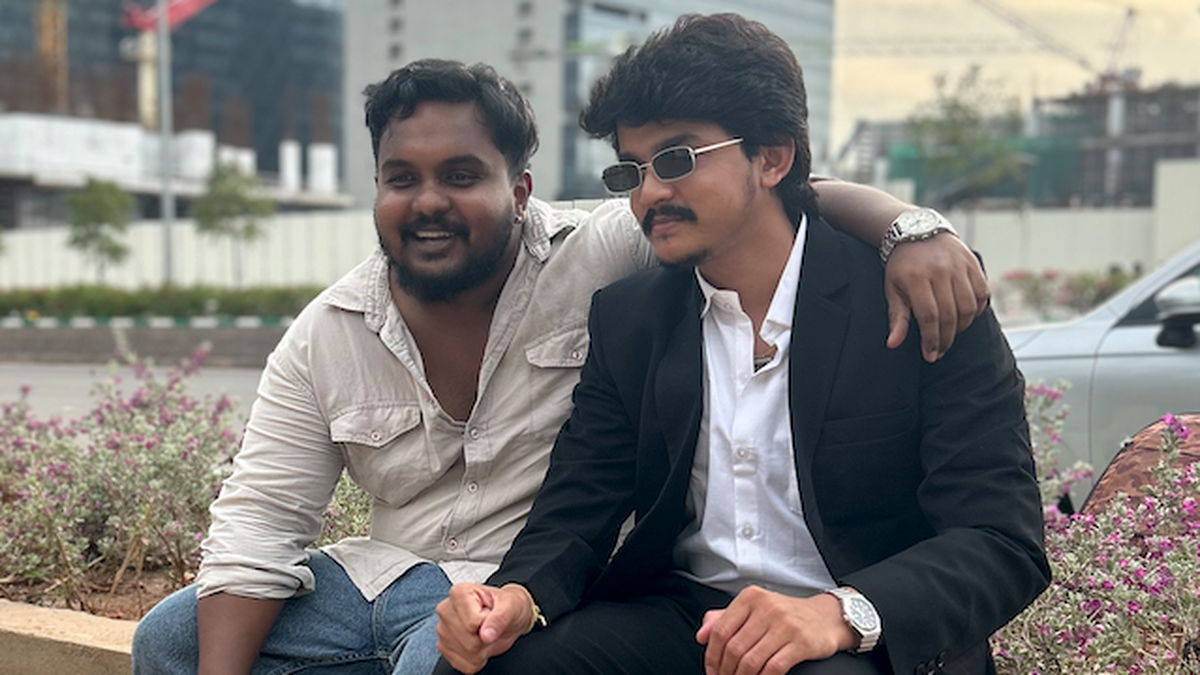
What happens when a filmmaker refuses to treat a two-minute episode as an excuse for two-minute storytelling? Telugu micro drama series Dhandha offers one possible answer. Instead of relying on familiar relationship melodramas or exaggerated twists, the 29-episode series enters the increasingly consequential world of cybercrime and follows an engineering student who joins a digital fraud network, learns its methods and gradually climbs its criminal hierarchy.
At the centre of that experiment is Aditya Devulapally, a former journalist making his directorial debut. Streaming on the Chai Shots app, Dhandha is designed around episodes that run a little more than two minutes, but its ambition is considerably larger than its runtime suggests.
The series attempts to solve one of the biggest problems facing short-form fiction: how do you make a story feel cinematic when the audience may consume it in fragments on a phone?
Devulapally’s answer has involved unusually intensive preparation, a 10-day shoot, AI-assisted previsualisation, a deliberately designed colour palette, specialised production design and editing built around the vertical screen.
But the more interesting part of Dhandha is not simply its production efficiency. It is the decision to use micro drama as a vehicle for a genre that depends on process, escalation and consequence.
What is Dhandha about?
Dhandha follows an engineering student, played by Dora Sai Teja, who enters a cyber fraud group and progressively becomes more deeply involved in digital financial scams.
The narrative tracks his transformation rather than presenting cybercrime merely as a technological gimmick.
As the protagonist rises through the criminal network, the stakes increase and the audience gets a glimpse of how apparently ordinary digital interactions can become part of organised fraud.
That focus gives the series a different dramatic engine from many conventional crime stories.
The central question is not simply whether the police will catch the criminals. It is how an ordinary young person becomes comfortable enough with wrongdoing to keep escalating.
That character transformation is potentially more important than the cybercrime itself because it gives the series a human progression: curiosity becomes opportunity, opportunity becomes involvement and involvement becomes identity.
Why cybercrime is a smart choice for micro drama
Cybercrime is particularly suited to short-form storytelling because digital fraud can unfold through small actions.
A phone call, a message, a fake identity, a manipulated conversation or a carefully timed transaction can alter the direction of a story within seconds.
That makes the genre compatible with two-minute episodes.
A traditional crime thriller might spend several minutes establishing a location, introducing a character and explaining a setup. A micro drama has to compress that process. Cybercrime naturally provides situations where a tiny interaction can have immediate consequences.
There is another advantage.
Most viewers already understand the basic language of digital communication. They recognise phone calls, messages, online transactions and suspicious links. The filmmaker therefore does not have to spend enormous amounts of screen time explaining the existence of the digital world.
The challenge is making that familiar environment dramatically threatening.
Dhandha attempts to do this by focusing on the network behind the scam rather than only on individual victims.
Devulapally’s unusual route into filmmaking
Devulapally’s journey to directing did not follow a conventional film-school-to-feature-film path.
He was academically strong but did not enjoy engineering and left the course after his first year. In 2018, he convinced his parents to support his decision to pursue a different direction and initially wanted a camera so he could work on small photography assignments.
That practical beginning is significant.
Instead of entering cinema through a large production, Devulapally gradually built his way toward filmmaking through photography, education, writing and journalism.
He later enrolled in mass communication and journalism at St Mary’s College in Hyderabad, where exposure to world cinema expanded his understanding of filmmaking.
He has recalled spending more time watching films in the college laboratory than attending classes, a line that sounds humorous but also explains the self-directed nature of his education.
Rather than treating cinema as a purely academic discipline, he immersed himself in films and began experimenting with short-form filmmaking.
Journalism became his bridge to the film industry
Devulapally’s early short films eventually helped him enter film journalism, leading to nearly two years at The New Indian Express.
That period gave him something that a conventional filmmaking education cannot always provide: proximity to the industry and an understanding of how films are discussed, promoted and positioned.
Journalism also appears to have influenced his approach to Dhandha.
The series is built around a subject that requires research and specificity. Cybercrime cannot be convincingly portrayed merely through people staring intensely at computer screens.
The mechanics have to feel plausible.
That is where Devulapally’s journalistic instincts become useful. He was not simply looking for a dramatic crime concept; he was interested in the details of how the criminal network operates.
How Chai Shots changed the opportunity
Devulapally’s relationship with Anurag Reddy and Sharath Chandra of the Chai Bisket team began before Dhandha.
He had previously narrated a script to them, but the project was not taken forward because they were not looking to produce a violent film at that time.
The relationship nevertheless continued.
When Chai Shots was launched in late 2025, Devulapally joined the team as a creative producer. That role exposed him to a large number of stories being developed specifically for the micro drama space.
He says he listened to more than 100 pitches.
That experience gave him a useful perspective on what the format was becoming.
According to Devulapally, many micro dramas were gravitating towards recurring premises involving sudden changes in wealth, romantic betrayal and relationship conflicts. He also felt that production quality was often inconsistent.
His conclusion was straightforward: short-form audiences may have less time, but they do not necessarily have less patience for poor storytelling.
The decision to stop producing and start directing
Devulapally eventually left his creative producer role to concentrate on directing.
Among the scripts he had encountered was a crime thriller written by Vijay Kumar. Devulapally saw potential in the story but believed it needed to be reshaped for the micro drama format.
With Kumar’s permission, he rewrote around 40% of the screenplay before pitching the revised version to Anurag Reddy and Sharath Chandra.
This detail reveals something important about the making of Dhandha.
The series was not created by taking a conventional screenplay and simply cutting it into tiny pieces. Its director consciously redesigned the material around the demands of the format.
That distinction matters because micro drama has its own grammar.
Every episode needs a reason to exist. Every cut must carry information. Every ending has to create enough curiosity for the viewer to continue.
Why Dhandha cost more than a typical micro drama
Devulapally says many micro dramas are made within budgets of approximately ₹10-12 lakh. He believed Dhandha needed substantially more because its cybercrime story required a more immersive visual world.
He estimated that the project would require three to four times the usual budget.
This decision reflects a larger issue in short-form entertainment.
Shorter does not necessarily mean cheaper.
A two-minute episode can require the same basic infrastructure as a longer production: actors, locations, cinematography, lighting, production design, sound, music, editing and post-production.
In fact, the compressed format can create additional demands because there is less time available to hide weak production choices.
When an episode lasts only two minutes, every frame has to work harder.
The visual identity of Dhandha
Cinematographer Ashwin Lenin proposed a green-and-copper visual palette inspired by the colours associated with Indian currency.
That is a deceptively useful idea for the subject.
The colour design does not merely make the series visually distinctive. It connects the world of the story to its central obsession: money.
Production designer Sanjana maintained gritty settings to match the criminal environment, while composer Rishi M experimented with musical influences that included Mexican instrumentation and African beats.
These choices suggest that the team was attempting to build a world rather than simply record dialogue.
For a micro drama, that ambition is significant.
The vertical screen changes how a director thinks
One of the most overlooked aspects of micro drama is the vertical format.
A filmmaker accustomed to cinema or conventional television cannot simply rotate the camera and expect the storytelling to remain unchanged.
Vertical framing changes how faces, bodies, locations and movement are composed.
It can make close-ups more dominant while reducing the amount of horizontal environmental information visible in a frame. That can actually benefit a psychological or crime thriller because the format naturally pushes attention towards characters and immediate details.
For Dhandha, the editing by Jagdish Goud was designed around this fast-paced vertical viewing experience.
The goal was not to imitate a feature film on a smaller screen but to develop a rhythm suitable for audiences consuming fiction through phones.
The astonishing 10-day shoot
Perhaps the most revealing production detail is that Dhandha was filmed in just 10 days.
That sounds extremely fast for a 29-episode drama, particularly one attempting a cinematic visual standard.
The explanation lies in preparation.
Devulapally credits extensive pre-production and AI-led previsualisation with helping the team execute the shoot efficiently.
According to him, the team finished each day with approximately 12-15 minutes of footage to be edited, compared with an industry norm of roughly three to five minutes.
That is not simply a productivity statistic. It reveals the philosophy behind the production.
The project appears to have treated preparation as the mechanism for buying speed.
In other words, the 10-day shoot was not the result of rushing into production; it was the result of trying to make as few decisions as possible for the first time on set.
AI as a pre-production tool rather than a replacement for filmmaking
The mention of AI-assisted previsualisation is particularly relevant because artificial intelligence is rapidly changing filmmaking workflows.
In a production like Dhandha, previsualisation can help a director anticipate framing, blocking, shot transitions and sequences before the camera rolls.
Its most practical benefit may be organisational rather than spectacular.
If the director and cinematographer arrive on set with a clearer understanding of what needs to be captured, fewer hours are spent experimenting with basic coverage.
That can be particularly valuable for low-budget productions.
AI does not remove the need for actors, cinematographers, production designers or editors. Instead, the Dhandha workflow suggests a more realistic near-term use of the technology: helping small teams plan like larger productions.
Why casting was crucial
Micro drama leaves little room for performances that require a long buildup.
Actors have to establish character quickly, sometimes within seconds.
Devulapally wanted recognisable performers for the student protagonist and the police officer, but he also identified a challenge in finding male actors between 20 and 25 who could convincingly carry a demanding leading role.
He eventually chose Dora Sai Teja after being impressed by his audition, particularly his ability to perform a long scene in a single take.
That ability becomes particularly useful in a format where cutting too aggressively can make a story feel fragmented.
Devulapally was also impressed that Sai Teja showed interest in the project’s marketing and intended audience.
That suggests the director was looking for an actor who understood the entire life cycle of the project rather than only the performance itself.
Nithin Prasanna was cast as the police officer, while Akshara Nalla plays the leading female role.
The unusual romantic detail in Dhandha
The protagonist’s romantic interest is introduced through an unusual character detail involving a foot fetish.
Rather than presenting the female character primarily as an object of conventional romantic attraction, Devulapally says the detail was designed to reveal something peculiar about the protagonist.
That choice fits the series’ broader strategy of making its anti-hero imperfect.
The protagonist is not supposed to behave like a traditional heroic lead. His attraction, decisions and increasing involvement in cybercrime are part of the process through which the audience watches him change.
That is dramatically more interesting than giving him the moral clarity of a conventional action hero.
How Dhandha researched cybercrime
One of the most important decisions was consulting someone with experience working alongside a cybercrime department.
The consultation helped the team develop details surrounding the modus operandi of cybercriminals, including practices such as call merging and fraudsters impersonating cybercrime professionals.
Such details can make a crime story feel authentic without turning it into a technical manual.
That distinction is important.
A responsible cybercrime thriller should create awareness about manipulation and criminal behaviour without unnecessarily providing operational instructions that could facilitate wrongdoing.
Dhandha appears to make another deliberate storytelling choice: the identities of victims are not foregrounded. Instead, the series focuses on the criminal network.
That decision keeps the narrative centred on the protagonist’s descent into crime.
The biggest weakness of a two-minute crime drama
Devulapally acknowledges one limitation of the format: the story does not yet have enough room to fully explore the consequences of the protagonist’s actions.
This is potentially the biggest challenge facing Dhandha.
Cybercrime is not merely a clever game of criminals versus police. Its real-world consequences involve financial loss, emotional distress and long-term damage to victims.
A story focused primarily on the criminal network risks making the process appear glamorous if it does not eventually confront those consequences.
The cliffhanger and proposed continuation could provide an opportunity to address that limitation.
The next stage of the story could become more powerful if the protagonist’s growing success begins to collide with the human cost of the system he has joined.
Dhandha as a director’s showreel
Devulapally’s original ambition was not simply to make another micro drama. He wanted to demonstrate that the format could be treated seriously.
That makes Dhandha function as a kind of extended directorial calling card.
A traditional short film can demonstrate visual style. A micro drama can demonstrate something else: a director’s ability to sustain tension across repeated short episodes.
That requires control over pacing, cliffhangers, character progression and visual continuity.
For a filmmaker trying to move towards larger productions, those are valuable skills.
From two-minute episodes to a feature film?
The series ends on a cliffhanger and discussions are reportedly underway about developing the story into either a feature film or a web series.
That possibility is particularly interesting because Dhandha may have been designed from the beginning with expansion in mind.
The cybercrime network, the protagonist’s transformation and the police investigation all provide potential narrative material beyond the micro format.
But expansion also creates a creative test.
A two-minute thriller survives through compression. A feature film needs depth.
Characters require richer motivations, consequences need more time to develop and the central conflict must sustain attention for considerably longer.
If Dhandha moves into a feature or long-form series, the filmmakers will need to resist simply stretching the micro drama.
The next version should deepen the world rather than merely lengthen it.
What Dhandha says about the future of micro dramas
The rise of micro dramas is often discussed as a technological or attention-span phenomenon: people have phones, people scroll quickly, therefore stories must become shorter.
That explanation is incomplete.
The more interesting development is that micro drama is becoming a laboratory for new storytelling structures.
Filmmakers can test concepts quickly. Platforms can identify which premises hold audience attention. Directors can demonstrate their visual abilities without requiring the resources of a feature film.
For emerging filmmakers, this could become particularly important.
A well-made micro drama can potentially function as both entertainment and proof of concept.
In that sense, Devulapally’s career path may become increasingly common: journalism or another creative profession, short-form experiments, platform work, and eventually original directing.
Traditional short film versus micro drama
| Feature | Traditional short film | Micro drama |
|---|---|---|
| Episode length | Usually one continuous story | Very short episodes released serially |
| Viewing environment | Festivals, online platforms or curated screenings | Primarily mobile and vertical viewing |
| Narrative rhythm | Can allow gradual development | Requires rapid setup and frequent hooks |
| Production strategy | Often focused on one compact film | Requires continuity across multiple episodes |
| Value to emerging filmmakers | Demonstrates storytelling and filmmaking ability | Can demonstrate sustained pacing, episodic structure and platform awareness |
The larger lesson from Aditya Devulapally’s debut
There is a temptation to view Dhandha simply as an example of the growing popularity of short-form entertainment.
Its more significant story is about access.
A filmmaker who might have needed years to raise money for a conventional feature can now potentially use a smaller production to demonstrate what he can do.
That does not make the barriers to filmmaking disappear. But it changes what an emerging director can show before asking a producer to trust them with a much larger budget.
Devulapally’s journey from engineering student to photographer, journalism student, film journalist, creative producer and finally director illustrates that point.
His first directing project is not merely an endpoint. It is another step in a career built through successive forms of experimentation.
Why Dhandha could matter beyond its 29 episodes
The most important outcome of Dhandha may not be whether micro drama becomes the dominant form of Indian entertainment.
It is more likely to influence how filmmakers think about scale.
A story does not need a feature-film budget to have cinematic ambition.
A production shot in 10 days can still have a deliberate colour language. A two-minute episode can still have researched subject matter. A mobile-first project can still use production design, music and cinematography as meaningful storytelling tools.
That is the real experiment taking place here.
Devulapally is effectively arguing that format should determine storytelling technique, not storytelling ambition.
Conclusion: Dhandha is a small-format experiment with bigger ambitions
Dhandha arrives as a micro drama, but its ambitions extend well beyond its two-minute episodes.
For Aditya Devulapally, the series represents the culmination of a winding journey through photography, journalism, cinema writing and creative production. For the Telugu short-form ecosystem, it represents an attempt to push the format beyond familiar melodramatic templates.
The cybercrime premise gives the series a naturally fast narrative engine, while its visual design, researched details and vertical-format editing attempt to give that speed a cinematic identity.
The 10-day shoot demonstrates what disciplined pre-production can achieve, while AI-assisted previsualisation points towards a future in which smaller filmmaking teams can use technology to plan productions with greater precision.
Yet the most promising aspect of Dhandha is its willingness to treat the audience as demanding viewers rather than assuming that short attention spans justify shallow storytelling.
Its future will depend on whether the story can confront the consequences of the protagonist’s actions and whether its cliffhanger can develop into a richer narrative in a second season, feature film or web series.
At 28, Devulapally sees the project as the beginning of his directorial journey. He has pointed out that several filmmakers he admires, including Quentin Tarantino, Stanley Kubrick, Christopher Nolan and David Fincher, began directing around the same age.
The comparison is ambitious, perhaps deliberately so. But the more useful takeaway is simpler.
A director does not need to wait for the perfect feature film to announce himself. Sometimes, a two-minute story is enough to show that there is a filmmaker behind the camera worth watching.
For breaking news and live news updates, like us on Facebook or follow us on Twitter and Instagram. Read more on Latest Entertainment on thefoxdaily.com.






COMMENTS 0