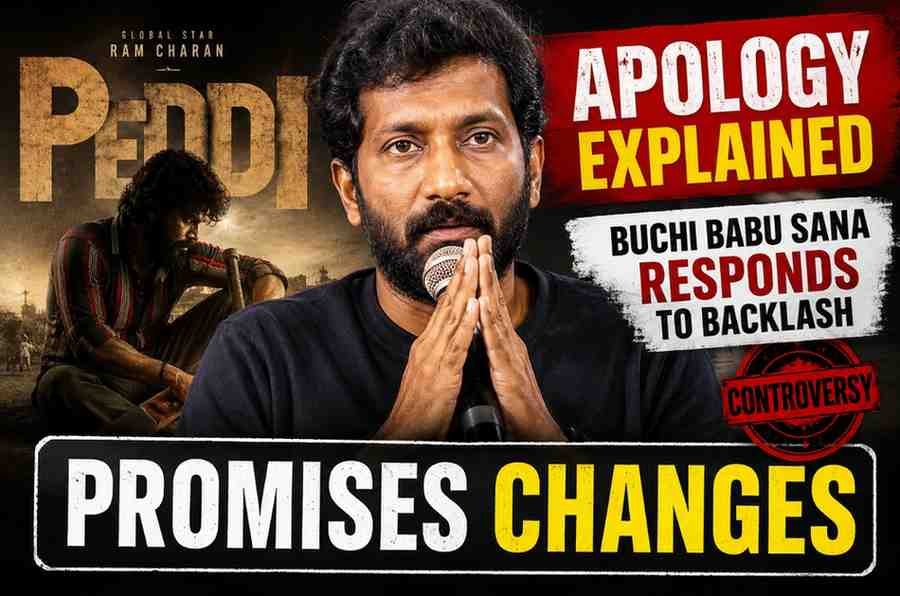
On Saturday, June 6, 2026 just two days after his blockbuster Peddi hit screens to record-breaking numbers and simultaneous nationwide outrage director Buchi Babu Sana did what almost no mainstream Indian filmmaker has ever done while a film is still running in theatres: he issued a public apology, acknowledged that certain scenes objectify Janhvi Kapoor’s character, and announced that changes would be made to the film. The statement, posted to his official X handle, has been received with a mix of cautious praise, deep scepticism, and urgent questions about what “changes” to a released film actually mean in practice — and whether an apology issued under commercial pressure carries the same moral weight as one offered freely.
The apology closes one chapter of the Peddi controversy and opens several more. But before examining what comes next, it is worth understanding precisely what prompted it and what Buchi Babu Sana, a director whose debut film Uppena won the National Award for Best Telugu Film, actually said.
The Apology in Full Context
Writing on X, Buchi Babu Sana said: “As a filmmaker, I believe cinema should entertain, inspire, and connect with audiences. It should never make anyone feel uncomfortable or disrespected. We have heard the feedback regarding certain scenes in Peddi and have taken it seriously. I have always had immense respect for women, both on and off screen, and it was never our intention to objectify or disrespect any female character. If any part of the film has been perceived that way, we respect those sentiments, understand the concerns being raised, and sincerely apologise.”
He continued: “Every woman deserves to be respected, valued, and represented with dignity. We remain committed to telling stories that celebrate strong characters and uphold those values. Thank you to everyone who shared their views honestly and sincerely.”
The director confirmed that changes would be made to the “concerned portions” of the film though, crucially, he did not specify which scenes would be altered, how significantly, or when the revised version would be available to audiences who have already paid to see the original cut.
As of publication, Janhvi Kapoor has not publicly responded to the apology, the controversy, or the announcement of changes. Her silence which began with an Instagram like on a post calling Peddi “the most expensive disrespect ever paid to a leading woman in Indian cinema” continues to speak volumes without saying
For readers who have not seen Peddi, the specific content that sparked this extraordinary chain of events deserves clear explanation because the controversy is not simply about revealing costumes or glamour shots, as some coverage has framed it. The objections are substantially more serious than that.
Peddi is set in 1980s rural Andhra Pradesh’s Vizianagaram region and follows the title character a lower-caste villager played by Ram Charan who turns to multi-sport athletics to win dignity and recognition for his community. The film’s second half has been widely praised as an effective, emotionally resonant sports drama. The first half, however, has been described by multiple critics and viewers as a “trainwreck” of objectification and normalised harassment.
The single most criticised scene involves Peddi using a power cut to forcibly kiss Achiyyamma Janhvi Kapoor’s character without her consent. The scene has been widely described online as depicting sexual assault. The film does not present this as an unambiguous wrong: Peddi later discloses what he did, Achiyyamma slaps him, and then the narrative proceeds to explain away his behaviour as his unique “love language” the natural expression of a raw, rural man who shows affection differently. Achiyyamma ultimately falls in love with him.
A separate sequence involves Achiyyamma being placed on a stage in revealing clothing as part of what critics have called a deliberate humiliation with Peddi swooping in as rescuer after himself having engineered the scenario. One of the sharpest critiques, published by The Federal, observed that the only time Achiyyamma appears in dignified clothing and the camera treats her with any civility is at the end of the film, once she has symbolically placed a mangalsutra on herself. The implication threaded through the narrative, critics argue, is unmistakable: in Buchi Babu Sana’s storytelling universe, a woman becomes deserving of respect only through her relationship to a man.
Beyond the narrative content, reviewers specifically noted the camera’s behaviour the repeated, deliberate framing of Kapoor’s body in close-up, independent of any emotional context the scene might otherwise have, is what critics mean when they say Peddi treats its female lead as a prop rather than a person.
The Buchi Babu Sana Paradox
What makes the Peddi controversy especially difficult to process is who directed it. Buchi Babu Sana is not a veteran commercial director coasting on old formulas. He is 43 years old, made his feature debut only in 2021, and that debut Uppena won the National Award for Best Telugu Film and was celebrated for its sensitive, emotionally authentic portrayal of a cross-caste love story. He served as chief associate director on Rangasthalam (2018), a film widely praised for its nuanced rural storytelling. His creative pedigree is not that of a filmmaker blind to the possibilities of meaningful cinema.
And yet Peddi’s first half reads, in the words of multiple critics, as a film that “actively glorifies” harassment and sexual assault as romantic colour. The disconnect between Buchi Babu Sana’s apparent artistic sensibilities and the content of Peddi’s romance track is genuinely puzzling and it is a puzzle his apology does not fully address.
The key phrase in his statement is: “it was never our intention to objectify or disrespect.” The intention defence is one of the most common and most inadequate responses in creative industries when harmful content causes real harm. Intention does not change the experience of an audience watching a forced kiss presented as romantic. Intention does not change what a young viewer absorbs about how women’s bodies and consent are treated in the cultural stories that entertain them. The road to harmful content is very frequently paved with good or at least indifferent intentions. What matters is the content itself, and its cumulative effect.
What “Changes” to a Released Film Actually Means
The announcement that Peddi’s “concerned portions” will be modified is, in the history of Indian cinema, almost without precedent for a film this size and this recently released. It raises immediate practical and philosophical questions.
| Question | What We Know | What Remains Unclear |
|---|---|---|
| Which scenes will be changed? | Buchi Babu refers to “concerned portions” | No specific scenes named |
| How will they be changed? | Not specified cuts, re-edits, or reshoots? | Reshoots would require cast/crew availability |
| When will changes be implemented? | No timeline given | Film is currently in active theatrical run |
| Will OTT release carry the revised version? | Not confirmed | Could be the most impactful intervention |
| Does CBFC need to re-certify? | Likely yes for theatrical re-release | Process and timeline unknown |
| What about audiences who already saw the original? | No compensation or acknowledgement offered | Standard industry position |
The most realistic and impactful scenario is that the OTT release which would reach a far larger audience than theatrical windows carries a revised cut. This has happened before in Indian cinema in limited ways, typically for censorship compliance, but doing so as a direct response to audience feedback about the dignity of a female character would be genuinely novel.
The more cynical reading, which a portion of social media has moved quickly to articulate, is that the apology is commercially motivated. Peddi opened to ₹135.36 crore worldwide on day one a historic number. It then dropped sharply to ₹26.90 crore on day two, a dip that is partly attributable to the usual weekday correction but may also reflect audiences staying away in response to the controversy. An apology and a promise of changes, under this reading, is damage control for the weekend box office an attempt to reassure fence-sitters that the makers have heard the criticism and are responding.
Both readings can be simultaneously true. An apology can be commercially strategic and still reflect genuine remorse. The test will be in what is actually cut, when, and whether the revised version genuinely addresses the scenes that caused harm or merely trims a few frames at the edges.
The Industry Silence That Surrounds the Apology
Buchi Babu Sana has spoken. Ram Charan whose character perpetrates the actions being apologised for has not. The producers at Mythri Movie Makers have not. The cinematographer whose camera performed the objectifying gazes has not. The costume designer whose choices contributed to the glamour-over-character formula has not.
This is not unusual. In Indian film controversies, the director typically serves as the sole public-facing voice of the production, absorbing criticism that is in reality distributed across an entire creative and commercial ecosystem. The director is the author of the film in the romantic sense but the objectifying male gaze in a big-budget Telugu production is rarely, if ever, one person’s project. It is a collaborative industry product shaped by star power dynamics, producer preferences, market calculations, and deeply entrenched assumptions about what audiences want from their heroines.
Ram Charan’s silence is particularly conspicuous. He is one of Indian cinema’s biggest stars, a man who has spoken publicly about responsible storytelling and his pride in RRR‘s international cultural impact. His character in Peddi performs the actions that the director has now apologised for. The question of whether the star bears any responsibility for the content he participates in not just as an actor following direction, but as a co-author of his own screen image and as a commercial force whose star power shapes what films get made and how is one the industry has not yet found a way to hold honestly.
Why This Apology Matters Even If It Is Imperfect
It is easy, and not entirely wrong, to be cynical about Buchi Babu Sana’s apology. It came two days after release, under significant commercial and social media pressure, and without specifying which scenes will be changed or how. It uses the intention defence. It does not acknowledge the specific content the forced kiss, the camera behaviour, the narrative arc that rewards a man for sexual assault with the woman’s love with any precision.
And yet: it happened. A director of a ₹350 crore Indian blockbuster, still in active theatrical release, issued a public apology for how a female character was treated in his film. That is not nothing. In an industry where the standard response to feminist criticism is silence, deflection, or the claim that “entertainment has no agenda,” a named, public acknowledgement of harm however imperfectly worded represents a meaningful departure from the norm.
It also reflects something real about where Indian cinema’s audience is in 2026. The social media discourse that forced this apology was not driven by a fringe. It was mainstream, it was sustained, it was articulate, and it came from the film’s own target demographic including Ram Charan fans who made clear they did not want their favourite star associated with content that normalises assault. That is the most powerful signal of all. When a hero’s own fans become the loudest critics of how women are treated in his film, the industry’s commercial calculus around “what audiences want” has to shift.
Conclusion: An Apology Is a Beginning, Not an End
Buchi Babu Sana has said sorry. He has promised changes. The bar for what those changes must deliver is now set by his own words: “Every woman deserves to be respected, valued, and represented with dignity.” That is not a modest standard. It is a comprehensive one. The revised version of Peddi whenever it arrives will be judged against it.
But the larger work that Peddi’s controversy has made necessary goes far beyond one film’s post-release edits. It requires the Telugu and broader Indian film industry to examine, honestly and without defensiveness, the structural assumptions that make it possible for a National Award-winning director to deliver a film in 2026 in which a woman’s forced kiss is her hero’s love language and to have apparently not anticipated that anyone would object.
An apology is the beginning of accountability. The industry’s response to the Peddi controversy over the coming weeks and months in its casting choices, its scripting decisions, its camera angles, and its conversations about what stories are worth telling and how will determine whether this moment becomes a genuine turning point or simply the most expensive sorry Indian cinema has ever offered.
For breaking news and live news updates, like us on Facebook or follow us on Twitter and Instagram. Read more on Latest Entertainment on thefoxdaily.com.






COMMENTS 0