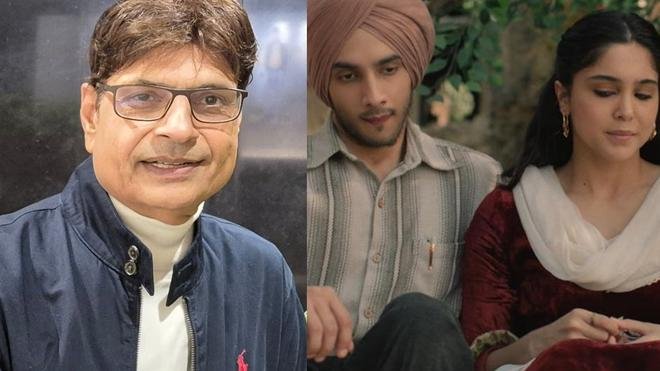
Irshad Kamil’s work on ‘Main Vaapas Aaunga’ offers a revealing look at how memorable film songs are built—not simply as lyrics for a scene, but as emotional experiences that listeners can eventually make their own. Through songs such as ‘Vo Nahin’, ‘Tere Paas Mai’ and ‘Kya Kamaal Hai’, the popular lyricist and poet explores a familiar but surprisingly difficult creative challenge: how do you write words that belong specifically to a film while still feeling personal to millions of people outside it?
That question sits at the heart of Irshad Kamil’s songwriting philosophy. His collaboration with filmmaker Imtiaz Ali has repeatedly demonstrated an interest in songs that carry narrative information without sounding like exposition. Instead of merely explaining what a character feels, the lyrics attempt to make the audience experience that emotion for themselves. With ‘Main Vaapas Aaunga’, this approach becomes particularly interesting because the songs are not functioning in isolation. They are part of a larger cinematic world, yet they also have to survive independently as music.
Why Irshad Kamil’s ‘Main Vaapas Aaunga’ songs matter beyond the film
Film songs occupy an unusual space in Indian popular culture. A song may be written for one character, one relationship or one moment in a screenplay, but once it reaches listeners, its ownership becomes almost impossible to control. A romantic song can become a personal memory. A melancholic lyric can acquire meaning after a breakup. A line written for a fictional character can suddenly sound as if it was written for someone’s real life.
This transformation is central to understanding the appeal of Irshad Kamil’s writing.
For a lyricist, the challenge is therefore twofold. The song must remain faithful to the emotional requirements of the film, while also leaving enough space for listeners to interpret it through their own experiences. If the writing becomes too specific, the audience may understand the story but struggle to identify with it. If it becomes too generic, the song may lose its cinematic identity.
The most effective film lyrics exist somewhere between those extremes.
‘Vo Nahin’, ‘Tere Paas Mai’ and ‘Kya Kamaal Hai’ can be viewed through precisely this lens. Rather than treating them simply as three songs from a new film, they provide an opportunity to examine how contemporary Hindi film songwriting balances character, emotion, melody and cultural memory.
Irshad Kamil and Imtiaz Ali: When lyrics become part of storytelling
The Irshad Kamil-Imtiaz Ali creative partnership is significant because both filmmakers and lyricists approach storytelling through emotional details. Their collaborations have often placed songs inside the psychological architecture of a film rather than treating music as a decorative interruption.
This distinction is important.
A conventional film song can tell the audience that two characters are in love, that someone is heartbroken or that a character is travelling. A more integrated song can make the audience understand why that particular emotion matters to the character at that particular point in the story.
For the lyricist, that means the screenplay becomes only the starting point. The words must understand the character’s emotional condition, but they also need rhythm, memorability and lyrical identity.
That is where Irshad Kamil’s poetic background becomes relevant. Poetry and film songwriting overlap, but they are not identical disciplines. A poem can exist entirely within the poet’s chosen world. A film song must cooperate with actors, music, editing, performance, visual imagery and narrative progression.
The lyricist is therefore writing inside a larger machine.
The best writing does not make that machinery visible.
‘Vo Nahin’: The power of emotional absence
Even the title ‘Vo Nahin’ immediately points towards one of the oldest subjects in poetry: absence.
Absence is powerful in songwriting because it creates a space for the listener. When a song concentrates exclusively on what happened, the emotional meaning can feel closed. When it revolves around what is missing, the listener has room to supply their own memories and interpretations.
This is one reason songs about separation, longing and emotional distance have such extraordinary longevity in Hindi music. The circumstances may belong to a particular film, but the feeling does not.
For ‘Vo Nahin’, that distinction is especially useful when considering Irshad Kamil’s larger approach. The objective of a lyric is not necessarily to describe sadness in increasingly elaborate language. Often, the more effective strategy is to identify the emotional contradiction at its centre: someone may be absent, but their presence continues to shape everything around them.
That tension can make a song memorable because it reflects an experience listeners already understand intuitively.
‘Tere Paas Mai’: Writing intimacy without over-explaining it
‘Tere Paas Mai’ operates from a different emotional vocabulary. Its very premise suggests closeness, attachment and the desire to remain emotionally connected.
For contemporary Hindi film songwriting, intimacy presents a particular challenge. The language must feel immediate without becoming overly literal. Too much explanation can remove mystery from a romantic song; too little can make it emotionally inaccessible.
This is where restraint becomes an important songwriting tool.
Strong romantic lyrics often do not need to tell listeners exactly what to feel. Instead, they create an emotional atmosphere in which listeners recognise something familiar. The song becomes less about announcing love and more about capturing the sensation of being emotionally oriented towards another person.
That distinction helps explain why certain romantic songs continue to resonate even after their original cinematic context disappears. Listeners do not necessarily remember the entire sequence in which they first heard the song. They remember how the song made a particular feeling sound.
‘Kya Kamaal Hai’ and the importance of musical immediacy
‘Kya Kamaal Hai’ brings another dimension into the conversation: memorability.
Not every successful song needs to be lyrically complex. In fact, excessive complexity can sometimes work against a song designed for mass listening. A phrase needs to be memorable enough to survive repeated listening, social sharing and casual singing.
This does not mean that simplicity equals superficiality.
A sophisticated lyricist understands that a short, accessible phrase can carry considerable emotional weight when it is placed correctly within melody and rhythm. The real craft lies in finding language that sounds effortless while being precisely constructed.
This is one of the great paradoxes of popular songwriting: the easiest line to sing may be the hardest line to write.
‘Kya Kamaal Hai’ is therefore useful for understanding the difference between literary cleverness and popular lyricism. A song intended for a wide audience cannot demand that every listener analyse its language before enjoying it. It has to work immediately and reveal more with repeated listening.
What makes a film song feel like it belongs to everyone?
This question is arguably more important than identifying which individual lyric is the most poetic.
There are several ingredients behind the transformation of a film song into a shared cultural experience.
- Emotional universality: The feeling should be recognisable even when the story is unfamiliar.
- Lyrical economy: Memorable phrases often communicate more by saying less.
- Musical compatibility: Words must naturally belong to the melody rather than compete with it.
- Character relevance: The song still needs to make sense within the world of the film.
- Interpretive space: Listeners should be able to attach their own experiences to the words.
The last element is particularly important.
A song becomes personal when the listener can temporarily forget that it was written for someone else.
The hidden difficulty of writing for cinema
There is a common misconception that songwriting begins when a lyricist sits down and starts searching for beautiful words. In cinema, the process is much more complicated.
A lyricist has to understand the scene, character, emotional progression and musical direction. A line may sound brilliant on paper but fail once sung. Another line may appear ordinary when read silently but become unforgettable because of melody, performance and placement.
This makes film songwriting a collaborative art form.
The lyricist works with the composer and filmmaker, while the singer ultimately gives the words a human voice. The actor’s performance and the editor’s choices can also change how an audience receives the song.
Irshad Kamil’s comments about his process are therefore valuable not merely as behind-the-scenes information. They highlight an underappreciated fact about Indian cinema: lyrics are often the bridge between narrative and memory.
Irshad Kamil’s poetry versus conventional Bollywood lyric writing
There is also a larger shift worth examining. Hindi film songwriting has increasingly moved between literary language and conversational speech.
Earlier generations of film music often embraced highly poetic vocabulary, while contemporary popular songs frequently favour language that sounds closer to everyday conversation. Neither approach is automatically superior.
The challenge is authenticity.
A lyric should sound natural for its character, setting and emotional situation. At the same time, it needs a distinctive voice. If every line sounds like ordinary conversation, the song may lack poetic elevation. If every line sounds like formal poetry, the character may stop sounding human.
Irshad Kamil’s body of work is interesting because it often operates in that middle space: language that can be understood immediately while retaining poetic texture.
That balance may become increasingly important as audiences consume music independently of films.
Why film songs now have a life beyond the movie
The relationship between cinema and music has changed dramatically with digital listening. A song no longer has to wait for a film’s television premiere or a physical music release to find an audience.
Listeners can encounter a song through streaming platforms, short-form videos, playlists or recommendations without knowing anything about the film in which it appears.
This creates a new test for lyricists.
The song must work twice: first as part of a cinematic narrative and then as an independent piece of music.
That second life can be decisive. A listener may never watch the film but still associate a song with a particular period of their life. Conversely, someone who discovers the song after watching the film may reinterpret its lyrics because of the characters and story.
This two-way relationship gives modern film songs an unusual cultural durability.
The bigger insight: the best lyrics leave room for the listener
The most important lesson from Irshad Kamil’s approach may be that successful songwriting is not about filling every emotional gap.
It is about knowing which gaps to leave open.
When a lyric tells listeners exactly what a character feels, there is little left to discover. But when it captures the emotional shape of an experience without explaining every detail, listeners can enter the song themselves.
That is how a film song moves from fiction into real life.
Someone hears ‘Vo Nahin’ and thinks about absence. Someone hears ‘Tere Paas Mai’ and associates it with closeness. Someone hears ‘Kya Kamaal Hai’ and remembers the excitement of a particular moment. The original cinematic meaning remains, but it acquires new layers through individual experience.
In that sense, the listener completes the lyric.
What the ‘Main Vaapas Aaunga’ songs suggest about the future of Hindi film music
The future of Hindi film songwriting is unlikely to be defined by one fixed style. Audiences now move comfortably between literary poetry, conversational lyrics, independent music and genre-blending soundtracks.
What may matter increasingly is emotional specificity combined with linguistic accessibility.
A song needs a reason to exist inside a film, but it also needs enough emotional independence to survive outside it. The strongest songs will probably continue to be those that achieve both.
This also explains why lyricists remain crucial even in an era dominated by visual storytelling and rapidly changing music trends. Technology can accelerate production and distribution, but it cannot eliminate the fundamental question at the heart of a memorable song: what does this feeling sound like?
Conclusion: When a film lyric becomes personal
Irshad Kamil’s work on ‘Main Vaapas Aaunga’, particularly through ‘Vo Nahin’, ‘Tere Paas Mai’ and ‘Kya Kamaal Hai’, opens a broader conversation about what makes Hindi film songwriting endure. The achievement is not simply in producing attractive phrases or emotionally charged songs. It lies in creating words that serve a character while remaining open enough for an audience to claim them.
That may be the real measure of a successful film lyric.
A song begins as someone else’s story. The lyricist writes it for a character, the composer gives it a musical identity, and the singer gives it a voice. But once listeners encounter it, the song can become something else entirely—a memory, a feeling, a private soundtrack.
For ‘Main Vaapas Aaunga’, that possibility makes the songs worth examining beyond their place in the film. They represent a larger idea about popular music: the most enduring lyrics do not tell audiences that a feeling belongs to them. They create enough emotional space for audiences to decide that it does.
For breaking news and live news updates, like us on Facebook or follow us on Twitter and Instagram. Read more on Latest Entertainment on thefoxdaily.com.

COMMENTS 0