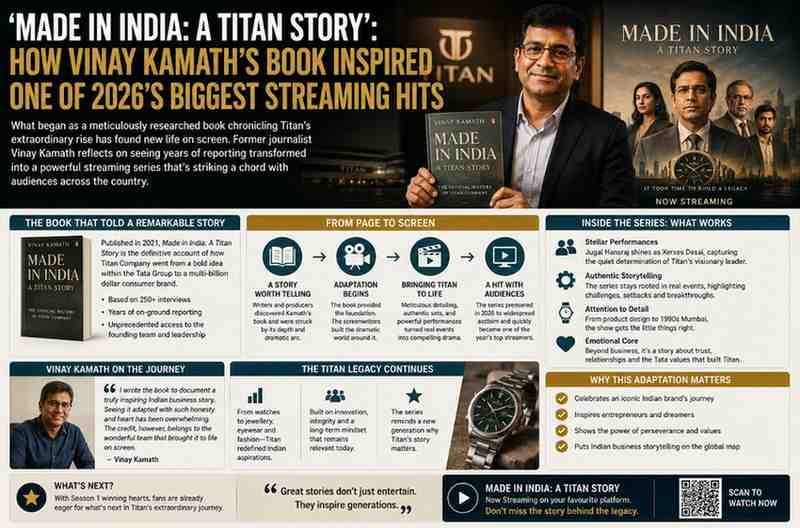
Business stories rarely become mainstream Entertainment. Yet when they do, they have the power to inspire audiences far beyond boardrooms and business schools. Made in India: A Titan Story is one such example—a streaming adaptation that turns the remarkable journey of one of India’s most respected companies into compelling drama while celebrating innovation, entrepreneurship, and nation-building.
For Vinay Kamath, former The Hindu BusinessLine journalist and author of the book that inspired the series, watching years of careful research evolve into one of 2026’s biggest streaming successes has been both rewarding and surreal. His reaction “It’s about time” captures not just personal satisfaction but also a broader recognition that Indian corporate success stories deserve the same cinematic treatment often reserved for politics, crime, or sports.
The adaptation also reflects a growing trend in Indian entertainment: audiences are increasingly embracing stories rooted in real institutions, visionary leadership, and transformative ideas rather than purely fictional narratives.
The Story Behind Titan’s Extraordinary Rise
Titan’s journey represents far more than the growth of a successful watchmaker. It is a story of innovation, branding, manufacturing excellence, and consumer trust that fundamentally reshaped India’s lifestyle retail industry.
From challenging traditional perceptions of watches to becoming a diversified lifestyle company with interests in jewellery, eyewear, fragrances, and accessories, Titan demonstrated how an Indian brand could compete through design, quality, and customer experience.
Its evolution mirrors India’s own economic transformation over the past several decades.
Why Vinay Kamath’s Book Resonated
As a business journalist, Vinay Kamath documented Titan’s evolution with a focus on leadership decisions, market challenges, and the strategic thinking behind the company’s growth.
Rather than presenting a simple corporate success story, the book explored the risks, setbacks, and calculated decisions that shaped one of India’s most admired companies.
That balanced perspective made the work particularly valuable, offering readers insights into how enduring businesses are built over time rather than overnight.
From Pages to Streaming Screens
Adapting a business history into a dramatic series presents unique creative challenges.
Unlike fictional stories, real corporate journeys depend less on explosive action and more on strategic decisions, leadership conflicts, innovation, and perseverance. Screenwriters must therefore transform boardroom conversations, product launches, and business milestones into emotionally engaging storytelling without losing factual authenticity.
The success of Made in India: A Titan Story suggests that audiences are increasingly interested in narratives driven by ideas as much as by spectacle.
Why Business Dramas Are Finding New Audiences
Streaming platforms have significantly expanded the types of stories audiences are willing to explore.
Viewers today often seek:
- Real-life success stories.
- Entrepreneurial journeys.
- Historical business milestones.
- Leadership challenges.
- Innovation-driven narratives.
- Stories rooted in Indian institutions.
This shift has created opportunities for corporate histories that may previously have been viewed as too niche for mainstream entertainment.
| Aspect | Why It Matters |
|---|---|
| Real corporate history | Adds authenticity to the narrative |
| Business journalism | Provides factual depth and context |
| Streaming adaptation | Introduces the story to wider audiences |
| Leadership focus | Highlights decision-making and innovation |
| Indian business success | Celebrates homegrown entrepreneurship |
More Than Watches: Titan’s Broader Legacy
Although widely associated with watches, Titan’s long-term influence extends well beyond a single product category.
The company played a significant role in transforming organized retail, strengthening Indian manufacturing capabilities, and redefining customer expectations through design-led products and trusted branding.
Its expansion into jewellery and other lifestyle segments demonstrated how strategic diversification can help businesses remain relevant across changing consumer preferences.
These broader themes give the adaptation significance beyond corporate history alone.
The Journalist’s Perspective Matters
Books written by experienced journalists often differ from conventional biographies because they combine extensive reporting with careful documentation and multiple viewpoints.
This depth of research provides filmmakers with a richer foundation, helping ensure that dramatic storytelling remains anchored in real events and credible character development.
It also reminds audiences that some of the most compelling stories emerge from years of patient reporting rather than fictional invention.
Why Corporate Stories Deserve the Spotlight
Business narratives are ultimately stories about people solving problems, taking calculated risks, responding to failure, and building organizations that influence millions of lives.
Companies shape employment, technology, consumer behaviour, and economic development, making their histories an important part of modern society.
Successful adaptations help humanize these institutions by focusing on the individuals and decisions behind major milestones.
The Growing Popularity of Fact-Based Entertainment
Indian audiences have shown increasing interest in productions inspired by real events, particularly when they combine factual credibility with engaging storytelling.
This reflects a broader shift toward content that informs while entertaining.
Business stories fit naturally within this trend because they offer lessons in leadership, resilience, innovation, and long-term thinking that remain relevant beyond the corporate world.
| Traditional Business Book | Streaming Adaptation |
|---|---|
| Detailed historical analysis | Visual storytelling |
| Comprehensive reporting | Character-driven narrative |
| Business insights | Broader audience appeal |
| Long-form reading experience | Accessible episodic format |
| Professional reference | Mainstream entertainment |
What This Means for Indian Storytelling
The success of Made in India: A Titan Story may encourage creators to explore more narratives inspired by India’s business history. The country’s entrepreneurial landscape offers countless stories involving manufacturing breakthroughs, technological innovation, family businesses, startups, and iconic brands that have influenced everyday life.
Rather than limiting business journalism to financial pages, such adaptations help preserve important chapters of India’s economic development for future generations.
The Bigger Picture: Where Journalism Meets Entertainment
The adaptation of Vinay Kamath’s work illustrates the growing intersection between journalism and visual storytelling. As streaming platforms search for authentic, meaningful content, carefully researched nonfiction increasingly provides valuable source material.
This trend benefits both industries. Journalists see their reporting reach wider audiences, while filmmakers gain access to stories grounded in real events, rich characters, and historical significance.
For viewers, it offers entertainment that also deepens understanding of the institutions and ideas that have shaped modern India.
Conclusion
Made in India: A Titan Story is more than a successful streaming adaptation—it is a celebration of Indian enterprise, thoughtful journalism, and the enduring value of well-researched storytelling. Vinay Kamath’s reflections on seeing his book reach a broader audience highlight how powerful nonfiction can become when translated effectively for the screen.
By bringing Titan’s remarkable journey to life, the series demonstrates that business histories can be just as compelling as political thrillers or sports dramas when they focus on visionary leadership, perseverance, and innovation. As audiences continue to embrace stories rooted in real achievements, this adaptation may mark the beginning of a new era for Indian business storytelling—one where corporate history becomes an integral part of mainstream entertainment.
For breaking news and live news updates, like us on Facebook or follow us on Twitter and Instagram. Read more on Latest Entertainment on thefoxdaily.com.






COMMENTS 0