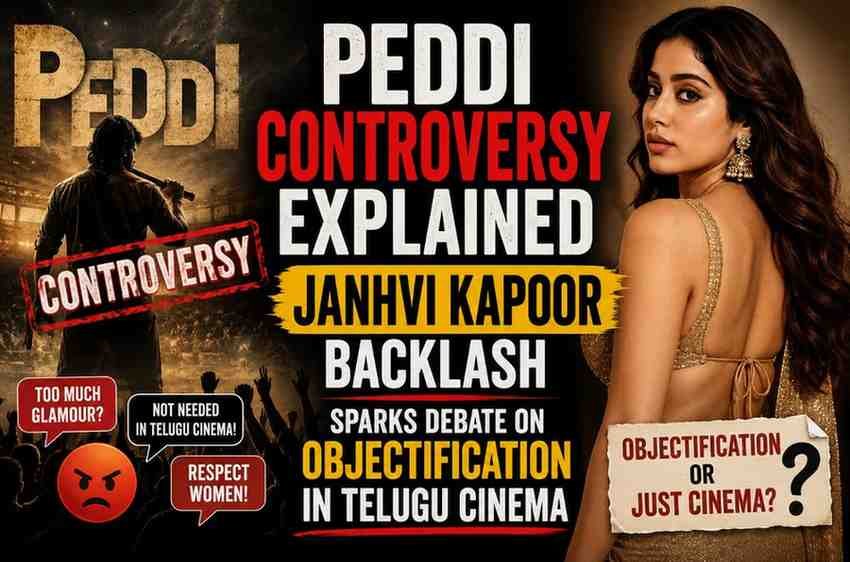
When a ₹350 crore film starring one of Indian cinema’s biggest stars opens to record-breaking box office numbers and simultaneous social media outrage, something has gone spectacularly and instructively wrong. That is exactly the situation surrounding Peddi, the Ram Charan-led Telugu sports drama directed by Buchi Babu Sana, which hit screens on June 4, 2026, and has since become the flashpoint for one of the sharpest conversations Indian cinema has had in years about how it treats the women on its biggest stages.
The immediate trigger: a viral Instagram post describing Peddi as “the most expensive disrespect ever paid to a leading woman in Indian cinema,” which Janhvi Kapoor allegedly liked an act of social media silent protest that sent the internet into overdrive. But it is the response from Telugu actress Gayatri Chaganti, known for her work in Jersey and Ala Vaikunthapurramuloo, that has elevated the conversation from routine outrage to genuine reckoning. Chaganti said the quiet part aloud: yes, Janhvi may be a victim in Peddi but she has also been a consistent participant in her own objectification across her career.
Chaganti did not write an op-ed or give an interview. She left a comment on Instagram the kind of blunt, unfiltered take that bypasses the usual diplomatic filters of the film industry. Commenting on the Recommendation Community post that Janhvi had liked, Chaganti wrote: “If we’re being real here, no one is hiring her for her acting chops. In fact, she doesn’t miss any chance to sexualise every character through her costumes (irrespective of the backstory). Her body is her whole image. I am all for flaunting glamour when the character needs to. Go on, do your thing.”
She went further, specifically pointing to Param Sundari Janhvi’s most recent Bollywood outing as an example where even a character written in traditionally modest clothing is styled for maximum glamour effect. Chaganti noted that Kapoor’s character in that film suddenly appears in an explicitly revealing saree during an engagement song, despite a rural setting that would make such styling contextually jarring. Her sharpest observation: even when Janhvi plays a schoolteacher, her cleavage is prominently on display.
Chaganti was careful to note that she does not oppose glamour in cinema when it serves the character and story. Her criticism is more precise: that Janhvi’s screen image has been reduced to a single, repeating formula regardless of who the character is, where she comes from, or what her story demands and that this formula is one Kapoor has not pushed back against.
Peddi: What Actually Happened on Screen
To fully assess Chaganti’s critique, one must understand what triggered the original backlash against Peddi in the first place. The film a high-budget, pan-India sports action drama with music by A.R. Rahman stars Ram Charan as Peddi, a raw, aggressive rural athlete from Andhra Pradesh’s Vizianagaram region. Janhvi Kapoor plays Achiyyamma, the female lead.
From the trailer onwards, viewers noted a stark disconnect: the film presents itself as a grounded, emotionally charged story about class, ambition, and rural identity and then positions its female lead in styling and sequences that sit awkwardly against that premise. Clips that circulated online after release showed scenes that many viewers described as harassment dressed up as romance the kind of “hero pursuit” tropes that Telugu commercial cinema has been gradually distancing itself from, now suddenly reappearing in a ₹350 crore flagship production.
Director Buchi Babu Sana has since acknowledged the controversy, telling SCREEN magazine that he “had not anticipated that the scenes would be perceived so negatively by audiences.” He said the backlash has prompted him to think more carefully about how female characters are presented in future projects a statement that is simultaneously the right thing to say and, to many observers, frustratingly insufficient given the scale of the production and the clear precedent that exists.
Meanwhile, the box office tells its own complicated story. Peddi opened to a massive ₹135.36 crore worldwide on day one, with preview shows alone generating ₹18.50 crore numbers that beat the openings of Dhurandhar, Pathaan, and Sikandar. Day two saw a significant dip to ₹26.90 crore. Whether that dip reflects the usual weekday correction or the weight of a controversy that has genuinely put audiences off remains to be seen.
The Agency Question: Victim, Participant, or Both?
The most intellectually honest and therefore most contested aspect of Chaganti’s comment is its refusal to let Janhvi Kapoor off the hook entirely, even while acknowledging that she has been objectified. This is the question that has divided social media most sharply: does an actress bear responsibility for how she is portrayed on screen?
The answer, inconveniently, is: it depends. And it depends on a set of structural realities that the debate often flattens.
In Indian commercial cinema particularly its largest, most expensive productions the power dynamic between a female lead and a male director or male producer is rarely equal. Scripts are frequently not shared in full before signing. Costume decisions, camera angles, and shot compositions may not be within an actress’s contractual control. The industry’s deeply embedded culture of hero-worship means that the male star’s comfort, screen time, and narrative centrality take precedence over almost everything else.
Janhvi Kapoor herself has spoken on precisely this subject. In a candid conversation on the Raj Shamani Podcast, she spoke about the over-sexualisation she faces not just in films but at the hands of the paparazzi. She said that camera angles and edits can create narratives she has not approved of, and stressed the importance of consent in how public figures are framed. “Even on set, if I am not comfortable with how a camera is positioned, I should have the right to voice my discomfort without it reflecting poorly on my professionalism,” she said.
That statement exists in direct tension with Chaganti’s observation. Janhvi has articulated awareness of and discomfort with objectification. She has also, across multiple films, appeared in roles and styling choices that critics argue she had the career standing to push back against particularly as her profile has grown. The question of where structural compulsion ends and personal choice begins is genuinely difficult. But it is also a question that matters, and Chaganti’s willingness to raise it rather than offering a clean victim narrative is part of why her comment has resonated so widely.
Janhvi’s Track Record: A Pattern That Precedes Peddi
| Film | Character | Criticism | Janhvi’s Response |
|---|---|---|---|
| Devara: Part 1 (2024) | Opposite Jr NTR (Telugu) | Minimal screen presence; heavy glamour focus | Defended role as challenging |
| Param Sundari (2025) | Malayali woman | Cultural stereotyping; glamour-over-character styling | Called it “fun and interesting” |
| Peddi (2026) | Achiyyamma (rural Andhra woman) | Hyper-sexualisation; harassment framed as romance | Liked critical Instagram post (silent protest) |
The table reveals a pattern that Chaganti’s comment makes explicit: across her most high-profile Telugu and pan-India outings, Janhvi Kapoor has been cast into roles that critics argue prioritise her physical appearance over any meaningful dramatic contribution. What is notable is the trajectory of her own responses from vocal defence to, in Peddi’s case, what appears to be a quiet, deniable acknowledgement that something went wrong.
The Bigger Problem: Telugu Cinema’s Female Lead Problem
It would be convenient and incorrect to frame this purely as a Janhvi Kapoor story. Peddi’s controversy exists within a wider context that Telugu cinema’s own artists and audiences are grappling with increasingly openly. The industry that produced the progressive female narratives of films like Mahanati and the globally celebrated visual poetry of RRR continues to simultaneously produce big-budget entertainers in which the heroine’s primary narrative function is to be desired by the hero.
The casting of Bollywood actresses in Telugu blockbusters Janhvi in Devara and Peddi, others before her has become a recurring site of this tension. These casting decisions are driven by multiple factors: the desire to expand the pan-India audience, contractual and producer relationships, and, critics argue, a preference for actresses who are seen as more “manageable” or less likely to challenge established on-set hierarchies. Whatever the motivation, the outcomes are frequently the same: a Bollywood actress dropped into a Telugu story, dressed for maximum visual impact, and written as a satellite to the male star’s orbit.
The backlash to Peddi suggests that audience tolerance for this formula is eroding even among the film’s core demographic of Ram Charan fans, many of whom have been vocal about their discomfort with how Janhvi’s character was handled. That is a meaningful shift, and one that filmmakers would be unwise to dismiss as social media noise.
The Chaganti Paradox: Speaking Truth Without Full Nuance
Chaganti’s comment is sharp, honest, and generates an important conversation. It also carries a risk that is worth naming: the tendency to place disproportionate responsibility on the actress while letting directors, producers, costume designers, and cinematographers almost invariably male largely escape the same level of scrutiny.
A 24-year-old actress navigating one of the world’s most commercially powerful film industries does not operate with the same leverage as a veteran male director with a portfolio of blockbusters behind him. The choices available to Janhvi Kapoor when confronting a powerful filmmaker on a ₹350 crore production are not the same choices available in theory. And the social cost of an actress being labelled “difficult” or “unprofessional” for pushing back on costume decisions is real and career-affecting in a way that has no male equivalent.
None of this negates Chaganti’s core observation that agency exists on a spectrum, and that Kapoor’s apparent alignment with her own glamour-first image across multiple films suggests a level of participation that cannot be entirely explained away by structural pressure. But the conversation is incomplete if it focuses on the actress while the directors who made these choices, and the producers who greenlit them, face only a brief, diplomatic acknowledgement of “not anticipating” the response.
Conclusion: A Reckoning That Is Long Overdue
The Peddi controversy, and Gayatri Chaganti’s viral comment within it, has done something valuable: it has moved a conversation that Indian cinema usually has in whispers into the full light of public debate. The question of how female leads are written, styled, and directed in Indian blockbusters who bears responsibility, how much agency actresses actually possess, and what audiences will and will not accept deserves exactly this kind of scrutiny.
Janhvi Kapoor is simultaneously a victim of an industry that has consistently reduced her to her physical appearance and an actress whose career choices have, at least in part, reinforced that reduction. Both things can be true. Gayatri Chaganti had the courage to say so, even if the full picture is more complicated than any Instagram comment can contain.
The more important question the one that will determine whether Peddi is a turning point or just another controversy that fades by the next big release is whether the filmmakers, producers, and studios who profit from this formula are prepared to genuinely examine their role in it. A director saying he “didn’t anticipate” the backlash to a ₹350 crore film is not accountability. It is the beginning of a conversation that Indian cinema urgently needs to have and has been postponing for far too long.
For breaking news and live news updates, like us on Facebook or follow us on Twitter and Instagram. Read more on Latest Entertainment on thefoxdaily.com.






COMMENTS 0