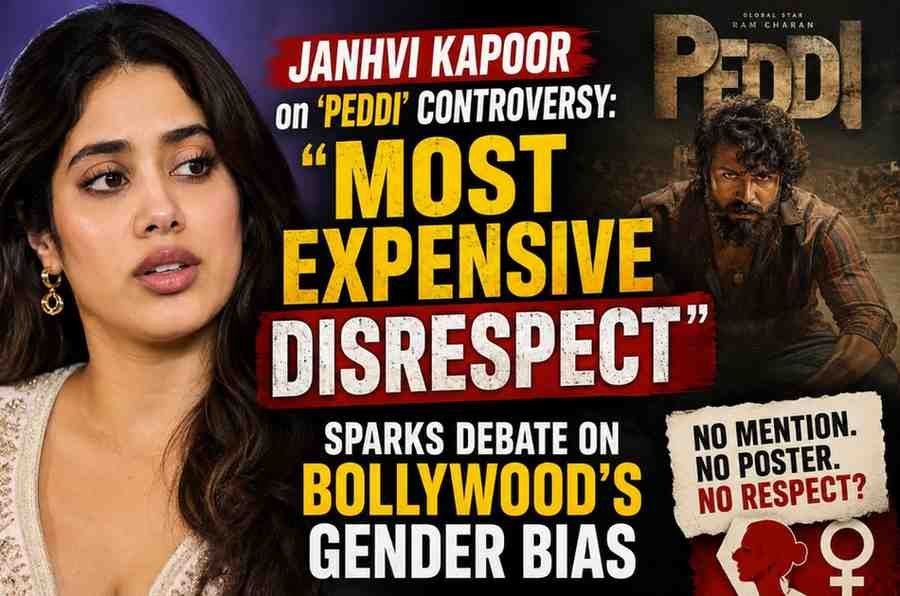
Primary Keyword: Janhvi Kapoor Peddi controversy
LSI Keywords: Janhvi Kapoor statement Peddi, Bollywood actress roles 2026, gender disparity in films India, female representation cinema, actresses screen time issues, Bollywood pay gap actresses, film industry sexism debate
Introduction: A Statement That Hit a Nerve
When Janhvi Kapoor reportedly agreed that “Peddi is the most expensive disrespect to an actress”, it didn’t just sound like a sharp remark it exposed a deeper truth about mainstream cinema.
Who: A leading young Bollywood actress speaking candidly.
What: A critique of how big-budget films treat female roles.
When: Amid growing industry conversations in 2026.
Where: Within the Indian film industry, but resonating globally.
Why: Increasing frustration over lack of meaningful roles for women.
How: Through public commentary that sparked debate online and within film circles.
This isn’t just about one film—it’s about an entire system.
What Does “Most Expensive Disrespect” Actually Mean?
The phrase is powerful because it highlights a contradiction: films with massive budgets still fail to offer substance to female characters.
- High production cost, low character depth
- Big star casts, minimal female agency
- Visual presence over narrative importance
Interpretation: Money is being spent—but not on storytelling that respects actresses.
The Bigger Issue: Representation of Women in Commercial Cinema
1. Screen Time vs Story Importance
Many actresses appear in films where their roles are limited to supporting the male lead rather than driving the plot.
2. Glamour Over Substance
Female characters are often written for visual appeal rather than emotional or narrative depth.
3. Pay Gap Still Exists
Despite progress, actresses continue to earn significantly less than their male counterparts in similar projects.
4. Lack of Strong Writing
Scripts frequently fail to develop layered female characters, especially in mass-market films.
Insight: The issue is not a lack of talent—it’s a lack of opportunity and intent.
Why This Debate Is Trending in 2026
- Rise of female-led films proving box office success
- OTT platforms offering stronger roles for women
- Increased audience awareness and criticism
- Actresses speaking openly about industry challenges
Trend Shift: Audiences no longer accept token representation they demand meaningful storytelling.
Comparison: Then vs Now Are Things Really Changing?
| Aspect | Earlier Bollywood | Bollywood in 2026 |
|---|---|---|
| Female Roles | Mostly decorative | Improving but inconsistent |
| Pay Equality | Significant gap | Still present |
| Story Focus | Male-centric | Gradually diversifying |
| Audience Expectation | Low | High demand for depth |
Deep Analysis: Why Big Budgets Don’t Guarantee Respect
One might assume that higher budgets lead to better storytelling—but that’s not always true.
Key issue: Budget allocation often prioritizes:
- Action sequences
- Visual effects
- Male star power
Meanwhile, character development—especially for women—takes a backseat.
Insight: True “respect” in cinema isn’t about pay or screen presence alone—it’s about narrative importance.
Real-World Impact on Actresses
- Limited career growth despite high visibility
- Typecasting in repetitive roles
- Reduced creative satisfaction
- Dependence on select directors for strong roles
Example pattern: Many actresses turn to OTT platforms or female led films for meaningful performances.
Industry Response: Is Change Happening?
There are signs of progress:
- More women-centric scripts being greenlit
- Actresses demanding better roles and pay
- Producers recognizing audience demand for diversity
However, the pace of change remains slow in mainstream commercial cinema.
Unique Insight: The Economics of “Disrespect”
The phrase “expensive disrespect” also points to an economic paradox.
Observation:
- Films spend crores on production
- But underinvest in writing strong female roles
Result: Missed opportunity.
Strong female characters are not just socially important they are commercially viable. Films with well-written women often perform better in the long run due to stronger audience connection.
Future Outlook: Where Does Bollywood Go From Here?
- Rise of script-driven cinema
- Increased influence of OTT storytelling standards
- Growing accountability from audiences
- More actresses taking control as producers
Prediction: The next phase of Bollywood success will depend on balanced storytelling not just star power.
Conclusion: More Than Just a Comment
Janhvi Kapoor’s agreement with the statement about ‘Peddi’ being the “most expensive disrespect” is more than a headline it’s a reflection of an ongoing industry reckoning.
The conversation is no longer about whether change is needed. It’s about how fast the industry can adapt.
Final Thought: In 2026, audiences are watching more closely than ever and respect in storytelling is no longer optional.
For breaking news and live news updates, like us on Facebook or follow us on Twitter and Instagram. Read more on Latest Entertainment on thefoxdaily.com.

COMMENTS 0