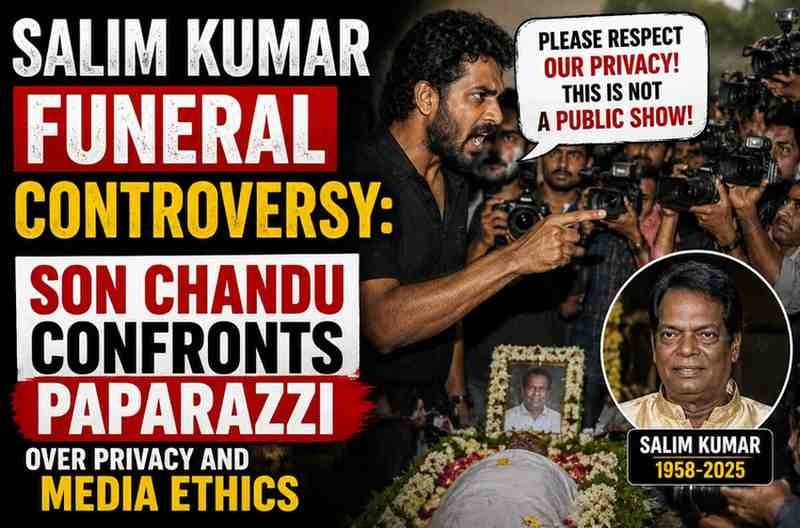
As family members gathered to pay their final respects, the presence of photographers and camera crews positioned to capture arriving mourners created the kind of physical bottleneck that transforms grief into obstacle course. Chandu Kumar, visibly distressed, confronted the assembled media and demanded space for his family to move freely and grieve without being photographed at close range during one of the most vulnerable moments a person can experience.
The outburst was neither aggressive nor threatening in any meaningful sense. It was the response of a grieving son who found himself navigating a scrum of cameras at the precise moment he needed physical and emotional room to process loss. That the moment itself was then photographed, captioned, and distributed as Entertainment content illustrates the recursive nature of the problem: the coverage of the reaction to coverage becomes its own content cycle.
Chandu Kumar is not a public figure in the conventional sense. His identity in media coverage derives almost entirely from his relationship to his father. This matters because the justifications that are sometimes offered for intensive celebrity grief coverage public interest in a public figure, the audience’s emotional investment in a star do not straightforwardly extend to that figure’s family members, who did not choose public life and whose presence at a funeral is not a media event by any reasonable definition.
The Paparazzi-Funeral Complex in Indian Entertainment Media
The practice of deploying photographers to film celebrity funerals, condolence visits, and cremation ceremonies has become so normalised in Bollywood and regional film industry coverage that it is rarely examined critically. It operates on a simple economic logic: grief content performs well. Images of stars crying, family members consoling each other, and public figures in states of visible distress generate clicks, shares, and emotional engagement that translate directly into advertising revenue for the platforms that publish them.
What this economic logic obscures is the human cost borne by the subjects of that content. Grief is a physiological and psychological process that requires specific conditions to proceed healthily chief among them a sense of safety, privacy, and freedom from performance anxiety. The presence of cameras at close range during a bereavement ritual activates threat responses in the nervous system that are fundamentally incompatible with the emotional openness that mourning requires. People who are photographed while grieving are not grieving in the way they would grieve privately; they are managing an additional layer of self-consciousness at the moment they are least equipped to do so.
The Malayalam film industry has generally maintained a somewhat more restrained media culture than Bollywood’s most intrusive outlets, but the convergence of social media, short-form video, and real-time distribution has compressed those distinctions. What was once the province of a handful of photographers outside a funeral home is now a multi-platform content opportunity that draws larger crowds of media personnel and amplifies every captured moment to audiences far beyond the industry’s immediate circle.
Industry Response Patterns: Solidarity, Silence, and Selective Outrage
When incidents like Chandu Kumar’s confrontation with paparazzi occur, they typically generate a brief wave of social media commentary from within the film industry expressions of solidarity with the grieving family, occasional criticism of media intrusion, and calls for greater sensitivity in bereavement coverage. These responses are genuine in many cases but structurally ineffective. They do not alter the economic incentives that drive paparazzi deployment to funerals, and they do not produce the kind of industry-wide or regulatory framework that would create enforceable standards.
The pattern is consistent across industries and geographies: the outrage cycle runs for 48 to 72 hours, generates its own content (think pieces, panel discussions, celebrity statements), and then subsides without producing structural change. The next high-profile bereavement in the film industry will be covered in substantially the same way, and the family members of the deceased will face substantially the same conditions.
| Coverage Type | Journalistic Justification | Human Cost to Family | Audience Value |
|---|---|---|---|
| Funeral arrival photography | Public figure’s passing as news | High physical intrusion during acute grief | Low largely voyeuristic |
| Condolence visit footage | Industry solidarity as cultural record | Moderate semi-public setting | Moderate context for fans |
| Family reaction capture | Human interest, emotional resonance | Very high non-consenting subjects in distress | Low exploitative framing |
| Tribute and career retrospective | Legitimate cultural documentation | None to low family not primary subject | High genuine value to audiences |
| Grief confrontation coverage (e.g. Chandu incident) | None reactive content creation | Compounding extends initial intrusion | None meta-content without substance |
The Legal and Ethical Gap in India’s Media Landscape
India does not have a comprehensive right to privacy statute that would provide clear grounds for restricting photographic coverage of individuals in grief, even in semi-public settings such as the exterior of a family home or a cremation ground. The Personal Data Protection framework and evolving judicial interpretations of the right to privacy under Article 21 of the Constitution have established privacy as a fundamental right, but the application of that right to real-time photographic journalism in bereavement contexts remains legally underdeveloped.
Press Council of India guidelines emphasise sensitivity, accuracy, and dignity in reporting, but they are advisory rather than binding, and they are not enforced in any systematic way against entertainment media outlets whose primary output is celebrity content rather than news journalism. The practical result is a near-complete absence of enforceable standards governing how close photographers can position themselves to grieving family members, how footage captured in those conditions can be used, or what consent, if any, is required from non-public family members who find themselves in frame.
By contrast, several European jurisdictions have developed specific protections for individuals photographed in states of distress, with particular attention to contexts of bereavement, medical emergency, and other involuntary vulnerability. France’s strong personality rights framework, for instance, would create significant legal exposure for a media outlet that published close-range photographs of a non-public figure crying at a family member’s funeral without consent. These frameworks are not without their own tensions with press freedom, but they represent a considered legislative attempt to balance competing interests that India has not yet undertaken in this specific context.
What Chandu Kumar’s Reaction Actually Communicates
Beyond the immediate incident, Chandu Kumar’s visible frustration communicates something important about the experience of being adjacent to fame in Indian entertainment culture. Family members of film industry figures occupy an ambiguous position: they receive some of the social and sometimes material benefits of proximity to celebrity, while bearing the costs of media scrutiny without the professional preparation, PR infrastructure, or psychological conditioning that public figures themselves develop over careers.
A working actor learns, over time, to manage camera presence as a professional skill. They develop a relationship with public attention that, however imperfect, gives them some tools for navigating it. Their children, parents, siblings, and spouses have no equivalent preparation. When they are thrust into media coverage at moments of maximum vulnerability and bereavement is precisely such a moment the asymmetry between their experience and the media’s expectations becomes acute and sometimes explosive.
That Chandu Kumar’s reaction has been covered as though his distress is the story, rather than the conditions that produced the distress, reveals the extent to which entertainment media has lost the capacity to distinguish between the people it covers and the content they generate. A son shouting at cameras to make space for his family to grieve is not content. It is a human being asking, in the only way available to him in that moment, to be left alone.
A Necessary Industry Reckoning
The Malayalam film industry has periodically demonstrated a capacity for self-reflection that distinguishes it from some of its larger counterparts the industry’s willingness to engage seriously with the Hema Committee report on workplace conditions being a recent and significant example. A similar reckoning with the ethics of bereavement coverage, led by the industry’s own associations in dialogue with media organisations, is both overdue and achievable.
Practical measures are not difficult to design: designated media pools at funeral events with agreed standoff distances, voluntary embargoes on close-range grief photography involving non-public family members, and editorial standards that distinguish between legitimate tribute journalism and voyeuristic distress capture. None of these require legislation. They require only the collective decision that the people behind the performances and the people who love them deserve to grieve without becoming content.
Chandu Kumar’s outburst will be forgotten within the week. The conditions that produced it will not change until the industry and its media ecosystem decide, together, that they should.
For breaking news and live news updates, like us on Facebook or follow us on Twitter and Instagram. Read more on Latest Entertainment on thefoxdaily.com.






COMMENTS 0