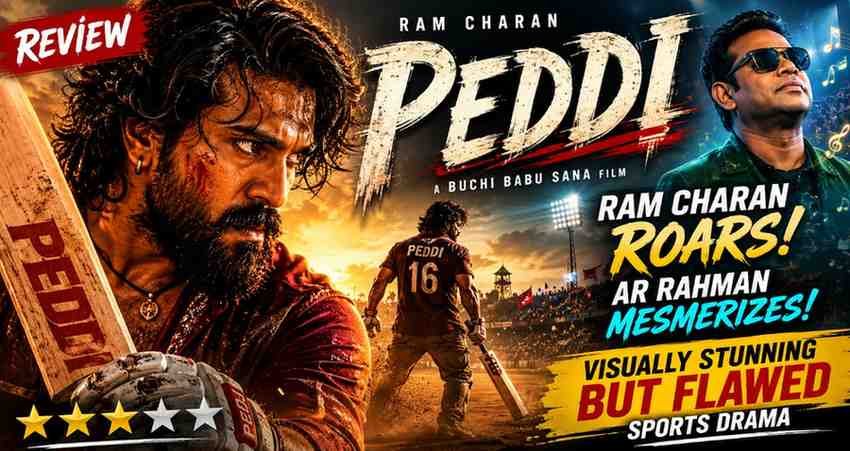
There is a particular kind of frustration that comes with watching a film that almost works. Peddi, the much-anticipated sports drama headlined by Ram Charan, belongs squarely in that category a movie that assembles a world-class technical team, casts one of Telugu cinema’s most magnetic stars, and then proceeds to hand them a screenplay that cannot carry the weight of their combined talent.
Set against the visceral backdrop of rural kabaddi circuits in Telangana, Peddi follows the story of a young man from a marginalised community who battles systemic bias, personal loss and institutional corruption to reach the national stage. On paper, the premise crackles with potential. In execution, it too often retreats into familiar territory, piling on subplots that dilute rather than deepen its central emotional argument.
Ram Charan: Carrying the Film on His Shoulders
It would be tempting to say that Ram Charan saves Peddi. The truth is more nuanced: he elevates it sufficiently that one finishes the film grateful rather than resentful. His physical transformation for the role is evident lean, explosive, believably athletic but physicality alone rarely distinguishes a performance. What Charan brings here is restraint, a quality that does not always define his blockbuster appearances. There are scenes, particularly in the second act, where dialogue is abandoned entirely in favour of a held look or a slow exhale, and the actor trusts those silences completely.
His portrayal of Peddi is at its most affecting in the quieter domestic sequences: a son navigating his father’s wounded pride, a young man who understands that the village watching him is not an audience but a burden. This emotional register the weight of collective expectation is terrain that Ram Charan has explored before, but rarely with this degree of internalisation.
AR Rahman’s Score: The Film’s True Protagonist
If Ram Charan is the film’s emotional anchor, AR Rahman’s music is its pulse. The maestro delivers what may be his most kinetically inventive Telugu score in years. The kabaddi raid sequences are underscored with a rhythmic language that borrows from Carnatic percussion, folk idioms and electronic texture simultaneously a compositional approach that feels genuinely novel rather than merely eclectic.
Standout tracks demonstrate the range of Rahman’s contribution: an arena-rock anthem that will dominate gym playlists for months; a folk elegy that arrives unexpectedly mid-narrative and stops the film cold in the best possible way. The background score deserves equal credit, deploying silence as aggressively as sound in the film’s climactic sequences, allowing tension to build without orchestral manipulation.
Rahman’s involvement was clearly a creative partnership rather than a commercial attachment the music shapes the film’s emotional grammar rather than merely accompanying it. Whether the screenplay ultimately justifies that investment is another question.
Ratnavelu’s Cinematography: Dust, Light and Dignity
Cinematographer Ratnavelu has long demonstrated an ability to find grace in unglamorous landscapes, and Peddi gives him ample canvas. His framing of the Telangana countryside the cracked earth, the temporary floodlit arenas, the spectators pressed against chain-link barriers carries a documentary credibility that grounds the film’s more melodramatic impulses.
Particularly impressive is the lighting design within the sport itself. Kabaddi, unlike cricket or football, has historically been cinematically underserved, its physical grammar difficult to translate into watchable spectacle. Ratnavelu solves this through extreme proximity tight frames that communicate the suffocating claustrophobia of close-contact sport and through a colour palette that shifts subtly between the warm ochres of village sequences and the harsher sodium blues of urban competition.
The Screenplay Problem: Where ‘Peddi’ Stumbles
None of the above, however, resolves the central issue: the film’s writing is structurally compromised in ways that accumulate into genuine narrative fatigue by the second half. The primary antagonist a state sports federation official whose corruption is signalled so broadly and so early that any pretence of dramatic ambiguity evaporates represents a missed opportunity. In a sharper script, institutional bias would have been rendered as systemic rather than personal, more suffocating for being diffuse.
Subplots multiply without resolution. A romantic thread that opens with unusual complexity is abandoned after the interval and then resurrected only to provide a climactic speech. A subplot involving Peddi’s mentor a former national player whose fall from grace mirrors the protagonist’s potential future is introduced, richly textured, and then inexplicably dropped for nearly forty minutes before a rushed conclusion.
The runtime, at approximately one hundred and fifty-eight minutes, is twenty minutes longer than the film’s actual story. The mathematics of Telugu commercial cinema the demands of songs, interval bang, climactic action visibly distort the screenplay’s architecture, forcing emotional peaks at predetermined junctions regardless of narrative readiness.
| Element | Peddi (2025) | Jersey (2019) | Maharshi (2019) |
|---|---|---|---|
| Sport Featured | Kabaddi | Cricket | Agriculture (non-sport) |
| Protagonist Arc | Rise from rural obscurity | Comeback from failure | Social redemption |
| Lead Performance | Restrained, physical | Emotionally devastating | Crowd-pleasing, broad |
| Screenplay Strength | Weak overstuffed | Strong economical | Moderate formulaic |
| Technical Craft | Exceptional | Strong | Competent |
| Runtime (approx.) | 158 minutes | 157 minutes | 175 minutes |
The Kabaddi Question: A Sport Finally Taken Seriously
One element that distinguishes Peddi from the broader tradition of Indian sports cinema is its commitment to representing kabaddi as a legitimate sporting spectacle rather than a rural novelty. The Pro Kabaddi League’s decade-long effort to urbanise and professionalise the sport has created a new visual vocabulary one that the film draws on intelligently.
The choreography of raid sequences, supervised evidently with considerable input from professional players, captures the sport’s unique blend of breathwork, spatial intelligence and explosive physicality. Non-kabaddi audiences will find themselves drawn into the tactical logic of the game, which is a considerable achievement for any sports film. This is the territory where Peddi most clearly justifies its ambition and, by extension, its budget.
Supporting Cast: Uneven but Occasionally Luminous
The ensemble surrounding Ram Charan is broadly competent without being consistently memorable. The actor playing Peddi’s father delivers a performance of understated dignity in the film’s earlier passages but is given increasingly thin material as the narrative progresses. The female lead is stranded by the screenplay’s indecision about her character’s function neither romantic interest nor independent agent, she occupies the film’s margins with evident talent and insufficient purpose.
A veteran character actor, appearing in a brief but pivotal role as a retired kabaddi coach, leaves the most durable impression among the supporting cast. His single extended scene with Charan a conversation conducted almost entirely in the language of shared professional grief represents the film’s clearest evidence of what a more disciplined screenplay might have produced throughout.
Verdict: Flawed But Unmissable for the Craft Alone
Peddi is a difficult film to assess without ambivalence. Its failures are structural and therefore irreparable in the edit suite no amount of recut trailers or repositioned songs could have resolved what is fundamentally a script that tries to carry three films’ worth of emotional cargo. But its achievements are genuine and, in certain sequences, genuinely extraordinary.
Ram Charan has delivered his most nuanced performance to date. AR Rahman has composed a score that will outlast the film’s theatrical run by years. Ratnavelu has photographed Telangana’s sporting margins with a beauty and specificity they have rarely received. These are not small things. They are, in fact, precisely the things that make Telugu cinema worth watching even when its commercial machinery occasionally overwhelms its storytelling instincts.
See Peddi for what it gets magnificently right. Stay through what it gets wrong. The final whistle, when it arrives, leaves you not cheated just aware, as with all flawed films that reach for something large, of the gap between aspiration and delivery.
Quick Verdict
- Ram Charan: Career-best restraint and physicality a performance that transcends the material
- AR Rahman: Rhythmically inventive, emotionally precise among his finest Telugu work
- Ratnavelu: Visually authoritative, consistently atmospheric
- Screenplay: Structurally overcrowded; subplots open and close without consequence
- Kabaddi sequences: Authentically choreographed, cinematically thrilling
- Runtime: Twenty minutes too long by conservative estimate
Peddi is the rare sports drama where the sport itself works better than the story surrounding it rescued from mediocrity by a star at the peak of his physical and emotional range, and a composer who understands that great music does not accompany emotion but creates it.
For breaking news and live news updates, like us on Facebook or follow us on Twitter and Instagram. Read more on Latest Entertainment on thefoxdaily.com.




COMMENTS 0