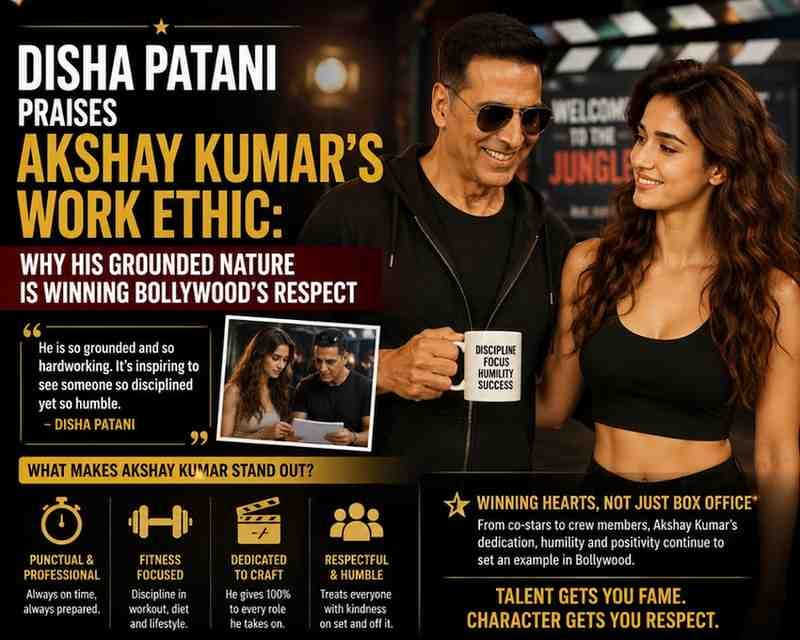
Disha Patani‘s remarks about Akshay Kumar‘s grounded nature and work ethic have caught attention not just because of who said it, but because of what it says about the culture on Bollywood film sets today. Who: Disha Patani, currently promoting her comedy ensemble film Welcome To The Jungle alongside Akshay Kumar. What: Public praise for Akshay’s discipline, humility, and professionalism on set. When: Amid the film’s ongoing promotional run and release window in 2026. Where: Across media interactions and interviews tied to the film’s rollout. Why: Because cross-generational respect on a 30-plus actor ensemble set is rare enough to be newsworthy. How: Through candid interview comments about what she learned simply by watching him work.
This isn’t just celebrity small talk. It’s a case study in how workplace culture even in an industry as glamorous and chaotic as Hindi cinema gets shaped by the behaviour of its most senior, most bankable stars.
The Context: A Reunion Film With 30-Plus Egos to Manage
Welcome To The Jungle isn’t a two-hero, one-heroine story. It’s a sprawling ensemble comedy featuring more than 30 actors, including Akshay Kumar, Suniel Shetty, Raveena Tandon, Paresh Rawal, Arshad Warsi, Lara Dutta, Jacqueline Fernandez, Johnny Lever, Rajpal Yadav, Tusshar Kapoor, Shreyas Talpade, and Disha Patani. Directed by Ahmed Khan, the film marks Akshay’s return to a franchise he had sat out for its previous installment, which starred John Abraham instead.
On paper, a set with that many established names sounds like a logistical nightmare and a psychological one too. Everyone has a brand to protect, screen time to negotiate, and an ego that comes with decades of stardom. Yet what has repeatedly surfaced in interviews around this film isn’t tension. It’s admiration.
Disha Patani, stepping outside her usual comfort zone of action and romance for a full-blown comedy role, has spoken about how demanding the genre actually is. She’s pointed out that making a scene look “effortless and natural” is far harder than it looks, and that she absorbed a great deal simply by observing veterans like Akshay Kumar, Johnny Lever, and Arshad Warsi at work. That observational learning watching how a senior actor carries himself between takes, how he treats junior crew members, how he handles pressure is where the “grounded” narrative comes from.
Key Developments: What Akshay Kumar Actually Said About Staying Grounded
Akshay Kumar has, in his own words during recent media interactions for the film, been unusually direct about why he behaves the way he does. He has described staying grounded as something with no hidden formula no “rocket science,” in his words but rather a simple discipline of showing up, doing the work, and going home. When a film underperforms, his stated approach is to learn from what went wrong and move forward rather than dwell on it.
He has also linked this mindset directly to his upbringing, crediting his father’s daily habit of waking up and going to work as the template he unconsciously followed his entire career. That’s a notable detail: Akshay isn’t framing his work ethic as a performance strategy or a PR-friendly soundbite. He’s framing it as inherited behaviour something closer to a family value than a career tactic.
His personal routine backs this up. He has spoken about preferring early dinners, avoiding late-night shoots, and adjusting production schedules for efficiency rather than glamour. It’s a strikingly unglamorous description of a career that has spanned three decades and produced dozens of box-office hits.
The consistent theme across his co-stars’ comments isn’t charisma or stardom it’s discipline. That distinction matters more than it might seem.
It’s Not Just Disha: A Pattern of Co-Stars Echoing the Same Praise
What makes this moment more than a one-off compliment is that Disha Patani isn’t the only co-star making similar observations. Raveena Tandon, reuniting with Akshay and Suniel Shetty more than two decades after their 1990s hits together, has described his work ethic as untouched by time still disciplined, still fully involved on set, still someone who treats every day of work as if it matters. She’s also noted that despite everyone in the cast having grown, evolved, and gathered decades of life experience, the core equations between the old Mohra-era co-stars haven’t changed at all.
When two actors from different generations one a contemporary from the 90s, one a newer-generation star reinventing herself in comedy independently arrive at the same conclusion about a colleague’s professionalism, that’s a signal worth paying attention to. It suggests the behaviour is consistent, not performed for a particular interview or co-star.
Why This Matters: The Business Case for Groundedness in a Hierarchical Industry
Bollywood, like most film industries built around star power, runs on hierarchy. Pay scales, billing order, vanity van sizes, and screen time are all silently ranked and closely watched. In that environment, a senior star’s on-set behaviour sets the tone for everyone below them assistant directors, junior artists, technicians, and yes, co-stars navigating unfamiliar genres.
When a top-billed actor treats the set as a workplace rather than a stage for ego, it changes how comfortable others feel asking questions, taking creative risks, or simply admitting they’re out of their depth in a new genre exactly what Disha Patani describes doing while learning comic timing from her seniors. That comfort isn’t a soft, feel-good side effect. It directly affects the quality of the final product, because actors who feel safe experimenting tend to deliver more natural, less guarded performances — which is precisely the “effortless” quality Patani says comedy demands.
There’s a broader organisational behaviour lesson hiding inside this celebrity story. Workplace psychology research has long shown that psychological safety the sense that you won’t be humiliated or punished for asking questions or making mistakes is one of the strongest predictors of team performance, whether that team is a Silicon Valley engineering pod or a Bollywood ensemble cast. Akshay Kumar’s described behaviour, intentionally or not, is a textbook example of a senior figure modeling that safety for a mixed-experience group.
| Workplace Principle | Corporate Version | Akshay Kumar’s On-Set Version |
|---|---|---|
| Consistency | Showing up reliably regardless of project outcomes | Treating every film — hit or flop — as a lesson, not a verdict |
| Psychological Safety | Encouraging juniors to ask questions without fear | Newer co-stars like Disha Patani learning by simply observing him, unprompted |
| Boundaries | Protecting personal time despite deadlines | Preferring early dinners and avoiding unnecessary late-night shoots |
| Humility | Crediting mentors or family for one’s success | Attributing his discipline to watching his father go to work every day |
The Unique Angle Most Coverage Is Missing
Most Entertainment coverage of this story treats it as a feel-good soundbite — a younger actress complimenting a senior co-star, filed under routine promotional chatter. What that framing misses is the structural rarity of it. In an industry where cross-generational, cross-gender professional respect is rarely discussed openly (and where on-set friction stories tend to travel faster than harmony stories), a multi-actor ensemble producing repeated, independent testimonials of the same behaviour is a genuinely unusual data point.
It’s also worth noting the genre angle: Disha Patani is stepping into comedy for the first time in a major way, working alongside genre specialists. Her praise isn’t generic “he’s a nice guy” flattery it’s specifically about learning a craft skill (comic timing) by watching someone senior model it without gatekeeping. That’s mentorship, not just niceness, and it’s a distinction worth drawing out because mentorship-driven set cultures tend to produce better ensemble chemistry on screen, which usually translates to how audiences respond to ensemble comedies in particular.
Real-World Impact: What This Means for Actors, Productions, and Audiences
For junior and mid-career actors navigating an unfamiliar genre or a high-pressure ensemble set, stories like this one function as informal case studies. They signal that even at the top of the industry, professionalism and approachability aren’t mutually exclusive with box-office dominance. For production houses, a set culture built around discipline rather than hierarchy-driven fear tends to reduce costly delays, reshoots, and off-camera conflict all of which affect a film’s bottom line as much as its reviews do.
For audiences, the impact is more indirect but real: ensembles that genuinely enjoy working together tend to produce more convincing on-screen camaraderie, and comedy in particular suffers when that chemistry is forced. If Patani’s comedic timing genuinely improved from observing her co-stars, that’s likely to show up in the finished film’s reception, not just in interview transcripts.
Conclusion: A Small Quote With a Bigger Signal
Disha Patani’s praise for Akshay Kumar’s grounded, disciplined approach to work fits into a wider pattern echoed by other co-stars on the Welcome To The Jungle set, and it points to something more substantial than routine promotional goodwill. It reflects a workplace culture where seniority doesn’t have to come with intimidation, and where genuine skill-sharing between generations of actors can happen simply through observation and mutual respect.
As Bollywood’s ensemble films continue to grow larger and more star-studded, the industry’s ability to manage 30-plus egos on a single set will likely depend less on contracts and call sheets, and more on whether its most powerful stars choose to lead the way Akshay Kumar reportedly does quietly, consistently, and without needing anyone to notice. If this pattern holds, expect more actors from future ensemble productions to cite similar on-set mentorship stories, turning “groundedness” from a personality trait into an increasingly marketable, and quotable, professional currency in Indian cinema.
For breaking news and live news updates, like us on Facebook or follow us on Twitter and Instagram. Read more on Latest Lifestyle on thefoxdaily.com.






COMMENTS 0