Onam 2026 is bringing a familiar debate back to Kerala’s dining tables: can the traditional Sadya evolve without losing what makes it special?
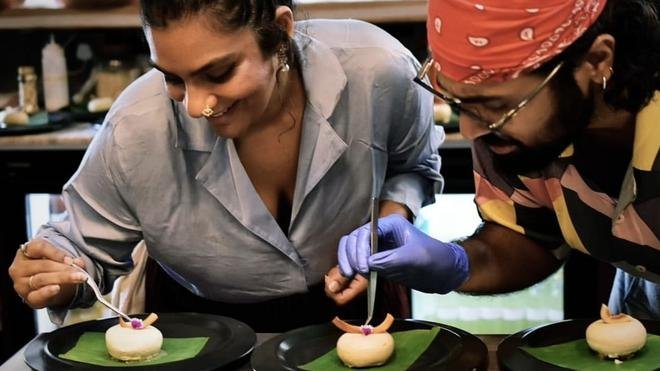
Across restaurants and contemporary kitchens, chefs are experimenting with classic Kerala dishes in ways that would have seemed unusual on a traditional banana-leaf spread. Olan is being reinterpreted as a consommé, Pradhaman is inspiring cake, and the familiar richness of Pal Payasam is finding a new expression as ice cream.
For some chefs, these experiments are a natural extension of culinary creativity. Traditional ingredients can be presented using modern techniques while retaining their essential flavours. For others, however, the Sadya is not a recipe waiting to be upgraded. It is a cultural ritual whose identity lies precisely in its familiar flavours, combinations, textures and method of eating.
The debate makes Onam food in 2026 more interesting than a simple conversation about fusion cuisine. It raises a larger question: when does reinterpretation become innovation, and when does it begin to erase the very tradition it claims to celebrate?
What makes a Sadya more than a meal?
A Sadya is often described as a traditional vegetarian feast served on a banana leaf. That description is technically correct but misses much of its cultural significance.
The experience involves a particular arrangement of dishes, a progression of flavours and a communal way of eating. Rice forms the centre, while curries, vegetable preparations, pickles, chutneys, fried accompaniments and desserts create a carefully balanced meal.
Different communities and regions can have their own variations, and the exact menu can change according to household, occasion and availability. Yet the underlying idea remains remarkably consistent: abundance expressed through a collection of relatively small preparations that are meant to work together.
That is why changing one dish in isolation can alter more than its taste.
It can change the relationship between dishes on the leaf.
Why chefs are experimenting with Sadya classics
Modern chefs are increasingly interested in regional Indian cuisine because it offers an enormous library of ingredients, techniques and culinary histories.
Kerala is particularly fertile ground for this approach. Coconut, black pepper, curry leaves, tamarind, jaggery, rice, lentils, tubers and an extraordinary variety of vegetables provide chefs with a broad palette.
Contemporary techniques can then change texture and presentation without necessarily abandoning the original flavour profile.
For chefs, this creates an opportunity to introduce Kerala cuisine to diners who may not encounter a traditional Sadya in its original context.
It also allows experienced cooks to examine familiar dishes differently.
What happens if the liquid component of Olan is clarified? Can the flavour profile of Pradhaman survive in a cake? Can Pal Payasam become a frozen dessert without losing its identity?
These are culinary questions rather than merely marketing exercises.
Olan becomes a consommé
Olan is among the quieter dishes of a traditional Sadya. Its restrained character contrasts with more assertive preparations that rely heavily on spice, sourness or roasted flavours.
Transforming Olan into a consommé changes its physical form dramatically.
A consommé is traditionally associated with a clear, refined broth. The technique prioritises clarity and concentrated flavour, creating a very different sensory experience from the rustic presentation of a traditional Olan.
The challenge is obvious: Olan’s identity comes partly from its simplicity.
Over-processing it could make the dish technically impressive while stripping away the qualities that make it recognisable.
The most successful reinterpretation would therefore need to preserve the essential character of the original rather than merely borrowing its ingredient list.
When Pradhaman becomes cake
Pradhaman is another dish that has attracted contemporary attention.
Traditional versions of Pradhaman can be made using ingredients such as jaggery, coconut milk and lentils, depending on the variety. The dessert is rich, aromatic and closely associated with festive meals.
Turning its flavour profile into cake changes the dessert’s texture and eating experience entirely.
Yet cake can also provide an interesting bridge between culinary traditions. A familiar festive flavour can be introduced to diners who might not normally order a bowl of Pradhaman.
The question again is whether the reinterpretation still communicates something meaningful about the original.
A cake that simply uses jaggery and coconut may technically draw inspiration from Pradhaman. A more thoughtful version would attempt to capture its deeper flavour relationships and balance.
Pal Payasam finds a place in the freezer
Few Kerala desserts are as instantly recognisable as Pal Payasam.
Its appeal lies in simplicity: milk, rice, sugar and slow cooking combine to produce a dessert that is deeply associated with celebrations and temple traditions.
Turning Pal Payasam into ice cream is perhaps one of the most intuitive modern adaptations.
The basic idea is easy to understand. A familiar flavour is placed into a contemporary dessert format.
But texture changes everything.
Traditional Pal Payasam is warm, creamy and fluid. Ice cream is cold, dense and structured. The temperature alone changes how sweetness and aroma are perceived.
A successful interpretation therefore needs to preserve the dessert’s recognisable identity while adapting its flavours to a frozen format.
The argument from the traditionalists
Not every chef is convinced that Sadya needs a makeover.
For traditionalists, the problem with excessive reinterpretation is not that creativity is inherently wrong. It is that the Sadya already represents an exceptionally sophisticated culinary system.
Why fix something that works?
That argument deserves serious consideration.
A Sadya’s genius is not necessarily found in any single dish. It is in the interaction between dozens of flavours and textures. Sour, sweet, salty, bitter, creamy, crisp and spicy elements appear across the leaf.
The rice and curries provide a base; pickles and chutneys sharpen the palate; fried items introduce crunch; desserts bring the meal to a sweet conclusion.
Viewed this way, the Sadya is already a form of culinary composition.
Tradition is not the same as stagnation
There is also a danger in treating tradition as something that has remained completely unchanged.
Kerala’s food culture has always evolved.
Ingredients changed as trade networks expanded. Communities developed regional variations. Household recipes adapted to availability and economics. Restaurant culture introduced new combinations, while migration carried Kerala flavours far beyond the state.
Even the Sadya served today is not necessarily identical to the Sadya served generations ago.
That makes the argument more nuanced.
The choice is not simply between “traditional” and “modern”. The more interesting question is whether a change emerges from an understanding of tradition or merely uses traditional ingredients as a branding device.
Fusion versus reinterpretation: an important distinction
Not every modern dish inspired by Kerala cuisine should be called fusion.
Fusion often suggests the deliberate combination of culinary traditions from different cultures. Reinterpretation can be more internal: the chef takes a familiar dish and changes its form, technique or presentation.
This distinction matters in the Sadya debate.
An Olan consommé may still be fundamentally about Kerala ingredients and flavour relationships. A Pradhaman cake could reinterpret a traditional dessert without necessarily combining two unrelated cuisines.
The technique is modern; the culinary reference remains regional.
Why restaurants are interested in reinvented Kerala food
There is also a commercial reason behind the trend.
Modern diners increasingly seek experiences that feel both familiar and new. Regional Indian food has become an important part of that movement.
A chef who places a contemporary Kerala dessert on a tasting menu can offer diners a story as well as a dish.
That story can be especially valuable to travellers. Someone visiting Kerala may want an authentic food experience but may also be interested in contemporary interpretations of local cuisine.
Restaurants can therefore use reinterpretation as a way to introduce regional culinary traditions to new audiences.
The danger of turning culture into a trend
There is, however, a line that chefs need to navigate carefully.
Regional cuisines have increasingly become fashionable in high-end restaurants. That can create opportunities for local ingredients and culinary traditions to receive recognition, but it can also encourage superficial appropriation.
There is a difference between understanding a dish and simply attaching a traditional name to a fashionable creation.
When a chef reimagines a Sadya dish, context matters. Where did the original come from? What role did it play in the meal? Which ingredients are essential? Which changes are merely technical?
Those questions can separate genuine culinary research from decorative nostalgia.
The banana leaf problem
There is another aspect of the Sadya that modern reinterpretation cannot easily reproduce: the banana leaf itself.
Eating from a leaf creates a physical relationship with the meal. The arrangement of dishes, the way rice is served and the mixing of curries are all part of the experience.
A plated tasting-menu interpretation can reproduce flavours but not necessarily that social ritual.
This is why the most successful contemporary approach may not be to replace the traditional Sadya, but to create a parallel experience.
Let the traditional feast remain intact while allowing chefs to experiment elsewhere.
What should remain non-negotiable?
If chefs want to reinterpret Sadya dishes, there are several principles that could help preserve their cultural connection.
- Respect the original: understand the dish before transforming it.
- Preserve flavour identity: a reinterpretation should still communicate where it came from.
- Explain the transformation: diners should know what inspired the dish.
- Avoid reducing tradition to decoration: ingredients should have culinary meaning rather than simply symbolic value.
- Keep the original alive: modern interpretations should complement traditional Sadya rather than replace it.
Onam 2026 could become a conversation between generations
The debate surrounding modern Sadya is ultimately a conversation between generations.
Older cooks may associate Onam with a familiar set of dishes prepared according to inherited methods. Younger chefs may see those same dishes as starting points for experimentation.
Neither perspective needs to defeat the other.
In fact, the healthiest food cultures are often those in which tradition and experimentation coexist.
A grandmother’s Sadya can remain exactly as it is while a young chef explores what happens when its flavours are translated into contemporary forms.
The two experiences do not have to compete.
A useful comparison: traditional Sadya versus modern reinterpretation
| Element | Traditional Sadya | Contemporary reinterpretation |
|---|---|---|
| Presentation | Banana leaf with a structured arrangement | Individual plates, bowls or tasting-menu formats |
| Technique | Time-tested household and regional methods | Modern culinary techniques may alter texture and form |
| Eating experience | Communal and ritual-oriented | Often individual and course-oriented |
| Purpose | Celebration, community and tradition | Exploration, innovation and introduction to regional flavours |
| Relationship with tradition | Direct continuation | Interpretation or adaptation |
Can a modern Sadya still be authentic?
Authenticity is perhaps the most difficult word in this entire debate.
If authenticity means reproducing a dish exactly as one’s grandparents made it, then an Olan consommé clearly cannot qualify.
But if authenticity means maintaining a meaningful connection with the original culinary tradition, the answer becomes more complicated.
Food traditions survive partly because they change.
The important issue is whether the change is informed.
A chef who understands the original dish can change its texture while preserving its flavour logic. A chef who does not understand it may produce something visually impressive that has little relationship with the food being referenced.
Prediction: Kerala cuisine will move in two directions at once
The future of Kerala food is unlikely to belong exclusively to either traditionalists or experimental chefs.
Instead, two parallel movements are likely to grow.
One will focus on preserving household recipes, regional techniques and traditional Sadya experiences. The other will explore Kerala ingredients and flavours through contemporary restaurants, modern pastry, tasting menus and global culinary techniques.
The two can strengthen each other.
As chefs experiment, they may generate new interest in the original dishes. And as traditional recipes receive greater attention, contemporary chefs gain a richer foundation from which to innovate.
The real test is whether the story survives the transformation
A dish can change shape without losing its identity. But once the connection to its origin becomes impossible to recognise, the reinterpretation becomes little more than a new dish borrowing an old name.
That is the challenge facing chefs this Onam.
Turning Olan into consommé, Pradhaman into cake or Pal Payasam into ice cream can be exciting. But the real achievement would be making diners curious enough to ask what the original tasted like.
If innovation sends people back to tradition, it has done something valuable.
Conclusion
Onam 2026 is showing that Kerala’s traditional feast is not simply a collection of recipes—it is a living culinary culture.
Chefs experimenting with Olan consommé, Pradhaman cake and Pal Payasam ice cream are asking how far familiar flavours can travel without losing their identity. Traditionalists, meanwhile, make an equally important point: the Sadya already represents generations of culinary knowledge and does not need to be “fixed”.
The answer may lie somewhere between those positions.
The traditional Sadya deserves to remain exactly what it is: a communal feast rooted in memory, ritual and flavour. At the same time, chefs should be free to question, reinterpret and experiment with the culinary ideas that made it possible.
Because the best food traditions do not survive by refusing to change. They survive when people understand them well enough to change them without forgetting where they came from.
For breaking news and live news updates, like us on Facebook or follow us on Twitter and Instagram. Read more on Latest Lifestyle on thefoxdaily.com.


COMMENTS 0