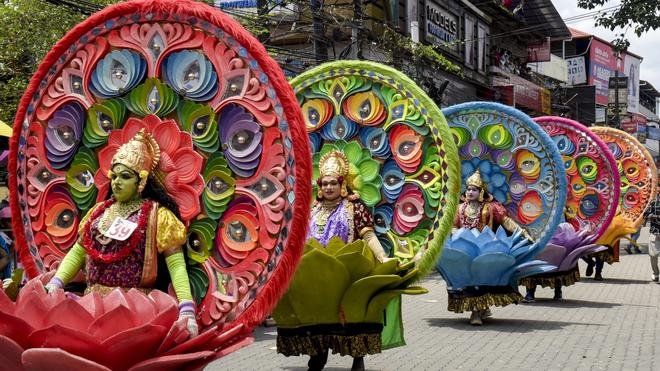
Onam 2026 is emerging as more than a festival of harvest, family gatherings and traditional rituals. Across India, chefs, designers and cultural creators are finding new ways to interpret Kerala’s heritage through food and fashion, bringing the visual language and flavours of Onam into contemporary life.
The familiar symbols remain instantly recognisable: the banana leaf spread with an elaborate sadya, the elegance of the kasavu saree and mundu, floral pookkalams, traditional motifs and the spirit of community. What is changing is the way these traditions are being presented and experienced.
Chefs are experimenting with familiar ingredients and regional flavours, while designers are exploring new silhouettes, textures, weaving techniques and styling ideas inspired by Kerala’s traditional textiles. The result is an Onam celebration that looks firmly rooted in the past while speaking to a younger, more design-conscious generation.
Why Onam continues to evolve
Tradition is often imagined as something that must remain unchanged. But cultural traditions have historically evolved with the communities that practise them.
Onam is a particularly strong example. The festival has travelled with Malayali communities across India and around the world, adapting to different homes, cities, workplaces and social settings while retaining its core identity.
Modern interpretations of Onam therefore do not necessarily represent a departure from heritage. In many cases, they are a way of keeping that heritage relevant.
A chef who presents a familiar Kerala ingredient in a new format and a designer who reworks the traditional kasavu aesthetic are both engaging with the same question: How can something deeply traditional remain meaningful in a changing world?
Onam sadya gets a contemporary makeover
The Onam sadya remains one of the festival’s strongest culinary symbols. Traditionally served on a banana leaf, the vegetarian feast brings together a wide range of dishes that balance sweetness, sourness, spice, bitterness and richness.
For contemporary chefs, the sadya offers an extraordinary canvas for experimentation.
Instead of abandoning traditional flavours, modern interpretations can focus on presentation, portioning, ingredient combinations and cooking techniques. Familiar dishes may be served in more contemporary formats while retaining the flavour profiles associated with Kerala’s culinary traditions.
This approach has an important advantage: it introduces the cuisine to diners who may not have grown up with a traditional sadya.
The experience becomes a bridge between generations. Older diners recognise familiar flavours, while younger audiences encounter those flavours in a format that feels fresh.
The power of Kerala’s ingredient palette
One reason Kerala cuisine adapts so effectively to contemporary cooking is the strength of its ingredient vocabulary.
Coconut, curry leaves, black pepper, ginger, tamarind, mustard seeds, chillies, banana, jackfruit and a wide variety of locally used vegetables provide chefs with an extensive foundation for experimentation.
Many of these ingredients are already associated with wellness, regional agriculture and sustainable cooking, giving contemporary chefs several ways to reinterpret them without disconnecting the dishes from their origins.
The challenge is maintaining the identity of the original cuisine while avoiding the temptation to turn every traditional dish into something unrecognisable.
Why the banana leaf still matters
The banana leaf is not simply a decorative replacement for a plate during Onam. It is part of the cultural experience of the sadya.
The arrangement of dishes, the order in which food is served and the communal nature of the meal all contribute to the experience.
Modern dining formats may change the presentation, but the banana leaf remains a powerful visual reminder of the traditional feast.
It also represents an approach to dining in which the meal itself becomes an event rather than simply a collection of individual dishes.
Modern Onam fashion is rewriting the traditional wardrobe
Food is only one part of the Onam transformation. Traditional Kerala clothing is also being reinterpreted for contemporary wardrobes.
The kasavu saree, recognised for its light fabric and characteristic golden border, remains one of the most recognisable elements of Kerala festive fashion.
But today’s designers are increasingly exploring how the visual language of kasavu can move beyond the conventional saree.
Contemporary collections may experiment with blouse designs, draping styles, layered separates, dresses, jackets, skirts and coordinated outfits while retaining traditional colours, borders or weaving references.
The result is not necessarily a replacement for traditional attire. Instead, it expands the number of ways people can express their connection to Kerala’s textile heritage.
From kasavu borders to contemporary silhouettes
The golden border associated with Kerala’s traditional textiles has a strong visual identity. It can instantly suggest Kerala even when used on a modern silhouette.
This makes the kasavu aesthetic particularly adaptable.
A contemporary garment can retain the traditional border while changing its cut, length or styling. Designers can also experiment with proportion, layering and accessories to create outfits that work in urban settings without losing their regional character.
This evolution is especially relevant for younger consumers who may want to participate in Onam celebrations without necessarily wearing traditional clothing from head to toe.
Heritage does not have to mean formal
One of the biggest changes in festive fashion is the movement away from the idea that traditional clothing must always look formal.
Modern Onam styling can be minimal, relaxed or even experimental.
A traditional textile can be paired with a contemporary blouse. A classic mundu can be styled with a modern shirt. Traditional gold accents can be balanced with simpler accessories.
This flexibility makes heritage clothing easier to incorporate into everyday wardrobes.
It also changes the relationship younger consumers have with traditional textiles. Instead of wearing them only during festivals, they can become part of a broader personal style.
The growing appeal of regional Indian fashion
The reinvention of Onam fashion reflects a wider movement in Indian design.
Consumers are increasingly interested in clothing that carries a story, particularly when traditional craftsmanship is combined with contemporary design.
Regional textiles are benefiting from this shift because they offer something mass-produced fashion often lacks: a clear cultural identity.
Kerala’s weaving traditions, natural visual palette and distinctive gold-bordered textiles are therefore well positioned for reinterpretation by modern designers.
Food and fashion are telling the same story
The most interesting aspect of Onam 2026 may be the similarity between what is happening in kitchens and what is happening in fashion studios.
| Traditional heritage | Modern interpretation | What remains constant |
|---|---|---|
| Onam sadya | Contemporary presentation and new culinary formats | Kerala’s flavours and ingredients |
| Kasavu saree | Modern silhouettes and styling | Traditional textile identity |
| Kerala ingredients | Creative cooking techniques | Regional flavour profile |
| Traditional festive dressing | Minimal and urban styling | Cultural motifs and textile references |
In both cases, the most successful reinterpretations are likely to be those that preserve the underlying identity while changing the format.
The fine line between innovation and cultural dilution
Modernising heritage also comes with a responsibility.
There is a difference between creative reinterpretation and stripping away the context that makes a tradition meaningful.
When traditional dishes are transformed beyond recognition or cultural motifs are used only as decorative elements, the connection to their origins can become weaker.
For chefs and designers, authenticity therefore does not necessarily mean reproducing the past exactly. It can mean understanding the history, ingredients, techniques and symbolism before changing them.
This is where thoughtful innovation becomes different from simply using “traditional” aesthetics as a marketing label.
Why younger audiences are driving the change
Young consumers are increasingly comfortable moving between traditional and contemporary identities.
A person may wear a modern outfit to work and choose a traditional saree for an Onam celebration. Similarly, someone may enjoy a classic sadya at home while also seeking innovative Kerala-inspired dishes at a restaurant.
Social media has accelerated this exchange by making food presentation, fashion styling and cultural events highly visual.
Festive traditions can now be shared through photographs and short videos, allowing regional aesthetics to reach audiences far beyond Kerala.
This visibility can help cultural traditions travel, but it can also encourage superficial interpretations. The strongest cultural storytelling is therefore likely to come from creators who combine visual appeal with genuine knowledge of the traditions they are presenting.
Onam as a platform for culinary storytelling
A contemporary sadya can do more than feed guests. It can tell a story about Kerala’s agricultural landscape, seasonal ingredients and regional cooking traditions.
Each dish can reflect a different ingredient, technique or flavour tradition.
This storytelling approach also creates opportunities for restaurants and chefs to educate diners about the origins of ingredients and the cultural significance of the meal.
For people unfamiliar with Kerala cuisine, that context can make the dining experience considerably more meaningful.
Fashion can preserve craft while changing the form
The same principle applies to textiles.
Traditional weaving techniques can survive more effectively when there is a contemporary market for the fabrics. Designers who incorporate traditional materials into modern clothing can help create new demand while introducing younger consumers to regional craftsmanship.
However, this requires attention to the people behind the textile. Supporting genuine weaving communities and maintaining the quality and identity of traditional fabrics is more meaningful than simply reproducing a visual imitation.
The future of heritage fashion may therefore depend on finding a balance between commercial relevance and respect for craftsmanship.
A new definition of festive luxury
Onam also reflects a changing idea of luxury.
For many modern consumers, luxury is increasingly associated with craftsmanship, authenticity, cultural meaning and individuality rather than simply expensive materials.
A handwoven textile with a recognisable regional identity can therefore carry a different kind of appeal from mass-produced festive clothing.
Likewise, a carefully prepared sadya built around high-quality regional ingredients can offer a sense of luxury through experience, tradition and hospitality rather than extravagance.
What Onam 2026 could mean for the future of heritage
The broader trend suggests that the future of Indian heritage may depend less on preserving traditions in a fixed form and more on allowing them to evolve responsibly.
If young people see traditional clothing as something they can style creatively and regional cuisine as something that can be explored rather than simply inherited, cultural practices have a stronger chance of remaining relevant.
The prediction for the years ahead is therefore not that traditional Onam celebrations will disappear. Instead, the festival may develop into an increasingly diverse cultural platform where classic and contemporary interpretations exist side by side.
Conclusion
Onam 2026 is showing how heritage can remain alive by changing with the people who celebrate it. Contemporary chefs are finding new ways to present the flavours of the sadya, while designers are transforming Kerala’s distinctive textile vocabulary into modern silhouettes and styling.
The most compelling part of this evolution is that it does not require tradition to compete with modernity. The two can coexist.
A familiar flavour can appear in a new presentation. A traditional kasavu border can become part of an entirely contemporary outfit. A centuries-old craft can find a new audience through modern design.
Ultimately, the future of Onam may belong to precisely this balance: preserving the cultural soul of Kerala while giving its traditions enough room to evolve.
For breaking news and live news updates, like us on Facebook or follow us on Twitter and Instagram. Read more on Latest Lifestyle on thefoxdaily.com.


COMMENTS 0