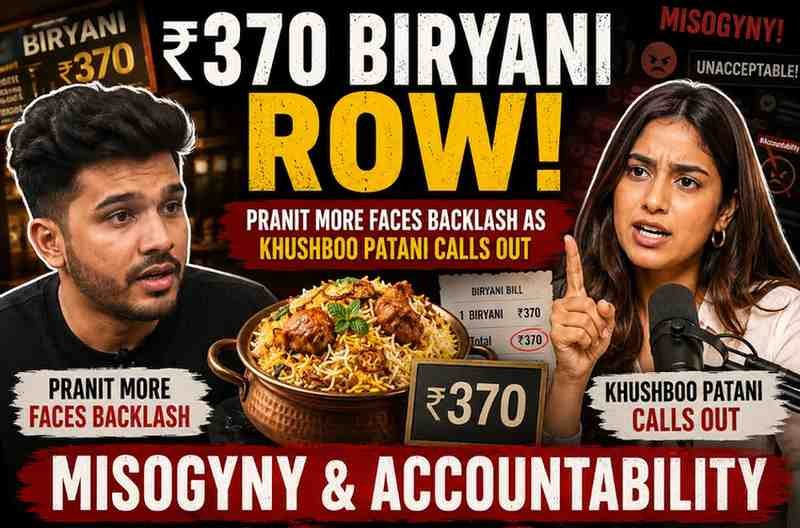
It started with a plate of chicken biryani worth ₹370. It ended with a comedian deactivating his Instagram account, a 23-year-old losing his job, and a national conversation about consent, misogyny, and the accountability of public entertainers that showed no sign of quieting down. The Controversy surrounding stand-up comedian Pranit More’s viral crowd-work clip is one of the most layered and consequential social media storms to hit Indian entertainment in recent memory and the voices calling for accountability now include Khushboo Patani, former Indian Army officer and elder sister of Bollywood actress Disha Patani, who did not mince words in her response.
Khushboo, who served as a Major in the Indian Army before becoming a fitness coach and entrepreneur, took to Instagram to call out Pranit More directly, describing the content he amplified on his platform as filth he chose to broadcast “Jo gandagi woh ugal raha tha” and questioning why a comedian with a significant public platform allowed such remarks to go unchallenged and then packaged them as entertainment for millions to consume. Her response added another powerful voice to a chorus of women and public figures who have refused to let this story die with a perfunctory apology.
What Actually Happened: The ₹370 Biryani Incident, Explained
Pranit More is a Mumbai-based stand-up comedian with over 2 million YouTube subscribers, a Bigg Boss Season 19 runner-up finish in 2025, and a growing reputation as one of India’s most engaging crowd-work performers. Crowd-work the practice of improvising comedy by interacting with individual audience members in real time is a format that thrives on spontaneity, authenticity, and the unpredictability of what ordinary people will say when handed a microphone in a comedy club.
During one such crowd-work segment, More called on a 23-year-old web developer from Gurugram named Himanshu Jangra. Jangra proceeded to recount a date he had been on, casually mentioning that he had spent ₹370 on a plate of chicken biryani for the woman. When she asked him to drive her home afterward implicitly declining to take things further Jangra’s framing suggested that the expenditure of ₹370 entitled him to something more. The implication was unmistakable: dinner paid equals physical intimacy owed.
The live comedy audience laughed. Pranit More laughed. He described it as a “Peak Gurgaon moment” and did not challenge Jangra’s framing at any point during the exchange. He then did something that elevated the moment from a regrettable live incident into a full-blown national controversy: he clipped the interaction, subtitled it, and posted it to his own Instagram feed, where it rapidly accumulated millions of views.
The Viral Fallout: When the Internet Stops Laughing
What played to a roomful of laughter did not play the same way to the internet. Within hours of the clip spreading beyond More’s own audience, the reaction was overwhelmingly one of outrage. The core criticism was not subtle: Jangra’s remarks treated a woman’s body as a commodity that could be purchased at the price of a biryani, reduced her refusal to an inconvenient breach of an implied transaction, and framed her saying no as something requiring explanation rather than acceptance.
The second wave of criticism was directed squarely at Pranit More not for what Jangra said, but for what More did next. He did not push back on stage. He did not use the moment to address the underlying entitlement on display. He laughed, called it a signature city moment, and then deliberately selected, edited, and uploaded the clip because he found it funny enough to share with his entire platform. The question that crystallized the debate was stark: if you find this content entertaining enough to post, in what meaningful sense do the views expressed in it not reflect yours?
Influencer and model Sakshi Shivdasani was among the first prominent voices to frame it this way on Instagram Stories, calling Pranit’s subsequent distancing “gross and disgusting” and pointing out the contradiction between claiming the audience member’s views do not represent your own while simultaneously distributing those views to millions. Her post resonated widely and opened the floodgates for further celebrity and public reactions.
Khushboo Patani’s Response: A Voice With Weight
Khushboo Patani’s entry into the conversation carries a specific kind of authority that purely celebrity reactions do not. She is not a Bollywood actress managing her image. She is a retired Army Major who built her post-service public profile around fitness, women’s empowerment, and a willingness to speak directly on social issues as she demonstrated earlier this year when she publicly called out dowry-related violence following the deaths of Twisha Sharma and Deepika Nagar.
Her condemnation of Pranit More went to the heart of the accountability question. The phrase “jo gandagi woh ugal raha tha” the filth he was spewing was applied not just to Himanshu Jangra’s remarks but to More’s decision to platform them, edit them, and present them as entertainment. Khushboo’s criticism focused on a failure of intervention: a man with a microphone, a stage, and an audience of thousands chose not to use any of that to challenge what was being said, and then actively chose to give that content a longer, wider life on social media.
For a former Army officer who has spoken consistently about women’s dignity and the culture of silence that enables harm, the issue was not simply about one comedian’s poor judgment. It was about what it means to hold a public platform and what you do with it when something genuinely harmful happens in real time in front of you.
The Real-World Consequences: Himanshu Jangra Loses His Job
The backlash carried consequences beyond social media debate. Himanshu Jangra’s employer, Starvik Design, announced the termination of his employment following the controversy. Company founder Vivek Vishwakarma issued a clear public statement: “The statements shown in those clips are offensive. They are not something I agree with. They are not something our company stands for.” Jangra subsequently deleted his social media accounts and issued a public apology.
The speed and decisiveness of that professional consequence became its own point of discussion. Sakshi Shivdasani noted that accountability in cases involving misogynistic behavior tends to arrive only after women collectively refuse to stay silent not as a matter of course, not through institutional action, but through sustained public pressure that makes staying silent more costly than acting. The biryani controversy bore that pattern out: the clip was up for some time before the volume of reaction forced a response from all parties.
Pranit More’s Apology And Why Many Rejected It
Facing mounting pressure, Pranit More issued a public apology in which he acknowledged that he should have challenged the audience member’s remarks during the show rather than laughing and moving on. He stated clearly that Jangra’s views did not represent his own beliefs about women, consent, or relationships.
The apology did not land well. The central problem was the same one critics had identified from the beginning: if the content genuinely did not represent More’s views, why did he clip it, subtitle it, and post it to his main social media channel? The act of uploading it was not passive. It was deliberate editorial curation. It required More to watch the clip back, judge it share-worthy, attach his brand to it, and distribute it. An apology that claims the content doesn’t reflect his views sits uneasily alongside that editorial chain of decisions.
Sakshi Shivdasani called the apology “hollow.” Khushboo Patani’s framing went further, characterizing the entire episode as an active choice to amplify content that degraded women rather than a moment of inaction that could be corrected with a belated statement. Ultimately, the backlash continued and intensified even after the apology, and Pranit More deactivated his Instagram account amid sustained pressure a move that itself became a story, read by many as an attempt to escape accountability rather than face it.
The Bigger Pattern: This Is Not the First Time
The biryani controversy does not exist in isolation. It sits within a recognizable pattern in Indian digital comedy what critics have called the long-running tradition of treating women’s refusals as punchlines and male entitlement as relatable content. The “friendzone” joke. The calculation of how much money a man spent before a woman said no. The framing of a woman’s bodily autonomy as an unfair economic outcome for a man who paid for dinner.
The Ranveer Allahbadia controversy earlier in 2025 put the question of what creators are responsible for on live digital platforms into sharp national focus. The biryani controversy brings it back to the more intimate, supposedly lower-stakes world of a crowd-work comedy club where the same dynamics of audience pressure, live performance adrenaline, and the incentive to chase laughter can produce moments that are subsequently given millions of impressions by the very performer who should have intervened.
The comedian’s defense that crowd-work is unpredictable, that audience members say what they say, that the performer cannot control what comes out of a stranger’s mouth is technically accurate and entirely insufficient. What performers can control is whether they challenge what is said, whether they sit with it and let it hang as entertainment, and whether they then actively choose to distribute it to a national audience. On all three counts, Pranit More’s choices in this instance failed the basic test of the responsibility that comes with a public platform.
What This Controversy Reveals About Indian Comedy’s Accountability Gap
India’s digital comedy ecosystem has grown explosively over the past decade, producing creators with audiences of millions who operate largely outside the editorial oversight structures that governed earlier entertainment formats. A stand-up comedian posting crowd-work clips to Instagram is not subject to a broadcaster’s standards department or a publication’s editorial board. The accountability, when it comes, is almost entirely social and as the biryani controversy demonstrates, it arrives inconsistently and often only after significant harm has already been distributed at scale.
The incident also surfaces a specific tension in crowd-work comedy: the format derives its appeal from authenticity and spontaneity, from the sense that what you are watching is real and unscripted. But when what is real and unscripted includes a man casually framing a woman’s refusal as a commercial breach of contract, the authenticity defense becomes a liability rather than an asset. The comedian’s job in that moment is not to preserve the authenticity of the audience member’s worldview. It is to use their platform to respond to it.
| Key Player | Role in Controversy | Action Taken |
|---|---|---|
| Himanshu Jangra | Audience member who made the ₹370 biryani remark | Lost job at Starvik Design; deleted social media; issued apology |
| Pranit More | Comedian who did not intervene on stage; posted clip online | Issued apology; deactivated Instagram account amid continued backlash |
| Sakshi Shivdasani | Model and influencer; first prominent voice to call out the hypocrisy | Publicly criticized More’s apology as hollow on Instagram Stories |
| Khushboo Patani | Former Army Major; Disha Patani’s elder sister | Condemned More for platforming harmful content; called the remarks “gandagi” |
| Starvik Design / Vivek Vishwakarma | Himanshu Jangra’s employer | Terminated Jangra’s employment; issued public statement distancing from the remarks |
Conclusion: ₹370 Is Not the Price of Anyone’s Consent
The ₹370 biryani controversy is, at one level, a story about a comedian who made a bad call in a crowd-work segment and then made a worse call by distributing it online. But the reason it has generated the response it has from a former Army officer, from influencers, from Jangra’s own employer is that it taps into something much deeper and much more persistent: the cultural habit of treating women’s choices about their own bodies as negotiable, transactable, and subject to audit by the men who paid for dinner.
Khushboo Patani’s voice in this debate matters not because of who her sister is but because of who she is: a woman who has served the country, built a platform around women’s dignity, and has demonstrated a consistent willingness to call out exactly the kind of institutional silence that allows this content to be produced, distributed, laughed at, and then apologized for without fundamental change. Her intervention, like Sakshi Shivdasani’s, represents the refusal to accept that a belated apology is a sufficient response to content that was deliberately chosen, carefully edited, and enthusiastically shared.
The biryani is ₹370. The conversation it has started is worth considerably more.
For breaking news and live news updates, like us on Facebook or follow us on Twitter and Instagram. Read more on Latest Entertainment on thefoxdaily.com.






COMMENTS 0