Introduction
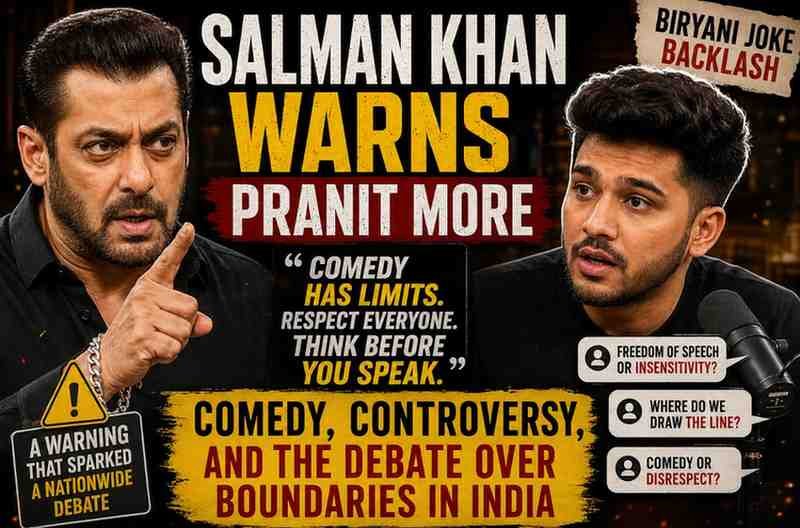
What happens when humor crosses the line and who gets to decide where that line is? This question resurfaced sharply when Bollywood superstar Salman Khan reportedly cautioned comedian Pranit More about his “below-the-belt” jokes. The moment quickly gained traction online, igniting debates across social media, comedy circuits, and entertainment circles.
The incident, which unfolded in a public-facing setting, wasn’t just about one joke or one warning. It highlighted a broader cultural tension: the clash between creative freedom and social responsibility. Who was involved? A veteran actor known for his mass appeal and a rising comedian pushing boundaries. What happened? A warning that not everyone would be “understanding” of certain types of humor. When and where? In an era dominated by viral content and instant backlash. Why does it matter? Because it reflects the evolving standards of comedy in India. And how does it affect audiences and creators? That’s exactly what this deep-dive explores.
Context: The Evolution of Comedy in India
To understand the significance of this moment, it’s important to look at how Indian comedy has transformed over the past two decades. From family-friendly stand-up acts and TV sketches to edgy, unfiltered digital content, the landscape has dramatically shifted.
Platforms like YouTube and Instagram have democratized comedy. Anyone with a microphone and an internet connection can now reach millions. This has encouraged experimentation—but also blurred the boundaries of acceptable humor.
Historically, mainstream Indian entertainment leaned toward safe, inclusive humor. Double entendres existed, but they were often subtle. Today, however, shock value and relatability often drive virality. This is where comedians like Pranit More find their audience young, urban, and digitally native.
The Key Moment: Salman Khan’s Warning Explained
Salman Khan’s caution wasn’t delivered as censorship it was framed more as a reality check. His core message? Not all audiences interpret humor the same way. What may seem funny to one group could be offensive to another.
This distinction is crucial. In a country as diverse as India, cultural sensitivities vary widely across regions, age groups, and social backgrounds. A joke that works in a metropolitan comedy club might not land well in a smaller town or a family setting.
Salman Khan, having spent decades in the public eye, understands this dynamic deeply. His warning reflects an awareness that public figures are constantly under scrutiny and that backlash can escalate quickly.
Why This Matters: The Real Issue Behind the Headlines
This incident is less about Salman Khan versus Pranit More and more about a systemic shift in how humor is consumed and judged.
1. The Rise of “Cancel Culture” in India
While the term originated in the West, its influence is now visible in India. Comedians, influencers, and even filmmakers have faced backlash for content deemed offensive. Social media amplifies outrage, often turning isolated jokes into national debates.
2. Comedy vs Responsibility
There’s a long-standing argument in comedy: should humor be completely unrestricted? Many comedians argue that comedy must challenge norms and provoke thought. However, critics point out that punching down targeting vulnerable groups can perpetuate harm.
3. The Celebrity Perspective
For someone like Salman Khan, whose audience spans generations, maintaining a broad appeal requires caution. His comment reflects a mainstream industry perspective, where inclusivity often outweighs edginess.
Comparison: Old-School Bollywood vs New-Age Digital Comedy
| Aspect | Traditional Bollywood Humor | Digital Comedy Era |
|---|---|---|
| Audience | Family-oriented, mass audience | Niche, targeted demographics |
| Content Style | Safe, subtle, widely acceptable | Bold, edgy, often provocative |
| Distribution | Cinema, television | Social media, streaming platforms |
| Risk Factor | Low | High (viral backlash possible) |
| Creative Freedom | Limited by censorship norms | Relatively unrestricted |
This contrast explains the generational divide in reactions. What older audiences may find inappropriate, younger viewers may see as honest and refreshing.
Deep Analysis: Where Is the Line in Comedy?
The real challenge lies in defining boundaries without stifling creativity. There’s no universal rulebook for humor, but some guiding principles have emerged globally:
- Punching up vs punching down: Jokes targeting those in power are generally more accepted than those targeting marginalized groups.
- Context matters: The same joke can be perceived differently depending on the setting and audience.
- Intent vs impact: A joke may not intend harm, but its impact can still be negative.
Salman Khan’s warning indirectly touches on all three. His message wasn’t “don’t joke” it was “be aware of consequences.”
Real-World Impact: What This Means for Creators
1. Content Strategy Will Evolve
Comedians and content creators may become more strategic in how they craft jokes. This doesn’t necessarily mean self-censorship—it could mean smarter storytelling.
2. Audience Segmentation Will Increase
Creators might tailor content for specific audiences rather than aiming for mass appeal. This reduces backlash but also limits reach.
3. Brands and Collaborations at Stake
Edgy humor can affect brand partnerships. Companies are increasingly cautious about associating with controversial figures.
Unique Insight: The Economics of Controversy
Here’s a perspective often missed in mainstream coverage: controversy can be both a risk and a growth strategy.
In the digital economy, attention equals currency. A controversial joke can lead to backlash but also massive visibility. Many creators knowingly walk this tightrope.
However, the sustainability of this strategy is questionable. Short-term virality doesn’t always translate into long-term credibility. Salman Khan’s warning, in this sense, can be seen as advice for longevity rather than restriction.
Prediction: The Future of Comedy in India
Looking ahead, Indian comedy is likely to move toward a hybrid model:
- More nuanced humor that balances boldness with sensitivity
- Greater awareness of cultural diversity
- Professionalization of digital creators
We may also see clearer distinctions between “mainstream” and “alternative” comedy spaces, allowing both to coexist without constant conflict.
Conclusion: A Moment Bigger Than a Warning
The exchange between Salman Khan and Pranit More is more than just a viral anecdote it’s a reflection of a cultural crossroads. As India’s entertainment landscape evolves, so do its expectations from creators.
The takeaway isn’t that comedy should be restricted. Rather, it should be intentional. In a world where every joke can be amplified to millions within seconds, awareness becomes as important as creativity.
Salman Khan’s caution serves as a reminder: humor is powerful, but with power comes responsibility. For comedians like Pranit More and countless others navigating the digital stage the challenge is not just to make people laugh, but to do so in a way that resonates without alienating.
And perhaps that’s the real art of modern comedy.<
For breaking news and live news updates, like us on Facebook or follow us on Twitter and Instagram. Read more on Latest Entertainment on thefoxdaily.com.






COMMENTS 0