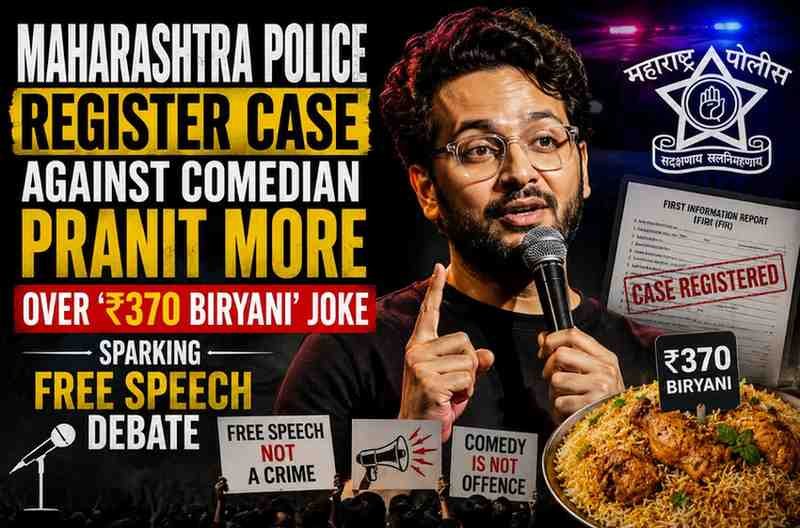
India’s stand-up comedy scene has often thrived on provocation, satire, and observational humour. But the line between comedy and controversy once again came under scrutiny after Maharashtra Police registered a case against comedian Pranit More and others over remarks made during a comedy show involving a reference to a “₹370 biryani”. The controversy gained momentum after clips from the performance circulated widely on social media, prompting strong reactions and eventually drawing the attention of the National Commission for Women (NCW).
The NCW took suo motu cognisance of media reports and viral videos, summoning Pranit More and fellow comedian Mr. Jangra to seek explanations regarding the remarks that allegedly offended sentiments and sparked criticism.
How a Viral Joke Became a Legal Matter
What might have remained a fleeting moment in a stand-up set quickly evolved into a national debate. Social media platforms amplified the clip, leading to outrage from various groups and demands for action.
Authorities subsequently registered a case, while the NCW initiated proceedings to examine whether the comments crossed acceptable boundaries.
The episode reflects how stand-up comedy in the digital era no longer remains confined to ticket-buying audiences. A joke intended for a live room can instantly reach millions, often detached from its original context.
The Expanding Reach—and Risks—of Viral Comedy
Modern comedians face challenges very different from those of previous generations. A single clip lasting a few seconds can shape public perception, regardless of the broader context in which it was delivered.
Social media algorithms reward controversy and outrage, ensuring that provocative moments spread rapidly.
This creates a difficult balancing act for performers:
- Pushing creative boundaries while avoiding legal complications.
- Maintaining artistic freedom without alienating audiences.
- Navigating diverse sensitivities in a highly connected society.
- Understanding that local performances can become national debates overnight.
Comedy and Controversy: A Familiar Relationship
Humour has historically challenged social norms and questioned authority. Stand-up comedy, in particular, often thrives on exaggeration, irony, and uncomfortable truths.
However, jokes that touch upon religion, gender, caste, or social identities frequently attract criticism and legal scrutiny.
India’s comedy ecosystem has witnessed several controversies over the years, illustrating how cultural expectations and humour often collide.
The Pranit More episode highlights the increasingly thin margin comedians must navigate between satire and public backlash.
Comparison: Stand-Up Comedy Before and After Social Media
| Earlier Era | Digital Era |
|---|---|
| Live audience only | Instant viral reach |
| Context remained intact | Clips circulate independently |
| Limited public reactions | Mass online outrage |
| Minimal legal attention | Rapid institutional involvement |
| Regional impact | National controversies |
The Role of the National Commission for Women
The National Commission for Women has increasingly taken suo motu cognisance of incidents that generate widespread public concern, particularly when comments are perceived as offensive or derogatory towards women.
By summoning Pranit More and Mr. Jangra, the Commission signalled that public figures and entertainers can be held accountable when their remarks trigger concerns about dignity and representation.
The case also demonstrates how institutions are responding more quickly to controversies amplified through social media.
Where Does Free Speech End and Responsibility Begin?
The controversy raises larger questions that extend beyond one comedian or one joke.
Supporters of artistic freedom argue that humour should not be interpreted literally and that comedy often relies on exaggeration and absurdity.
Critics counter that comedians, like all public figures, bear responsibility for how their words affect audiences.
The tension between these viewpoints has become one of the defining debates surrounding modern entertainment.
An Insight Competitors Often Miss: The Audience Has Changed Faster Than Comedy
Much of the discussion focuses on whether a joke was offensive. But perhaps the more significant shift lies in how audiences consume comedy.
Stand-up routines were once experienced in full, with context, tone, and audience interaction shaping interpretation.
Today, isolated clips stripped of setup and nuance often become the subject of public judgment.
This transformation means comedians are performing not just for audiences in a room, but for millions online—many of whom were never intended to hear the joke in the first place.
The medium itself has changed, and comedy is still adapting.
What This Means for India’s Stand-Up Industry
The industry has grown significantly over the past decade, with streaming platforms and digital content helping comedians reach wider audiences than ever before.
However, increased visibility also brings greater scrutiny.
- Legal complaints have become more common.
- Clips can go viral within hours.
- Public outrage can influence careers.
- Institutions are responding faster to controversies.
- Comedians are becoming more cautious about sensitive topics.
The challenge for creators will be preserving the spirit of satire and social commentary without losing sight of changing audience expectations.
Conclusion
The case against comedian Pranit More over the ‘₹370 biryani’ remark has evolved from a viral clip into a wider debate about humour, accountability, and free expression in the digital age. With Maharashtra Police registering a case and the National Commission for Women seeking answers, the controversy illustrates how quickly entertainment can intersect with law and public sentiment.
Beyond the immediate legal proceedings, the incident reflects a broader transformation in India’s comedy landscape. In an era where every joke can travel far beyond its intended audience, comedians and institutions alike are navigating a new reality one in which humour, responsibility, and public scrutiny are more intertwined than ever.
For breaking news and live news updates, like us on Facebook or follow us on Twitter and Instagram. Read more on Latest Entertainment on thefoxdaily.com.




COMMENTS 0