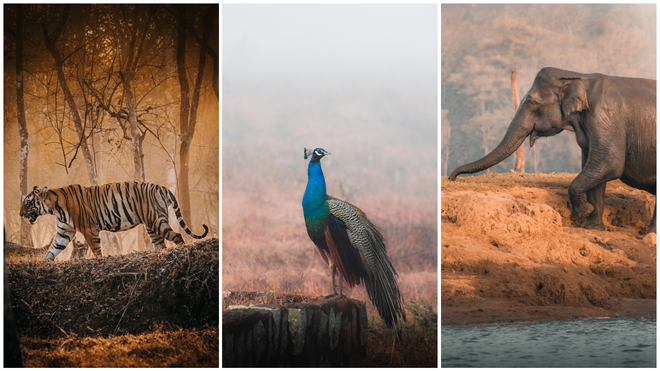
There is a particular kind of optimism that comes with entering a tiger reserve at dawn. You have barely left the gate and already the imagination has taken over. Somewhere beyond the trees, perhaps, a tiger is walking silently through the undergrowth. Maybe it will cross the track. Maybe it will pause in the open. Maybe, if luck decides to be unusually generous, it will look directly at the safari vehicle.
That was the plan at Nagarhole.
The reality, as it turned out, was far more interesting.
I went into the forest hoping to find a tiger and came away with sightings of otters, crocodiles, jackals and a remarkable variety of birds, along with the experience of travelling through a landscape transformed by the monsoon. The forest was green, wet, noisy in places and strangely quiet in others. Every bend seemed capable of producing something unexpected.
That is perhaps the best lesson of a wildlife safari: the forest does not know what you came to see.
Nagarhole: where the journey matters as much as the sighting
Nagarhole National Park, part of the larger Nilgiri Biosphere landscape in Karnataka, is one of southern India’s important wildlife habitats. Its forests connect ecologically with adjoining protected areas, creating a large landscape through which animals can move.
The reserve is particularly associated with elephants and tigers, but its ecological importance extends far beyond these charismatic species.
Leopards, wild dogs, sloth bears, deer, gaur, wild boar, crocodiles, otters and numerous bird species inhabit the wider landscape. Rivers and streams cut through forests and provide water for wildlife, while grasslands and forest clearings create feeding areas for herbivores.
That diversity changes the character of a safari. A tiger may be the headline, but it is only one part of the story.
The monsoon changes everything
Visiting Nagarhole during the monsoon creates an entirely different experience from the dry-season safari that many wildlife photographs have made familiar.
The forest becomes intensely green. Leaves appear brighter, streams fill and the smell of wet earth seems to accompany the vehicle throughout the drive.
The visual drama is obvious, but the ecological changes are even more important.
Rain replenishes water sources and triggers new plant growth. Herbivores have access to fresh vegetation, insects become abundant and the forest floor changes rapidly. Every shower can alter tracks and visibility.
For a visitor hoping to spot a tiger, however, there is a catch.
Dense vegetation can make large animals harder to see. Puddles and wet tracks can make driving slower. The animal may have no reason whatsoever to step into an open safari road simply because a tourist vehicle happens to arrive.
In other words, the monsoon makes the forest beautiful and the wildlife unpredictable.
The morning begins with expectation
Early morning is when the forest seems to hold its breath.
The light is softer, temperatures are cooler and the sounds of birds begin to build around the vehicle. The safari road cuts through vegetation that can look almost impenetrable from a distance.
Every movement becomes interesting.
A branch moving slightly could mean a bird. A sudden alarm call could indicate a predator. A herd of deer staring toward the forest can make everyone in the vehicle silently scan the same patch of trees.
This is the strange psychology of a tiger safari. You spend much of the drive searching for clues rather than animals.
Tracks, alarm calls, pugmarks, movement in grass and the behaviour of prey can all become pieces of an incomplete puzzle.
And then came the otters
The tiger did not appear on schedule. The river, however, had its own plans.
Along the water, a group of otters offered one of the most entertaining sightings of the trip. Their energy was completely different from the stillness associated with watching a big cat.
Otters move quickly, disappear beneath the surface and reappear seemingly wherever you least expect them. Their playful behaviour can easily turn a quiet riverbank into a miniature wildlife theatre.
It was also a reminder that rivers are not merely scenic elements in a forest.
They are ecological highways and life-support systems.
They provide drinking water, feeding grounds and habitat for aquatic species while also influencing the distribution and behaviour of animals across the surrounding forest.
A river safari reveals another Nagarhole
A conventional jeep safari gives you a ground-level view of the forest. A river safari changes the perspective completely.
From the water, the landscape appears less fragmented. Forest edges, muddy banks, exposed rocks and overhanging vegetation become part of a single living system.
It is also an excellent way to observe animals that are closely connected to aquatic habitats.
Crocodiles can remain almost invisible when they are motionless, blending into the riverbank until the shape of a head or eye gives them away. Birds gather around water because fish, insects and other food sources are concentrated there.
And then there are the fleeting sightings—the ones that last only a few seconds but remain in memory for years.
Crocodiles: masters of disappearing into the landscape
One of the pleasures of a river safari is learning how easily wildlife can hide in plain sight.
A crocodile lying beside the water may look like a fallen log until it moves. Once the eye learns what to look for, the riverbank begins to reveal more shapes.
This is one reason experienced guides are so important. Wildlife viewing is partly a skill of observation. Guides learn to notice movement, tracks, calls and patterns that inexperienced visitors can miss.
They also understand that a sighting is not worth disturbing an animal or compromising safety.
The jackal appears when you least expect it
Jackals do not have the same star status as tigers, but encountering one in the forest can be just as memorable.
They are adaptable predators and scavengers, capable of living in a wide range of habitats. Their presence tells a broader ecological story about the forest’s food web.
During a safari, an animal like a jackal also changes the mood of the vehicle.
Everyone may have been scanning the trees for stripes. Suddenly the focus shifts to a smaller predator moving across the landscape. Cameras come up. Conversations stop. The vehicle slows.
For a few minutes, the jackal becomes the most important animal in the forest.
The birdlife keeps the safari moving
If you spend enough time in Nagarhole, you quickly realise that a safari is as much a birdwatching experience as a search for mammals.
The forest supports an impressive variety of birds, from raptors and kingfishers to forest species that can be much harder to spot.
Bird calls also contribute to the atmosphere of the safari. Long before an animal becomes visible, the forest announces its presence through sound.
For visitors accustomed to urban noise, this can be one of the most striking changes. The sounds are layered but rarely chaotic: calls from the canopy, movement in the undergrowth, insects, water and the occasional distant alarm call.
The tiger remains the great unanswered question
Of course, there was still the tiger.
Every safari vehicle carries a little hope that it will be the one to receive the call over the radio: tiger nearby.
That hope can become almost comical. Vehicles pause at the slightest suggestion of movement. Binoculars are raised. Everyone looks into the same patch of vegetation.
Sometimes the forest rewards the patience.
Sometimes it does not.
And that is an important part of the wildlife experience. A tiger reserve is not a zoo. Animals are not placed at convenient locations for visitors. Their movements depend on food, water, temperature, territory, breeding behaviour and countless environmental variables.
A tiger sighting is therefore a privilege, not a guaranteed feature of the ticket.
Why not seeing a tiger can still mean a successful safari
This may be the most difficult lesson for first-time safari visitors.
Wildlife tourism often creates a hierarchy of sightings. Tiger first, leopard second, elephant third, and everything else somewhere below.
Ecologically, that hierarchy makes little sense.
An otter hunting in a river, a crocodile waiting motionless on a bank, a jackal crossing a track or a rare bird calling from the canopy can reveal just as much about the ecosystem as a tiger.
In fact, paying attention to smaller and less famous species can make a visitor more aware of how interconnected the forest really is.
The forest is a network, not a collection of animals
One of the strongest impressions from a Nagarhole safari is how dependent every sighting is on everything else.
Tigers depend on prey. Prey depend on vegetation and water. Vegetation depends on soil, rainfall and ecological processes. Rivers support aquatic life and influence where animals congregate.
Remove one part of the system and the effects can spread outward.
This is why protecting a tiger is ultimately about protecting an entire habitat.
The monsoon’s hidden advantage for wildlife tourism
Monsoon travel is sometimes considered less predictable because rain can disrupt plans. But that uncertainty is precisely what gives the experience its character.
The landscape is at its most vibrant. Water bodies become active, vegetation flourishes and the forest feels dramatically different from its dry-season appearance.
Photography also takes on a different quality. Wet leaves catch light, mist can soften distant views and dark clouds create dramatic skies.
But visitors should also understand that weather can change quickly and that wildlife visibility may be lower.
A safari is also a lesson in patience
There are stretches when nothing seems to happen.
The vehicle moves slowly. The road curves through trees. You scan the bushes. Nothing.
Then suddenly a bird flies across the track, deer raise their heads or movement appears near the river.
The rhythm is almost meditative.
In a world built around instant information and instant entertainment, wildlife watching demands the opposite: attention without immediate reward.
What responsible visitors should remember
A memorable safari should not come at the expense of the animals being watched.
- Follow park and guide instructions at all times.
- Do not shout or play loud music to attract wildlife.
- Never attempt to feed animals.
- Do not pressure drivers to leave designated routes or approach animals too closely.
- Avoid littering, including food wrappers and plastic bottles.
- Use photography equipment responsibly and avoid disturbing animals for a better picture.
The best wildlife photograph is one that records an authentic moment without changing the behaviour of the animal.
The real luxury of Nagarhole is unpredictability
Luxury wildlife tourism is often associated with comfortable lodges, private vehicles and carefully planned itineraries. Those things can certainly improve the experience.
But the real luxury is something no lodge can guarantee.
It is uncertainty.
You can spend hours searching for a tiger and find a family of otters instead. You can expect silence and hear a forest full of birds. You can follow a river expecting scenery and discover crocodiles watching from the bank.
The forest refuses to follow the itinerary.
Prediction: the best wildlife experiences will move beyond the “Big Five” mindset
As wildlife tourism matures, visitors are likely to become more interested in complete ecosystem experiences rather than collecting a checklist of famous animals.
That shift would benefit places such as Nagarhole. A forest does not need a tiger sighting every morning to be extraordinary. Its ecological value lies in the entire network of species and habitats that coexist there.
Visitors who understand this are likely to leave with a deeper appreciation of conservation rather than simply a photograph for social media.
Conclusion
I went into Nagarhole looking for a tiger.
I found something more unpredictable: a forest that refused to perform on demand.
There were otters moving through the river, crocodiles almost disappearing into the banks, a jackal making a brief appearance and birds constantly reminding us that the canopy was alive. The monsoon had transformed the landscape into a lush, breathing world where every turn carried the possibility of discovery.
The tiger, as it happens, became almost secondary.
That is the beauty of a wildlife safari. The forest does not owe visitors a sighting. It offers something better: the opportunity to pay attention.
And sometimes, when you stop insisting on seeing the animal you came for, you begin to see the jungle itself.
For breaking news and live news updates, like us on Facebook or follow us on Twitter and Instagram. Read more on Latest Lifestyle on thefoxdaily.com.

COMMENTS 0