Pakistan has warned Yemen’s Houthi movement that the newly signed Mecca Joint Defence Agreement could be activated if fighting spills into Saudi Arabia, sharply raising the stakes after a wave of Houthi missile and drone attacks struck targets across the kingdom.
Pakistan Defence Minister Khawaja Asif said there should be “no ambiguity” over the mutual-defence commitment agreed by Pakistan, Saudi Arabia and Türkiye. Under the pact signed in Makkah on August 7, an armed attack against any one of the three countries is to be regarded as an attack against all three.
Asif stressed that the agreement is defensive rather than an authorization for Pakistan, Saudi Arabia and Türkiye to launch offensive military operations against another country on their own initiative. But he made clear that an attack on Saudi territory could trigger the collective-defence mechanism.
His warning came after Iran-aligned Houthi forces launched coordinated attacks on several locations in southern Saudi Arabia. Saudi authorities said at least 73 civilians were injured, while energy and military-related sites were among the targets.
The timing gives the relatively new defence pact its first major real-world test and raises a difficult question: how will the three countries interpret their mutual-defence commitment if attacks originating from Yemen continue to hit Saudi territory?
What did Khawaja Asif say about the Mecca defence pact?
In an interview with Geo TV, Asif said the terms of the agreement should be understood plainly: an act of aggression against one member state would activate the collective-defence commitment.
He specifically referred to the possibility of the Yemen conflict spilling over into Saudi Arabia and said that such circumstances could make the agreement operative.
“There should be no ambiguity,” Asif said, emphasizing that Pakistan was bound by the terms of the pact and would honour its commitments to Saudi Arabia if the conditions requiring a response were met.
At the same time, he avoided suggesting that the agreement automatically means Pakistan would launch an attack against the Houthis. He stressed that the pact is fundamentally defensive.
That distinction is important because the treaty’s existence does not necessarily predetermine the form of any response. Collective defence could involve military assistance, intelligence, air-defence support, logistics or other measures depending on the circumstances and the decisions taken by the three governments.
What exactly does the Mecca agreement say?
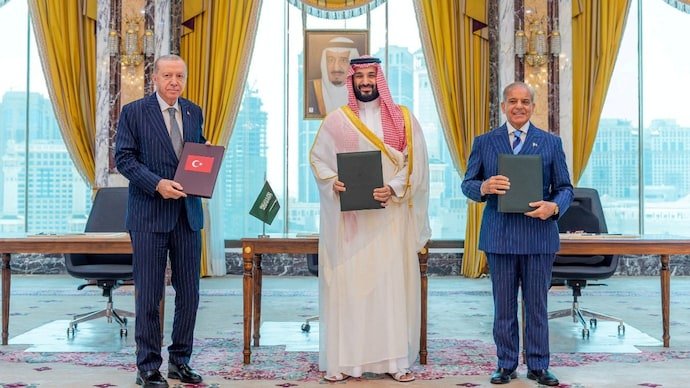
The Makkah Joint Defence Agreement was signed on August 7 by Saudi Crown Prince and Prime Minister Mohammed bin Salman, Turkish President Recep Tayyip Erdoğan and Pakistani Prime Minister Shehbaz Sharif.
The agreement is designed to strengthen collective deterrence and defence cooperation among the three countries. Its central provision states that an armed attack against any one of them will be considered an attack against all.
The arrangement also calls for broader cooperation across defence fields rather than creating a narrow alliance focused on one specific threat.
Plans include stronger coordination, joint military activities and cooperation in areas such as air defence, unmanned systems, electronic warfare and defence technology.
The agreement has sometimes been compared politically with collective-defence arrangements such as NATO’s Article 5 because of its “attack on one, attack on all” principle. But that does not mean the Mecca pact is identical to NATO. It has its own political and legal framework, and the partners have emphasized its defensive character.
Why the Houthi attacks have changed the stakes
The defence agreement was signed only about a month before the latest escalation involving Saudi Arabia.
On September 8, Houthi forces launched a large wave of missiles and drones against multiple locations in southern Saudi Arabia. Saudi authorities said civilian sites and economic Infrastructure were hit, while Reuters reported damage and operational disruption at energy facilities.
The cities targeted included Abha, Jizan, Najran and Khamis Mushait. Energy installations associated with Saudi oil giant Aramco were among the sites targeted, while Khamis Mushait is also home to important Saudi military infrastructure.
The attacks reportedly injured 73 people, including women and children, according to Saudi authorities.
That scale matters because the attacks were not limited to remote border areas. They demonstrated an ability to reach populated locations and strategically important infrastructure deeper inside Saudi territory.
For Riyadh, the incident is therefore both a National Security problem and an economic one.
Saudi Arabia’s energy infrastructure makes the escalation more dangerous
Saudi Arabia is one of the world’s most important oil producers, making attacks on its energy infrastructure significant far beyond the immediate military confrontation.
Any sustained disruption to oil production, refining or transportation can affect Global energy markets because Saudi Arabia remains a major supplier and holds substantial influence over available global production capacity.
The latest attacks contributed to another rise in oil prices as traders reacted to the possibility of a wider regional conflict affecting energy infrastructure.
That is why the Houthi strikes have implications not only for Saudi Arabia and Yemen but also for Asian economies, European consumers and global businesses that depend on relatively stable oil supplies.
A prolonged campaign against Saudi energy facilities could create pressure well beyond the battlefield, particularly if other regional actors become involved.
Asif says Pakistan does not want an offensive war
While warning that the Mecca pact could become operative, Asif carefully emphasized that it should not be interpreted as a declaration of offensive intent.
He said the three countries would not simply decide on their own to attack another state under the agreement. The pact, in his description, exists to respond to aggression against one of its members.
That position allows Pakistan to signal strong support for Saudi Arabia without openly committing itself to an offensive campaign inside Yemen.
It also reflects Islamabad’s traditionally cautious position on Middle Eastern conflicts. Pakistan has maintained close military and political ties with Saudi Arabia but has historically been reluctant to become directly involved in every regional conflict.
For Pakistan, that balancing act is particularly important because its relationships with Gulf Arab states coexist with diplomatic and geographic realities involving Iran and the wider Muslim world.
Why Pakistan is taking Saudi Arabia’s security seriously
Pakistan and Saudi Arabia have maintained deep defence ties for decades.
Pakistani military personnel have historically provided training and advisory support in Saudi Arabia, while the two countries conduct defence cooperation and exercises. Saudi Arabia is also an important economic partner for Pakistan and a key destination for Pakistani workers.
Türkiye adds another significant military power to the arrangement. Ankara has developed a substantial indigenous defence industry and has expanded cooperation with both Pakistan and Saudi Arabia.
The three-way pact therefore combines Pakistan’s military capabilities and personnel base, Saudi Arabia’s strategic geography and resources, and Türkiye’s expanding defence-industrial capacity.
The agreement also gives each country a mechanism for closer consultation if its security is threatened.
Türkiye’s role could become increasingly important
Türkiye is not a direct participant in the Yemen war, but its involvement in the Mecca pact gives the agreement a wider geopolitical dimension.
Ankara has substantial military capabilities, including drones, missiles, air-defence systems and a growing domestic defence industry. Türkiye has also maintained an active diplomatic role across the Middle East.
For Riyadh and Islamabad, Turkish participation broadens the strategic reach of their defence relationship.
For Türkiye, the pact provides another platform for strengthening ties with two major Muslim-majority states while expanding its role in regional security.
The three countries have also agreed to institutionalize cooperation through political and defence mechanisms, meaning the relationship is intended to extend beyond the signing ceremony.
The Houthis say their attacks are retaliation
The Houthi movement has presented the latest Saudi strikes as retaliation for Saudi military action in Yemen.
Houthi officials said the attacks were a response to Saudi airstrikes against areas under Houthi control. The group also accused Saudi Arabia of conducting an airstrike on a prison in northern Yemen on September 7.
Those accusations were made by the Houthis and should be distinguished from independently verified assessments of the incident.
The broader pattern is clear, however: military action by Saudi Arabia inside Yemen is being met with attempts by the Houthis to impose costs inside Saudi territory.
That creates the precise kind of escalation Pakistan is warning against. If attacks remain confined to Yemen, the Mecca pact may remain largely a deterrent instrument. If they become sustained attacks on Saudi territory, the agreement’s collective-defence language becomes much more consequential.
Who are the Houthis and why are they fighting Saudi Arabia?
The Houthis, formally known as Ansar Allah, are a Yemeni armed and political movement that emerged from the country’s Zaidi Shia community.
The group seized control of large parts of northern Yemen, including the capital Sanaa, in 2014. In 2015, Saudi Arabia led a coalition that intervened militarily in support of Yemen’s internationally recognized government.
The conflict subsequently became one of the Middle East’s most complicated wars, involving domestic Yemeni factions as well as regional and international powers.
Iran has provided political and military support to the Houthis, although the exact scale and nature of that support has been a subject of continuing international debate.
A UN-brokered truce in 2022 significantly reduced cross-border fighting between Saudi Arabia and the Houthis, but it did not permanently resolve the underlying conflict.
The renewed attacks demonstrate how quickly a conflict that appeared to be entering a period of relative restraint can expand again when regional tensions rise.
The Yemen conflict is now linked to a wider Middle East crisis
The latest escalation cannot be viewed entirely in isolation from the wider confrontation involving Iran, the United States and their regional partners.
The Houthis have long used their ability to launch missiles and drones as part of their broader regional strategy. Their attacks have also affected Shipping through the Red Sea, creating risks for one of the world’s important trade corridors.
That gives the Yemen conflict significance far beyond the country’s borders.
If fighting intensifies simultaneously across Yemen, Saudi Arabia and the Red Sea, the resulting crisis could create pressure on energy supplies, shipping routes and military deployments throughout the region.
It could also place Pakistan and Türkiye under increasing pressure to clarify how far they are prepared to go to defend Saudi Arabia.
Does the pact automatically mean Pakistan will send troops?
Not necessarily.
Asif’s comments establish Pakistan’s political commitment under the agreement, but they do not specify what form a response would take in every possible scenario.
Collective-defence agreements can involve different forms of assistance depending on the nature and severity of an attack. A member state could request military support without necessarily requiring another member to launch offensive operations.
Air-defence assistance, intelligence sharing, surveillance, logistical support, cyber capabilities or military deployments could all theoretically form part of a response, subject to the agreement’s terms and the decisions of the participating governments.
That gives Pakistan political room to support Saudi Arabia while avoiding an immediate commitment to a large-scale ground war in Yemen.
“We don’t need to respond to a brick with a stone”
Asif’s language also suggested that a response to aggression would not necessarily be immediate retaliation in kind.
He said the combined military capabilities of Pakistan, Saudi Arabia and Türkiye could themselves serve as a deterrent and argued that the three countries did not necessarily have to answer every action with an equivalent military strike.
That distinction between deterrence and retaliation is crucial.
The purpose of a collective-defence pact is partly to convince a potential attacker that the costs of attacking one member will be much greater than the apparent benefit. If that threat is credible, the alliance can potentially prevent escalation rather than merely respond to it.
But deterrence can fail when an adversary believes the members are unwilling to act. The latest Houthi attacks therefore present an early test of whether the pact’s language will influence the group’s calculations.
The biggest risk is an escalation cycle
A continuing cycle of Houthi attacks on Saudi territory and Saudi retaliation inside Yemen could quickly become difficult to contain.
The more damage inflicted on Saudi infrastructure, the greater the domestic pressure on Riyadh to respond. Stronger Saudi military operations could in turn motivate more Houthi attacks.
If those attacks cause mass civilian casualties or significant damage to strategic energy infrastructure, pressure on Pakistan and Türkiye to demonstrate solidarity could increase.
That is the scenario the Mecca agreement appears designed to deter, but it is also the scenario that could place the greatest strain on the new alliance.
Pakistan’s Iran balancing act
Another complication is Pakistan’s relationship with Iran.
Pakistan shares a long land border with Iran and has sought stable relations with Tehran despite periods of tension. At the same time, Islamabad maintains close strategic ties with Saudi Arabia and now has a formal defence commitment with Riyadh.
Pakistan therefore has an interest in preventing a wider confrontation in which it is forced to choose between regional partners.
Asif’s comments reflect that balancing strategy. He warned the Houthis against exporting the Yemen conflict but also expressed hope that the situation could be resolved through diplomatic efforts.
That combination allows Islamabad to reinforce its commitment to Saudi security while avoiding rhetoric that would unnecessarily widen Pakistan’s dispute with Iran.
Why Saudi Arabia may prefer deterrence to a wider war
Saudi Arabia has significant military resources, but a prolonged war in Yemen also carries substantial costs.
The kingdom has invested heavily in economic diversification and infrastructure under its Vision 2030 strategy. A sustained conflict that threatens major cities, tourism projects, airports or energy facilities could undermine the stability and investor confidence Saudi Arabia is trying to build.
Riyadh therefore has a strong incentive to deter attacks without becoming trapped in another long-running ground conflict.
The Mecca pact potentially strengthens that strategy by demonstrating that an attack on Saudi Arabia could bring additional military and political capabilities into the equation.
The strongest version of the agreement’s value may therefore be measured by whether it prevents future attacks rather than by whether it ultimately has to be used.
What happens if the Yemen conflict continues to spill over?
Much will depend on the scale and frequency of future attacks.
A limited incident could be handled primarily through Saudi air defences and diplomatic channels. Repeated attacks causing substantial civilian or infrastructure damage would create a much more serious test for the Mecca pact.
Another important factor is whether the attacks remain attributable to the Houthis or become connected more directly to another state actor. The political consequences would be considerably different if Saudi Arabia or its allies concluded that a state government was directly involved.
For Pakistan, the key issue will be interpreting exactly what constitutes an armed attack under the agreement and determining what response is both necessary and proportionate.
The pact is already changing regional calculations
Even before any military response is required, the Mecca agreement has already altered the strategic Environment.
Saudi Arabia now has a formal defence relationship with Pakistan and Türkiye that can be invoked in the event of an armed attack. For potential adversaries, that raises the expected cost of directly targeting Saudi territory.
For Pakistan, the pact transforms its relationship with Saudi Arabia from close bilateral defence cooperation into a trilateral collective-security framework.
For Türkiye, it creates another avenue for projecting diplomatic and strategic influence in the Middle East.
The arrangement is therefore significant even if no troops are ever deployed under its collective-defence clause.
A new test for the “attack on one, attack on all” principle
The Houthi strikes have arrived at precisely the moment when the Mecca Joint Defence Agreement is still new enough for its deterrent value to be uncertain.
Pakistan has now publicly clarified that an armed attack on Saudi Arabia can bring the pact into operation. At the same time, Islamabad insists that the agreement is defensive and does not automatically authorize offensive action against another country.
That is a carefully calibrated position. It strengthens the warning to the Houthis while leaving the three member states flexibility over how they would respond.
The next phase will depend on whether the warning changes Houthi calculations and whether Saudi Arabia can prevent further attacks on its territory.
What the latest warning means for the Middle East
Khawaja Asif’s statement has turned the Mecca defence pact from a newly signed diplomatic agreement into a live factor in the region’s security calculations.
Pakistan, Saudi Arabia and Türkiye have formally committed to treating an armed attack against one member as an attack against all. The Houthi strikes have now created the first major situation in which that principle could become relevant.
But invoking collective defence does not automatically mean a new three-country war. Asif has explicitly described the pact as defensive and suggested that deterrence, rather than immediate military retaliation, is the preferred outcome.
The larger danger is that repeated attacks and counterattacks could remove that room for manoeuvre. A prolonged Houthi campaign against Saudi cities or energy infrastructure could make it increasingly difficult for Riyadh’s partners to remain on the sidelines.
For now, Pakistan is sending a clear message: the Yemen conflict must not be allowed to spill into Saudi Arabia. If it does, Islamabad says the Makkah pact will no longer be merely a political symbol. Its collective-defence provisions could become an active part of the regional response.
For breaking news and live news updates, like us on Facebook or follow us on Twitter and Instagram. Read more on Latest World on thefoxdaily.com.



COMMENTS 0