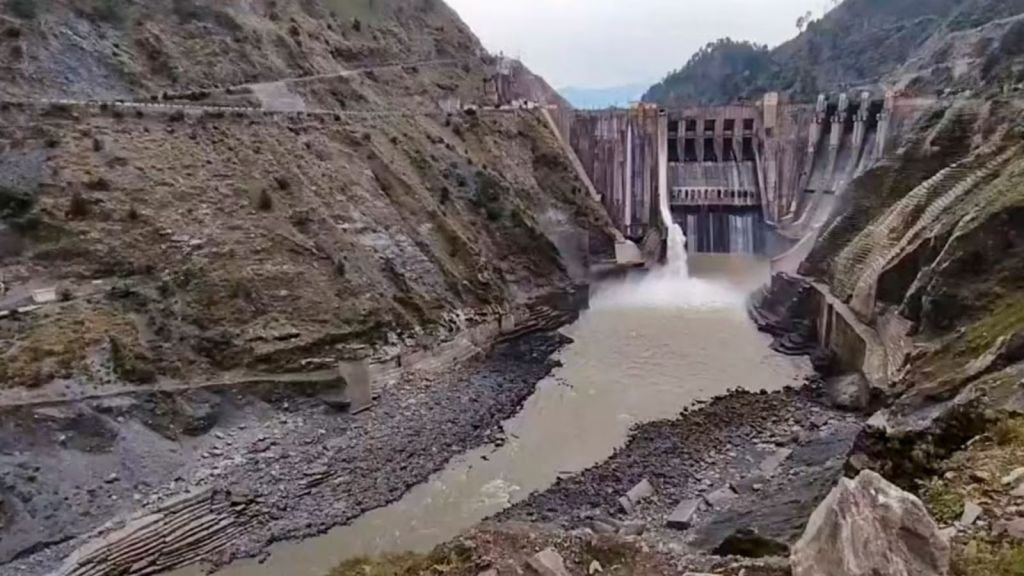
India has rejected a major ruling by the Court of Arbitration in The Hague concerning the Indus Waters Treaty, saying the tribunal has no jurisdiction to rule on India’s sovereign decision to keep the water-sharing agreement with Pakistan in abeyance.
The dispute has added another layer to already strained India-Pakistan relations. The Permanent Court of Arbitration said on August 31 that the Indus Waters Treaty remains fully in force and that India must continue observing its obligations under the agreement, including rules governing the design and operation of hydroelectric projects on the western rivers.
India, however, has refused to recognise the authority of the tribunal involved in the proceedings. The Ministry of External Affairs said the so-called Court of Arbitration was illegally constituted and that its latest pronouncement would have no effect on India’s actions.
The disagreement is therefore not simply about water-sharing rules. At its core is a clash over whether the arbitration process itself has legal authority over the treaty after India announced in April 2025 that it would hold the agreement in abeyance.
What did the Court of Arbitration decide?
The Court of Arbitration concluded that India’s decision to place the Indus Waters Treaty in abeyance was not permissible under the treaty or applicable international law.
In its latest decision, the tribunal said the agreement remained in force and that India continued to have obligations under it. Those obligations include provisions governing Indian hydroelectric projects on the Western Rivers.
The latest proceedings also involved interim measures concerning the Ratle hydroelectric project in Jammu and Kashmir. Reuters reported that the tribunal ordered restrictions on construction of the dam wall and power intake structure above specified levels while a neutral expert assesses whether the projects comply with the treaty.
The neutral expert, appointed through a process involving the World Bank, is expected to deliver a decision by July 2027. The interim restrictions are linked to the tribunal’s assessment of the dispute-resolution process and are therefore separate from the broader political disagreement between India and Pakistan over the treaty’s status.
The ruling is significant because it directly addresses the legal effect of India’s April 2025 decision rather than merely dealing with technical questions about hydroelectric project design.
Why India says the tribunal has ‘no jurisdiction’
India’s response rests on a fundamental objection: New Delhi does not recognise the Court of Arbitration as having jurisdiction over the matter.
The Ministry of External Affairs described the body as an “illegally constituted” Court of Arbitration and said India has never recognised its legal existence. New Delhi has also refused to participate in the proceedings before the tribunal.
The MEA argued that the tribunal was constituted in breach of the terms of the Indus Waters Treaty and that its pronouncements therefore have no legal effect on India’s sovereign decisions.
India’s position has remained consistent throughout the arbitration. It has previously argued that the dispute-resolution mechanism initiated by Pakistan should not proceed in parallel with another process under the treaty.
This is an important distinction. India is not simply disputing the tribunal’s interpretation of a particular provision. It is challenging the tribunal’s authority to hear and decide the dispute in the first place.
Why the Court of Arbitration says it can proceed without India
The tribunal has taken the opposite position.
According to the Permanent Court of Arbitration’s case record, Pakistan initiated the arbitration in 2016 under the dispute-resolution provisions of the Indus Waters Treaty. The Court of Arbitration was constituted in 2022 in accordance with Annexure G of the treaty.
India has not participated in the arbitration proceedings and has repeatedly challenged the tribunal’s competence.
However, the Court of Arbitration previously ruled in July 2023 that it was properly constituted and competent to decide the disputes submitted to it. In June 2025, it issued a supplemental award on competence and concluded that India’s April 2025 announcement that the treaty would be held in abeyance did not remove the tribunal’s jurisdiction.
The tribunal has therefore continued to treat the proceedings as legally valid even though India has refused to participate.
| Issue | India’s position | Court of Arbitration’s position |
|---|---|---|
| Status of the arbitration | India does not recognise the tribunal as legally constituted | The tribunal says it was properly constituted under the treaty |
| India’s April 2025 decision | The decision to hold the treaty in abeyance remains in force | The treaty does not permit India to suspend or terminate it on those grounds |
| India’s participation | India has refused to appear before the tribunal | The tribunal says India’s non-participation does not remove its competence |
| Hydroelectric projects | India says the tribunal’s pronouncements have no effect on its actions | The tribunal says treaty obligations concerning Western River projects remain applicable |
Why India put the Indus Waters Treaty in abeyance
India’s decision dates back to April 2025, following the Pahalgam terrorist attack in Jammu and Kashmir.
On April 23, 2025, the Cabinet Committee on Security decided that the Indus Waters Treaty of 1960 would be held in abeyance with immediate effect until Pakistan “credibly and irrevocably” stopped supporting cross-border terrorism, according to the Indian government’s stated position.
The move marked a major departure from the treaty’s long history.
The Indus Waters Treaty was signed by India and Pakistan in September 1960 with the World Bank’s involvement. It established a framework for sharing the waters of the Indus river system and allocated the eastern rivers and western rivers between the two countries subject to specified rights and restrictions.
Despite wars and repeated periods of severe political tension, the treaty remained in operation for decades.
India’s decision to place it in abeyance therefore represented a significant change in the relationship between the two countries and brought the treaty into the centre of the wider India-Pakistan security dispute.
How the Indus Waters Treaty works
To understand why the current dispute matters, it is necessary to understand the basic structure of the treaty.
The agreement divides the six major rivers of the Indus river system into two groups. The eastern rivers are the Ravi, Beas and Sutlej, while the western rivers are the Indus, Jhelum and Chenab.
Broadly, the treaty gives India unrestricted use of the eastern rivers, while Pakistan receives the principal use of the western rivers, subject to specific provisions allowing India certain uses of the western rivers.
Those permitted uses include limited domestic, agricultural and hydroelectric activities, provided projects meet technical requirements laid down by the treaty.
This is why hydroelectric projects have become such a recurring source of disagreement. India can develop run-of-river hydroelectric facilities on the western rivers, but the treaty places restrictions on how such projects can be designed and operated.
The dispute involving projects such as Ratle and other facilities in Jammu and Kashmir has therefore focused heavily on engineering specifications, reservoir capacity, pondage and the operational flexibility available to India.
Why the Ratle project is at the centre of the latest dispute
The Ratle hydroelectric project is located on the Chenab River in Jammu and Kashmir, one of the western rivers covered by the treaty.
Hydroelectric development on the western rivers is particularly sensitive because India’s permitted use of these rivers is governed by detailed treaty provisions.
Pakistan has challenged aspects of Indian hydroelectric projects, arguing that certain design features could give India greater control over water flows than permitted under the agreement.
India, meanwhile, has maintained that its projects comply with the treaty and has objected to the arbitration process being used to decide the matter.
The latest interim order means that construction at Ratle is now connected to the tribunal’s wider process. Reuters reported that the restrictions will remain in place until after the neutral expert’s decision and an additional 90-day period specified by the order.
That creates a practical consequence even though India rejects the tribunal’s jurisdiction: the dispute could continue to affect the legal and diplomatic Environment surrounding major Hydropower projects in the region.
The dispute has already produced several legal decisions
The current confrontation did not emerge suddenly in 2026. The arbitration has been developing for years.
- 2016: Pakistan initiated arbitration proceedings against India under the dispute-resolution provisions of the Indus Waters Treaty.
- 2022: The Court of Arbitration was constituted under Annexure G of the treaty.
- July 2023: The tribunal ruled that it was properly constituted and competent to hear the disputes submitted to it.
- August 2025: The Court of Arbitration issued an award concerning general interpretation of the treaty and the rules governing relevant hydroelectric projects.
- April 2025: India announced that it would hold the Indus Waters Treaty in abeyance following the Pahalgam attack and its broader security concerns.
- June 2025: The tribunal issued a supplemental decision maintaining that India’s abeyance announcement did not remove its competence.
- August 31, 2026: The Court of Arbitration issued its latest award on the treaty’s status and an interim order concerning the Ratle hydroelectric project.
India and Pakistan are now operating from completely different legal positions
The most consequential feature of the latest development is that India and the tribunal are not merely interpreting the same ruling differently. They are operating from fundamentally different assumptions about whether the arbitration has authority at all.
For the Court of Arbitration, the treaty remains legally operative and the tribunal has jurisdiction under its dispute-resolution provisions. The tribunal has therefore proceeded to interpret the agreement and issue decisions even in India’s absence.
For India, the tribunal itself is illegitimate and its decisions are consequently without legal effect.
That gap is unlikely to be resolved simply by another ruling from the same tribunal. If India does not recognise the tribunal’s authority, additional awards are likely to face the same fundamental objection.
The dispute therefore has both a substantive and procedural dimension: one concerns how India can use the waters and develop hydroelectric projects, while the other concerns who has the authority to decide whether India is complying with the treaty.
What the ruling means for India’s hydroelectric projects
The practical implications will depend heavily on whether India treats the tribunal’s interim order as binding.
India has already said that the ruling will have no effect on its actions connected with its projects. That means the legal disagreement could continue alongside physical construction and development activity.
At the same time, the neutral-expert process concerning the hydroelectric projects is expected to continue. The expert’s assessment could provide another layer of technical findings on whether particular project designs comply with the treaty framework.
For India, hydropower development in the Himalayan region has strategic and economic significance. Such projects can add electricity-generation capacity while also supporting regional Infrastructure.
For Pakistan, the issue is tied to concerns about the timing and predictability of water flows from rivers on which its agriculture and wider Economy depend.
That makes technical disagreements over dams and reservoirs unusually sensitive because engineering decisions can have consequences beyond the boundaries of an individual power project.
Why the treaty matters to Pakistan
The Indus river system is central to Pakistan’s agriculture and water security. Reuters reported that the treaty is connected to water supplies serving around 80% of Pakistani farms.
Pakistan has therefore treated the continuation of the treaty as a major national interest.
From Islamabad’s perspective, the treaty provides a rules-based framework for managing shared river waters despite political disagreements with India. Any uncertainty about the agreement’s future can therefore have implications for irrigation planning, hydropower and long-term water management.
India, on the other hand, has increasingly linked the treaty to its security concerns, particularly its demand for an end to what it describes as Pakistan’s support for cross-border terrorism.
This creates a difficult intersection between water Diplomacy and National Security.
What happens next?
The immediate next step is likely to be continued disagreement over the legal and practical consequences of the latest award.
The tribunal’s process concerning hydroelectric projects is also expected to continue, including the work of the neutral expert whose decision is expected by July 2027.
India’s position suggests that New Delhi is unlikely to accept the latest ruling as altering its policy. The MEA has explicitly said that India’s decision to hold the Indus Waters Treaty in abeyance remains in force.
Pakistan, meanwhile, has gained an international legal decision affirming the tribunal’s view that the treaty remains operational and that India cannot suspend its obligations on the grounds it cited.
The resulting gap between the two positions could make the treaty dispute a continuing source of tension.
A longer-term resolution would ultimately depend on political and diplomatic developments as much as legal proceedings. The original treaty was designed to provide a durable mechanism for water cooperation between two countries with a deeply difficult relationship. The current crisis tests whether that framework can continue to function when one party rejects the jurisdiction of the dispute-resolution mechanism being used.
Indus Waters Treaty dispute enters a new and difficult phase
India’s rejection of the Court of Arbitration’s latest ruling marks another major chapter in the dispute over the Indus Waters Treaty.
The tribunal says the 1960 treaty remains fully in force and that India must continue complying with its provisions, including those governing hydroelectric projects on the western rivers. India rejects the tribunal’s authority altogether and maintains that its decision to keep the treaty in abeyance remains valid.
The disagreement is especially significant because the treaty survived wars, political crises and decades of hostility between India and Pakistan. Its present challenge is therefore not merely another technical dispute over a dam. It is a fundamental disagreement over whether the treaty continues to govern relations between the two countries and who has the authority to determine its legal status.
For now, the two sides remain far apart. The tribunal’s proceedings will continue, including the neutral-expert process concerning hydroelectric projects, while India has made clear that it does not accept the tribunal’s authority.
The next phase will show whether the dispute remains primarily a legal confrontation or becomes part of a broader diplomatic effort over water, security and the future of India-Pakistan relations.
For breaking news and live news updates, like us on Facebook or follow us on Twitter and Instagram. Read more on Latest World on thefoxdaily.com.






COMMENTS 0