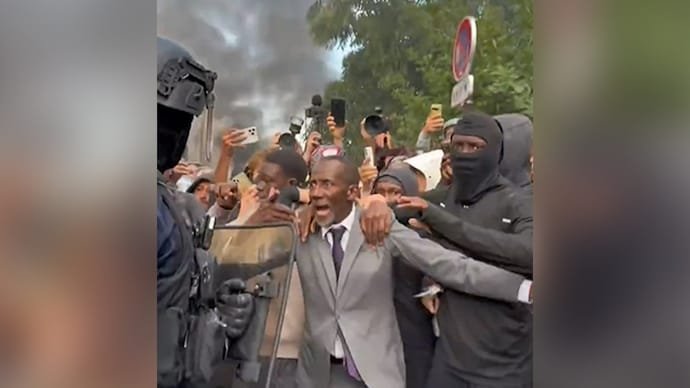
A dramatic video from France shows Saint-Denis Mayor Bally Bagayoko stepping between police and student protesters during a march, shouting “stop” as officers moved towards the young demonstrators. The confrontation has added to growing scrutiny of police tactics as Student Protests continue to spread across the country.
Bagayoko, a member of the hard-left France Unbowed party, said he intervened during Tuesday’s demonstration because he believed police were moving against students WHO had not behaved aggressively towards officers.
The mayor said he felt a responsibility to stand with the young protesters, many of whom come from his working-class suburb north of Paris. Police eventually fired tear gas at the group, including Bagayoko himself, according to the mayor.
Saint-Denis Mayor Steps Between Police and Students
The video shows Bagayoko standing directly between police officers and a group of student protesters as tensions rise. He can be heard repeatedly shouting “stop” while attempting to prevent officers from advancing towards the young demonstrators.
Bagayoko later explained that he had intervened after police moved to charge the students. According to the mayor, many of those gathered had not displayed aggressive behaviour towards the police.
Speaking to reporters at his town hall office in Saint-Denis on Wednesday, Bagayoko said he believed his position as mayor required him to support the students.
“The high school children who were in the street could be my children … it is my responsibility to be at their side,” he said.
The mayor’s intervention has since become one of the most striking images from the nationwide demonstrations, particularly as the debate over police conduct has intensified.
Mayor Calls Police Response “Totally Disproportionate”
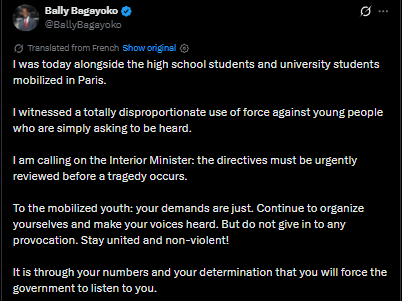
Bagayoko criticised the police response in a post on X, describing the use of force as “totally disproportionate” against young people who, in his view, were simply demanding to be heard.
He called on the interior minister to urgently review the instructions being given to police, warning that the situation could result in a tragedy if tensions continued to escalate.
At the same time, Bagayoko urged protesters to remain united and non-violent. He argued that the size and determination of the demonstrations would put pressure on the government to respond to the students’ demands.
His comments placed him directly at the centre of the growing dispute over how authorities should respond to demonstrations involving large numbers of teenagers.
Why Are Students Protesting Across France?
The confrontation in Saint-Denis took place after more than two weeks of student protests across France. The demonstrations initially gained momentum in marginalised areas around Paris, including Saint-Denis, before spreading to other parts of the country.
Students have raised concerns about overcrowded classrooms, poor sanitation, teacher shortages and unequal educational opportunities.
Many of the complaints focus on conditions inside schools and the resources available to students. Protesters have also expressed wider frustration about inequalities affecting young people and communities with fewer economic opportunities.
Saint-Denis has become an important centre of the protests because of the social and economic challenges faced by many residents. Poverty levels in the area are more than twice the national average, according to the supplied account.
Police Tactics Under Growing Scrutiny
The protests have increasingly become a debate over police tactics as well as education policy. Rights groups and unions have accused police of using excessive force against minors, including batons, tear gas and non-lethal flashball guns.
Authorities, however, have also pointed to injuries suffered by police officers during the unrest. Police have reported hundreds of officers injured, while some schools have been burned or ransacked and teachers and members of the public have also been attacked.
The competing accounts have created a difficult situation for authorities attempting to maintain public order while responding to demonstrations involving large numbers of young people.
Bagayoko’s intervention in Saint-Denis has intensified that discussion because the mayor was physically positioned between police and protesters before tear gas was used.
More Than 6,000 Arrested as Protests Spread
The demonstrations have resulted in more than 6,000 arrests since the unrest began, while dozens of students have been injured.
The scale of the disruption has also extended beyond individual clashes. Schools have been damaged, some have been forced to close and further demonstrations have been planned by student and teacher unions.
The unrest comes roughly six months before an election to replace French President Emmanuel Macron, adding a significant political dimension to the growing movement.
The government has accused politicians from France Unbowed of helping drive the protests. Bagayoko rejected that suggestion, arguing that blaming political figures for the demonstrations was insulting to the young people taking part.
Government Promises Response to Student Demands
Prime Minister Sebastien Lecornu said on Wednesday that the government would review the demands raised by students and present proposals by the end of October.
He did not provide details of the measures that could be announced. The promise of a government response comes as the protests continue to put pressure on authorities to address concerns over schools, staffing and educational inequality.
The government’s challenge is complicated by the increasingly confrontational nature of some demonstrations. While many protests have remained peaceful, other gatherings have involved clashes, vandalism and attacks.
Stun Grenades Suspended After Teenager Loses Hand
The controversy over police tactics intensified further after a 15-year-old boy lost his hand during a clash with riot police in Lens on Monday.
The government subsequently suspended the use of stun grenades during the protests. Interior Minister Laurent Nunez said there was a “strong possibility” that a stun grenade caused the teenager’s injury.
Nunez also said 18 incidents had been referred to the police inspectorate for investigation, adding another layer of scrutiny to the conduct of officers during the unrest.
The suspension of stun grenades followed mounting concerns over the use of crowd-control equipment against young demonstrators. However, the decision did not immediately bring the protests to an end.
More Than 500 Schools Remain Closed
The scale of the unrest remained visible across the education system. More than 500 schools were still closed a day after demonstrations swept across France.
Education Minister Edouard Geffray told Parliament that 24 high schools had suffered enough fire or vandalism damage to remain closed for weeks.
Those closures were expected to affect around 30,000 students, while the estimated cost of repairs was placed between 20 million and 30 million euros.
The figures illustrate the wider impact of the protests. What began as demonstrations over school conditions has evolved into a nationwide disruption involving students, teachers, unions, police and the government.
Not All Protests Turn Violent
Despite the clashes and property damage reported during the unrest, many demonstrations have remained peaceful.
At a high school in central Paris on Wednesday, protesters sang the Marseillaise, chanted slogans and performed Mexican waves while blocking the entrance to the school.
The scenes contrasted sharply with confrontations elsewhere, where police have used tear gas and pushed protesters back.
Outside Sciences Po university in central Paris, police used tear gas and moved against protesters as tensions rose around the demonstration.
The contrast between peaceful school blockades and violent clashes has made the government’s response particularly difficult. Authorities must address the grievances behind the movement while also responding to incidents involving attacks, vandalism and disruption.
Bagayoko’s Intervention Becomes a Symbol of the Protests
Against this backdrop, the footage of Bagayoko standing between police and students has become a powerful representation of the dispute over policing and protest.
The mayor’s intervention was not simply a political statement. By physically placing himself between officers and young protesters, Bagayoko presented himself as a mediator seeking to prevent a confrontation from escalating.
His statement that the students could be his own children also reflected the particular significance of the protests in Saint-Denis, where many young people are demanding better conditions in schools and greater equality of opportunity.
France Faces Growing Pressure to End the Unrest
The government now faces pressure on several fronts. Students and teachers are demanding changes to education conditions, unions are preparing further demonstrations, rights groups are questioning police tactics and authorities are dealing with the consequences of damaged schools and violent incidents.
The suspension of stun grenades following the Lens injury has shown that police tactics are already becoming a central part of the government’s response. The investigations into alleged misconduct could further shape the debate over how officers should respond to demonstrations involving minors.
At the same time, officials have stressed that police officers have also been injured and that some protesters have engaged in violence and property destruction.
The Saint-Denis confrontation captures the tension at the heart of the crisis: young protesters demanding to be heard, police attempting to control increasingly tense demonstrations and political leaders arguing over who is responsible for the escalation.
As more schools remain closed and further marches are planned, the government’s promised proposals by the end of October will be closely watched. For now, the image of Bally Bagayoko standing between police and students, shouting “stop” as officers moved forward, has become one of the defining moments of France’s growing school protest movement.
For breaking news and live news updates, like us on Facebook or follow us on Twitter and Instagram. Read more on Latest World on thefoxdaily.com.






COMMENTS 0