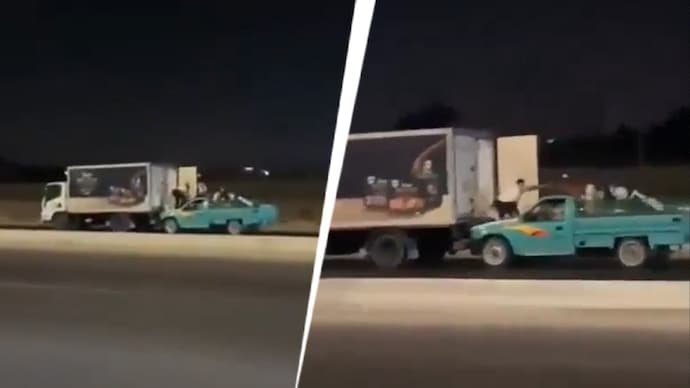
A bizarre highway robbery in Egypt has gone viral after a group of thieves allegedly climbed onto a moving refrigerated truck to steal more than 100 kilograms of frozen chicken while the vehicle was travelling through Cairo.
The unusual operation, which took place on August 25, was captured by a passing motorist and quickly spread across Social Media. The footage showed two men using a pickup truck to reach the rear of the moving lorry, open its doors and remove boxes of frozen chicken without stopping either vehicle.
The stunt ended with a very different kind of action sequence. Egyptian Security forces later identified six suspects allegedly connected to the robbery. When Police moved to arrest them, authorities said the suspects opened fire, triggering an armed confrontation in which three suspects were killed and three others arrested.
The case has attracted attention not only because of the dramatic method used to steal the food, but also because the Viral Video became an important lead in the Investigation. What initially looked like an audacious theft on a Cairo highway ultimately gave investigators a visual trail that helped them locate the alleged perpetrators.
How the moving-truck chicken robbery happened
The robbery began with a truck carrying a much larger shipment than the thieves ultimately managed to take.
The refrigerated lorry was transporting approximately four tonnes of frozen chicken from a factory when it was targeted on a Cairo highway on August 25.
Rather than forcing the truck to stop, the suspects allegedly used a pickup to approach it from behind while both vehicles were moving. Video recorded by a passing driver showed two men positioned on the front of the pickup as they reached the rear of the refrigerated truck.
They then opened the lorry’s rear doors and began removing boxes of chicken.
The apparent precision of the operation made the footage particularly striking. The thieves were not simply breaking into a parked vehicle. They were allegedly transferring cargo between two moving vehicles on a busy highway.
Social media users quickly compared the scene to the elaborate vehicle stunts seen in the Fast & Furious movie franchise, turning an otherwise conventional cargo theft into one of Egypt’s more unusual viral Crime stories.
The truck driver reportedly did not know the cargo was being stolen
According to the driver’s statement, he was unaware that the robbery was taking place behind him.
That detail helps explain why the thieves were able to remove the chicken without immediately triggering a confrontation. The refrigerated truck continued along the highway while the suspects allegedly operated from the pickup behind it.
The driver discovered afterward that approximately 105 kilograms of chicken were missing.
Compared with the roughly four-tonne shipment being transported, the stolen quantity represented only a portion of the cargo. But the method of theft created a far bigger public reaction than the amount of food involved.
The video recorded by the passing motorist proved particularly valuable because it provided investigators with a visual record of the suspects, the pickup truck and the method used to access the refrigerated lorry.
The viral video became a major clue for investigators
Crime investigations do not normally begin with a video spreading across social media, but that is what happened in this case.
The footage circulated widely after the incident, drawing attention to the unusual robbery and helping bring the case to authorities’ attention.
Once investigators began examining the incident, the video offered information that a conventional report from the truck driver might not have provided. It showed how the suspects approached the truck and provided details about the vehicle allegedly used during the theft.
That kind of publicly available footage can be valuable in investigations because witnesses may capture events that the people directly involved do not realize are being recorded.
In this case, the recording transformed an unusual theft into a case with a visible trail.
Police say all six suspects had previous criminal records
Egypt’s Interior Ministry said security forces eventually identified six suspects allegedly involved in the robbery.
Authorities said all six had previous criminal records and that investigators traced them to hideouts in Cairo and Qalyubia.
The identification reportedly followed an investigation into the highway robbery and information gathered about the suspects and their movements.
Police then moved to apprehend the group.
According to the Interior Ministry, the suspects responded by opening fire at security forces. An armed confrontation followed, leaving three of the suspects dead and three others in custody.
The ministry did not describe the incident as a routine arrest operation. The reported exchange of gunfire transformed the case from an unusual cargo robbery into a deadly police confrontation.
Three suspects were killed and three were arrested
Egyptian authorities said three suspects were killed during the confrontation while three others were arrested.
Police also seized weapons and the pickup truck allegedly used in the original robbery.
Some of the stolen chicken was recovered, along with other property that authorities believe may be connected to separate robberies.
The recovery of additional suspected stolen property could broaden the investigation beyond the chicken theft itself. If prosecutors establish links to other incidents, the surviving suspects could potentially face charges related to more than the August 25 robbery.
The exact legal outcome will depend on the evidence gathered by investigators and the charges ultimately brought by Egyptian authorities.
Why the robbery attracted so much attention
Food theft is not unusual. Cargo theft involving valuable commercial goods occurs in many countries. What makes this Egyptian case stand out is the combination of the target, the method and the video.
Frozen chicken is ordinary consumer merchandise, but the thieves allegedly chose to steal it from a moving refrigerated truck rather than intercepting a stationary shipment.
The operation also required coordination between the pickup and the truck. The suspects had to position the vehicles close enough for the men to reach the cargo while the lorry was still moving.
That unusual visual element made the incident particularly suited to social media, where dramatic footage can Travel much faster than conventional crime reports.
Within a short period, the video had become a talking point in Egypt, with users focusing as much on the audacity of the method as on the alleged theft itself.
The case highlights the vulnerability of moving cargo
Commercial trucks carrying food and other valuable goods are designed to keep cargo moving efficiently from factories and warehouses to distribution points. That also creates opportunities for thieves who can exploit moments when security systems are weakest.
A conventional cargo robbery might involve intercepting a truck after it stops at a warehouse, roadside location or delivery point. The Cairo incident allegedly took a different approach by attacking the cargo while the vehicle was still in transit.
That creates several potential security challenges.
- The driver may have limited visibility of what is happening behind the vehicle.
- Refrigerated trucks can carry valuable cargo while travelling long distances.
- A moving vehicle may be difficult for the driver to monitor without additional cameras or tracking systems.
- Once cargo is removed, the theft may not be discovered until the vehicle reaches its destination.
The incident does not establish that the shipment lacked security measures, but it demonstrates why logistics companies increasingly rely on tracking, surveillance and controlled access to protect high-value cargo.
Why frozen food can become a target for thieves
Food shipments have characteristics that can make them attractive to criminals.
Unlike some stolen goods, food can potentially be sold quickly through informal networks. Popular food products may also have a ready market, particularly when prices are high or supply is tight.
Frozen meat and poultry present an additional logistical challenge because they require temperature-controlled storage. Once stolen, maintaining the correct conditions becomes more difficult, which can limit how long the products remain suitable for sale.
That does not mean every food theft is driven by the same motive. Criminal investigations are needed to establish why particular goods were targeted and how stolen merchandise is distributed.
In the Egyptian case, authorities have not publicly established a broader motive beyond the alleged robbery, so speculation about an organized food-smuggling or resale operation should be treated cautiously.
The police shootout changes the significance of the case
The deaths of three suspects make the case considerably more serious than an ordinary cargo-theft investigation.
Egyptian authorities said the suspects fired at security forces when police attempted to arrest them. That account places the reported gunfight at the centre of the official explanation for the deaths.
The three surviving suspects are expected to face legal proceedings over the alleged robbery and the confrontation with security forces. The evidence recovered during the arrests, including weapons and the pickup truck, is likely to form part of the investigation.
Because the case involves deaths during an armed police operation, the circumstances of the confrontation will be particularly important in determining what happened during the arrest attempt.
The incident is part of a wider pattern of unusual food thefts
The Egyptian chicken robbery also fits into a broader international pattern of criminals targeting food shipments, although the circumstances differ from case to case.
In May 2026, more than 12 tonnes of KitKat chocolate bars were reported stolen from a shipment in Canada. The incident attracted attention because of the sheer volume of confectionery involved and prompted Nestlé to increase security around some remaining deliveries.
Such cases highlight an overlooked aspect of organized theft: criminals do not necessarily need to target luxury products to make a significant profit. Everyday consumer goods can become valuable when they can be moved or resold quickly.
However, the Egyptian case is unusual because of the alleged method. Stealing 105 kilograms of frozen chicken from a moving truck is far more hazardous and technically demanding than taking the same goods from a stationary warehouse.
What the viral footage reveals about modern crime investigations
One of the most significant aspects of the case may have little to do with chicken.
The incident demonstrates how Smartphones and social-media platforms have changed the information available after crimes occur in public places.
The motorist who recorded the robbery was not apparently involved in the investigation. Yet the footage captured details that became relevant to authorities after the incident gained public attention.
That does not mean viral videos automatically solve crimes. Footage can be incomplete, misleading or difficult to authenticate. But when investigators can connect images with vehicles, locations and known suspects, publicly circulated recordings can provide valuable leads.
For criminals, there is an obvious downside: an operation that might once have been witnessed by only a handful of people can now be recorded and distributed to thousands or millions of viewers within minutes.
What happens next in the Egypt chicken robbery case?
The immediate focus will be on the three arrested suspects and the evidence gathered during the investigation.
Authorities will need to establish each suspect’s alleged role in the highway robbery, determine whether the recovered property is connected to other crimes and pursue the appropriate charges.
The viral video is likely to remain an important piece of evidence because it documents the alleged theft itself. The weapons and pickup truck seized during the arrests may provide additional evidence linking suspects to the operation, subject to the findings of the investigation and judicial process.
The case also raises practical questions for transport companies. If thieves can approach a moving refrigerated vehicle and remove cargo without the driver immediately noticing, logistics operators may need to reassess how vulnerable their shipments are during transit.
A strange theft with a serious security lesson
The Cairo chicken heist may have become an internet sensation because it looked like a scene from an action movie, but the underlying incident illustrates a real challenge for modern logistics: protecting valuable cargo after it leaves a secure facility and before it reaches its destination.
In this case, approximately 105 kilograms of frozen chicken were allegedly removed from a truck carrying around four tonnes of product. The suspects’ unusual method was captured by a passing motorist, and that footage helped investigators pursue the case.
The subsequent police operation ended with three suspects dead and three arrested after authorities said the group opened fire on security forces.
For the public, the story may remain memorable because of the sheer oddity of stealing chicken from a moving truck. For investigators and transport operators, however, the more important lesson is about visibility, tracking and the vulnerabilities of cargo in transit.
The episode is a reminder that even an ordinary shipment of frozen food can become the centre of a major criminal investigation when thieves combine a risky method with a very public trail.
For breaking news and live news updates, like us on Facebook or follow us on Twitter and Instagram. Read more on Latest World on thefoxdaily.com.






COMMENTS 0