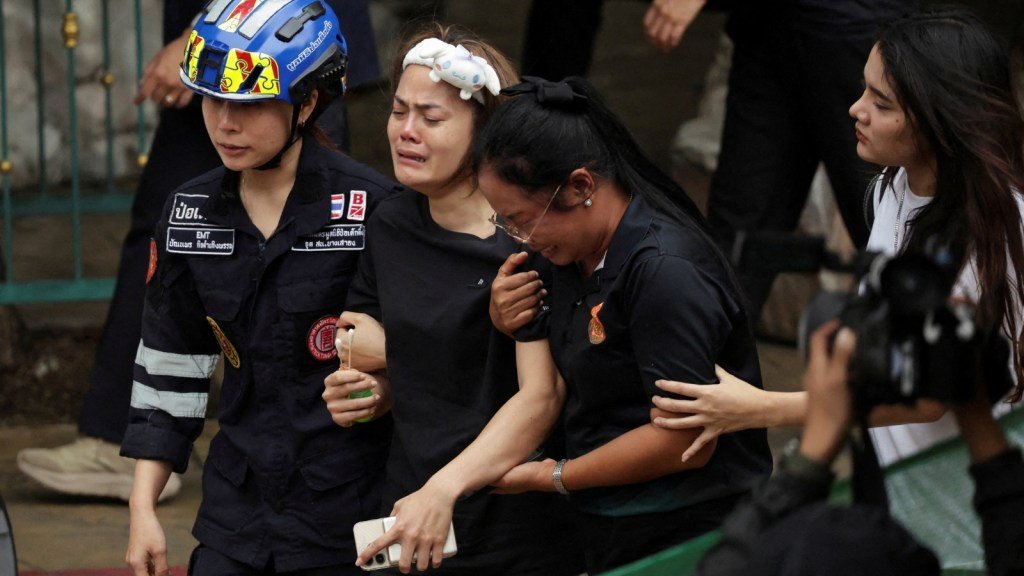
A 14-year-old student allegedly killed his grandparents before opening fire at Debsirin Nonthaburi School near Bangkok on August 7, killing teachers and staff and injuring 23 people. Police say the teenager used a handgun belonging to his grandfather, fired at least 26 rounds and had another 34 rounds of ammunition at the scene. He later died after shooting himself.
The attack has raised immediate questions about how a teenager gained access to a firearm, whether the shooting was planned, what role school-related stress and alleged bullying may have played, and whether Thailand‘s existing gun-control measures are strong enough to prevent weapons from reaching young people.
What happened at the Thailand school shooting
The shooting took place at Debsirin Nonthaburi School in Bang Kruai district of Nonthaburi province, on the northwestern outskirts of Bangkok. The school had about 3,100 students and 147 teachers during the 2025 academic year, according to district authorities.
Police said the teenager first killed his grandparents at their home before going to the school. Authorities later discovered the bodies of the grandparents when they went to the residence following the attack at the school.
At the school, the teenager opened fire on teachers and staff. Police said he fired at least 26 rounds. Another 34 rounds of ammunition were recovered, although the presence of additional ammunition does not by itself establish exactly how much the teenager intended to use.
Students initially struggled to understand what was happening. One student told Reuters that he first thought the sounds were firecrackers or someone striking an object. After the shooting continued, students barricaded themselves inside classrooms while teachers helped protect and treat injured students.
Emergency workers entered while the attack was still unfolding. They treated students with injuries to areas including the back, chest and arms. A male teacher was found dead on an upper floor, while a female teacher was found with injuries to her chest and arm.
After a final gunshot, emergency workers found the teenager with a gunshot wound to the head. They attempted to resuscitate him, but he later died.
How many people were killed and injured?
Police said the teenager killed his grandparents before the school attack and then killed at least five teachers and staff members at the school. He also died after shooting himself.
Twenty-three people were reported injured in the attack, with Prime Minister Anutin Charnvirakul saying nine of those wounded were in critical condition. The injuries occurred during a chaotic emergency in which students and staff were attempting to escape, shelter or assist others.
The casualty figures also underline why the incident was more than a single act of violence involving one firearm. The shooting unfolded inside a large school community, affecting students, teachers, families, emergency workers and others WHO witnessed the attack.
Was the Thailand school shooting planned?
Thai authorities are investigating the motive, but the prime minister said preliminary information suggested the teenager had experienced stress related to school. Anutin also said the available information indicated that the attack appeared to have been planned.
That distinction is important. Authorities may eventually establish a clearer sequence of events, but the early Investigation should not be confused with a final explanation of why the teenager carried out the shooting.
A 17-year-old student, Purin Khumchoo, told AFP that friends who knew the suspect had described him as interested in guns and the FBI and said he had been bullied by other students. Those comments provide a possible line of investigation, but they do not establish that bullying was the cause of the attack.
The same caution applies to the teenager’s reported interest in guns. An interest in firearms can be relevant to an investigation into how someone becomes familiar with weapons, but it does not by itself explain why a person commits a mass shooting.
Investigators will therefore have to establish what happened before the attack, how the gun and ammunition were accessed, whether there was evidence of preparation, and whether the teenager communicated his intentions to anyone.
The gun belonged to his grandfather
One of the most significant facts in the case is the reported source of the firearm. Police said the teenager used a gun belonging to his grandfather.
This detail shifts part of the discussion away from simply asking whether the teenager could legally own a gun. At 14, the teenager was not an adult firearm owner. The more immediate question is how a firearm in a household became accessible to a child who allegedly went on to use it in a deadly attack.
Gun ownership rules and safe-storage practices are therefore likely to become part of the investigation. A firearm can be legally owned and still become a serious public-safety risk if unauthorized people can gain access to it.
The reported recovery of another 34 rounds of ammunition is also likely to receive attention as investigators reconstruct the incident. Police will need to determine where the ammunition came from and how the teenager obtained access to it.
Why the attack has renewed Thailand’s gun-control debate
Thailand has a significant civilian gun stock compared with many other countries in the region. Estimates cited by Reuters put the number of civilian-held firearms at about 10.3 million, equivalent to roughly 15 guns for every 100 residents.
The figures include both registered and unregistered firearms. Reuters reported that the Small Arms Survey estimated slightly more than 6 million of the weapons were registered, while about 4 million were unregistered.
Those numbers do not mean that most gun owners are involved in Crime. They do, however, help explain why firearm access remains a recurring policy issue after major shootings.
The challenge is particularly complicated when a weapon is already present inside a household. Traditional licensing rules can address who is legally permitted to own or carry a firearm, but preventing unauthorized access also depends on storage, supervision and enforcement.
Thailand has tightened gun rules before
The latest shooting is not the first time Thailand has responded to Gun Violence with calls for stronger regulation.
After a 14-year-old opened fire at Bangkok’s Siam Paragon shopping centre in 2023, authorities introduced several measures. These included a temporary halt on new firearm licences, restrictions on imports and a ban on people under 20 using shooting ranges.
Longer-term measures also included requirements involving medical certification and assessments of the mental and psychological condition of gun owners, as well as specified validity periods for some licences.
The significance of the 2026 shooting is that the weapon was reportedly obtained from a family member rather than through a straightforward purchase by the teenager. That makes the effectiveness of household firearm security an especially relevant question.
Prime Minister Anutin, who was previously interior minister when earlier gun-control measures were introduced, said after Friday’s attack that he would propose a new firearms-control law. He also said he would discuss gun control with the country’s police chief.
The exact contents of any new legislation will determine whether the response focuses primarily on carrying firearms, ownership requirements, storage, access by minors or broader enforcement.
A history of deadly shootings
The latest attack comes against the backdrop of several major shootings in Thailand over the past several years.
In February 2020, a soldier went on a shooting rampage in Nakhon Ratchasima, killing 29 people. The attack involved multiple locations, including a shopping mall, and became one of Thailand’s most notorious mass shootings.
In October 2022, a former police officer carried out a gun-and-knife attack in northeastern Thailand. The attack killed 36 people, including 22 children at a daycare centre. It remains one of the country’s deadliest mass killings by a single attacker.
Then, in October 2023, a 14-year-old opened fire at a Bangkok shopping centre, killing two people and injuring five. Police said the weapon used in that case was a modified handgun likely obtained online.
The 2026 school shooting therefore has a particularly troubling connection with the 2023 Bangkok mall attack: both alleged attackers were 14-year-old students. The similarity should not be interpreted as proof of a common cause, but it makes questions surrounding youth access to firearms and early warning signs especially difficult for authorities to ignore.
Why the school setting makes this case different
A school is designed to be a controlled environment where students and teachers should be able to learn and work without expecting armed violence. The Debsirin Nonthaburi attack demonstrates how quickly that sense of security can disappear when a firearm enters the school environment.
The school’s size also matters. With thousands of students and more than a hundred teachers, a violent incident can affect people far beyond those physically targeted.
Students described hiding inside classrooms while teachers helped them remain safe. Emergency workers had to treat injured people while the threat was still active. For those who survived, the consequences do not end when police secure the building.
Thailand’s Health ministry deployed seven mental-health crisis assessment and treatment teams to provide psychological support to people affected by the shooting. That response recognizes an important part of school violence that is sometimes overlooked: survivors, witnesses and families may continue to deal with fear and trauma long after the physical danger has passed.
What the bullying claims do and do not tell us
Bullying is among the claims investigators will have to examine carefully. The student who spoke to AFP said people who knew the suspect believed he had been bullied and described him as troubled.
But it would be premature to conclude that bullying caused the shooting.
Large acts of violence rarely have a single simple explanation. School pressure, interpersonal conflict, access to weapons, individual behavior, planning and other circumstances may all need to be examined. Establishing a motive requires evidence rather than assumptions made from a suspect’s reputation or comments circulating after an attack.
That distinction is particularly important when the suspect has died and cannot be questioned as part of the investigation. Authorities will have to rely on witnesses, digital evidence, school records, family information and other investigative material to reconstruct what happened.
What could happen next?
The immediate priority will be supporting the injured, identifying the victims, assisting their families and establishing a complete account of the attack.
The investigation will also focus on the firearm and ammunition, the suspect’s movements before the shooting, his relationship with the school and family, and any evidence that could explain how the attack was prepared.
For policymakers, the next major question is whether Thailand’s response will go beyond restrictions on firearm ownership and carrying. The circumstances of this case make access by minors and the security of firearms kept in private homes particularly relevant.
The prime minister’s promise of a new firearms-control law means the shooting is likely to trigger another national debate over gun regulation. Whether that produces lasting change will depend on the details of any legislation and, just as importantly, how effectively existing and new rules are enforced.
The bigger lesson from the Thailand school shooting
The attack at Debsirin Nonthaburi School is a tragedy for the victims and their families, but it also exposes several difficult public-safety questions at once.
How did a 14-year-old gain access to a family firearm? Were there warning signs that could have been identified earlier? What happened inside the teenager’s home and school before the attack? Did anyone know about preparations? And are existing gun-control measures sufficient when firearms are already present in private households?
Those questions cannot be answered responsibly through speculation. The investigation will need to separate confirmed evidence from claims about the teenager’s behavior and possible motive.
What is already clear is that the attack has reopened Thailand’s debate over firearms at a moment when the country has experienced several major shootings in recent years. The reported use of a grandfather’s gun also places firearm access and safe storage alongside licensing and carrying restrictions at the centre of the discussion.
For the students who hid in classrooms, the teachers who tried to protect them, the emergency workers who entered while the shooting was still underway, and the families waiting for news, the consequences are immediate and deeply personal. For Thailand, the longer-term test will be whether the lessons from this attack lead to practical measures capable of preventing another teenager from gaining access to a gun and turning a school into the scene of a mass tragedy.
For breaking news and live news updates, like us on Facebook or follow us on Twitter and Instagram. Read more on Latest World on thefoxdaily.com.






COMMENTS 0