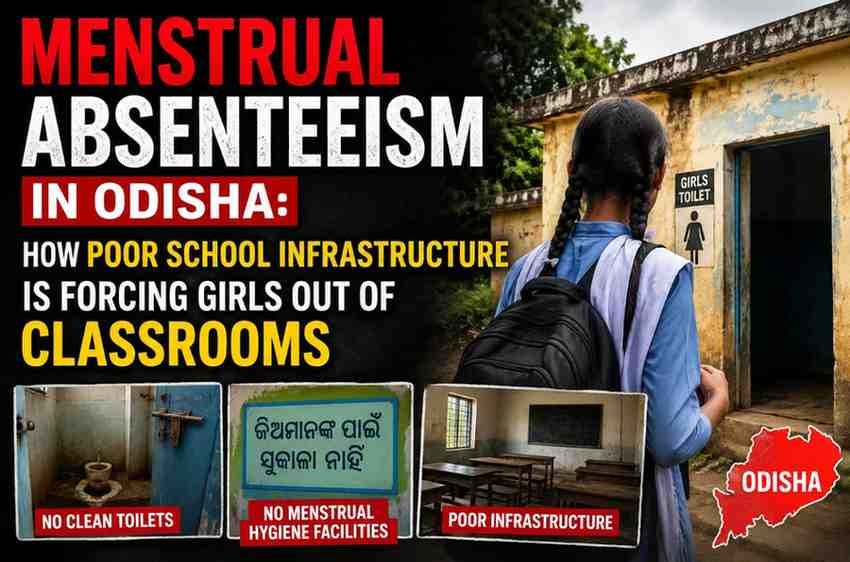
Across Odisha’s government schools, thousands of adolescent girls quietly disappear from classrooms every month not because of illness, not because of exams, but because of something as natural as menstruation. The absence of functional toilets, running water, and a social environment free from stigma is turning a biological reality into an educational crisis.
India has made significant strides in girls’ Education over the past two decades. Enrolment numbers have improved. Mid-day meal schemes have helped retention. Yet one persistent, deeply uncomfortable problem continues to undermine all of that progress: menstrual absenteeism. In Odisha one of India’s states with the highest proportion of tribal and rural populations the situation is particularly acute. Girls in rural and semi-urban schools regularly miss three to five days of school every month during their periods, amounting to nearly 60 school days lost per year. That is almost one full academic quarter, quietly erased.
The reasons girls miss school during menstruation are not mysterious. They are structural, social, and entirely preventable. Three core barriers dominate the problem in Odisha.
India’s Swachh Bharat Mission and the Samagra Shiksha programme have poured funds into building school toilets. The infrastructure, at least on paper, exists. But the reality on the ground in Odisha tells a different story. A significant proportion of toilets in government schools particularly in districts like Rayagada, Malkangiri, Koraput, and Nabarangpur are either non-functional, lack water supply, or are shared with male students and staff. For a menstruating adolescent girl, a broken lock or the absence of water inside a toilet cubicle is not a minor inconvenience. It is a reason to stay home.
Research consistently shows that functional, private, water-accessible girl-only toilets are among the most powerful interventions for reducing period-related absenteeism. When a girl cannot change her pad, cloth, or other menstrual material hygienically and privately at school, staying home becomes the only rational choice available to her.
Beyond toilets, the absence of pad disposal units and the lack of access to menstrual hygiene products at the school level compound the problem. Many girls in Odisha’s tribal and rural belts still use old cloth as their primary menstrual material not entirely by choice, but due to cost and availability. Reusable cloth is not inherently a problem. The problem is that schools offer no private, hygienic space to rinse, dry, or store such materials during the school day. The result: girls simply cannot manage their periods at school.
The Odisha government’s Khushi scheme, launched to distribute free sanitary napkins to adolescent girls through schools and Anganwadi centres, has improved access in some districts. But distribution has been irregular, and in many remote schools, supplies run out for months at a stretch. The gap between policy and delivery remains wide.
Perhaps the hardest barrier to fix with a budget line is stigma. In large sections of rural Odisha and across India menstruation is still treated as a subject of shame, ritual impurity, and secrecy. Girls are told not to speak about it publicly. Teachers, many of whom are male, are often ill-equipped or unwilling to address the subject. Peer embarrassment the fear of a visible stain, the fear of being seen entering a toilet with a pad keeps girls silent and absent.
This stigma does not exist in isolation. It is reinforced by household practices, community customs, and a broader cultural silence around female bodies. In Odisha’s tribal communities, menstrual taboos are particularly entrenched, with some customs confining girls to separate spaces during their period and restricting their participation in daily activities. Bringing that logic into the school environment creates an atmosphere where staying home during menstruation feels not just acceptable, but expected.
By the Numbers: The Scale of the Problem
| Indicator | Odisha / National Data |
|---|---|
| Average school days lost per month due to menstruation | 3–5 days per girl |
| Estimated annual school days lost | Up to 60 days per year |
| Girls in India using hygienic menstrual products (NFHS-5) | ~64% nationally; lower in rural Odisha |
| Government schools with functional girls’ toilets (UDISE+ 2022–23) | Significant gaps in rural districts |
| Odisha school dropout rate girls at secondary level | Among the higher rates in eastern India |
| Districts most affected | Malkangiri, Koraput, Rayagada, Nabarangpur, Kandhamal |
The cumulative educational impact of this absenteeism is devastating. A girl who misses 60 school days a year falls behind in lessons, loses confidence, and faces a higher risk of dropout particularly when she reaches Class 8 or 9 and academic content becomes harder to recover without consistent attendance. Menstrual absenteeism is not just a Health issue. It is a direct driver of the gender gap in secondary school completion.
Odisha is not unique in facing this challenge, but its specific combination of high tribal population, poverty concentration, and geographic remoteness makes the problem sharper here than in more urbanised states. Compare this with Kerala or Himachal Pradesh, where sustained investment in school infrastructure and relatively lower stigma around menstruation has kept period-related absenteeism minimal. Tamil Nadu’s Pudhumai Penn scheme and Rajasthan’s community-level menstrual hygiene initiatives offer replicable models.
What differentiates the states that have made progress is not just money it is integration. Infrastructure upgrades, product supply, and stigma-reduction through school curricula and teacher training were implemented together, not in isolation. Odisha’s approach has historically been fragmented: good schemes that are poorly implemented, infrastructure that is built but not maintained, and awareness campaigns that never reach the classroom floor.
One of the most underreported dimensions of this crisis is the role or the absence of school teachers in addressing menstrual health. In Odisha’s government schools, the majority of teachers in rural areas are male. Female teachers, when present, are often the only available source of support for a girl experiencing period distress at school. But most teachers, regardless of gender, receive no training in menstrual health management, no protocols for handling a girl who needs to go home, and no guidance on how to discuss the topic without embarrassment.
The result is a conspiracy of silence. Girls do not ask for help. Teachers do not offer it. And the school environment becomes a place that is actively hostile to the physical reality of adolescent female bodies. Breaking this silence requires systematic teacher training a measure that costs relatively little and delivers outsized impact.
What Needs to Change: A Policy Roadmap
Solutions to menstrual absenteeism in Odisha are well-understood. The challenge is political will and implementation quality, not knowledge. Here is what evidence suggests must happen simultaneously:
- Functional, private, water-supplied girls’ toilets in every school with maintenance budgets attached, not just construction funds
- Consistent supply of free sanitary napkins under the Khushi scheme with real-time supply-chain monitoring
- Incinerators or sealed disposal units in every girls’ toilet block
- Mandatory menstrual health modules in school curricula from Class 5 onwards, addressing both girls and boys
- Teacher sensitisation training particularly for male teachers on how to support menstruating students without stigma
- Community engagement in tribal areas to challenge menstrual taboos through women’s self-help groups and Anganwadi workers
- Data collection at the school level on menstruation-related absenteeism to make the invisible crisis visible to administrators
It is worth stating plainly what this issue really is. When a girl cannot attend school because her school fails to provide the basic conditions she needs to manage her body safely and privately, that is not a hygiene problem. It is a rights violation. The right to education enshrined in Article 21A of the Indian Constitution is functionally denied to girls who lose 60 school days a year not because they chose to be absent, but because their schools made it impossible to stay.
India’s commitments under the UN Sustainable Development Goals, specifically SDG 4 (quality education) and SDG 5 (gender equality), demand that this gap be closed. Odisha’s own Vision 2036 education targets cannot be met if a structural barrier this significant is not addressed at scale.
Menstrual absenteeism is the most expensive problem India’s education system doesn’t officially track. It costs millions of girls their academic futures while remaining invisible in school attendance data.
What Progress Looks Like And Where It’s Happening
There are green shoots worth acknowledging. Some Odisha districts under the Samagra Shiksha Abhiyan have seen improved toilet construction in recent years. NGOs like Dasra, Goonj, and local organisations such as Mahashakti Foundation have run effective community-level menstrual hygiene programmes in tribal belts. The state’s Mission Shakti network one of the largest women’s self-help group networks in Asia has the potential to serve as a powerful delivery mechanism for both products and awareness, if systematically tapped.
Pilot programmes in Koraput and Kandhamal districts that combined toilet renovation, pad distribution, and classroom-based menstrual health education showed measurable reductions in absenteeism within two academic years. The model works. The question is whether Odisha’s education bureaucracy has the institutional will to scale it.
The story of girls in Odisha missing school because of menstruation is not a story about biology. It is a story about neglect the neglect of basic infrastructure, of health education, of the social conditions that adolescent girls need to participate equally in public life. Every month that passes without intervention is another month where thousands of girls fall further behind in classrooms they should never have had to leave.
The solutions are known. The costs are manageable. What remains is the decision to treat menstrual health in schools not as a peripheral women’s issue but as a core education equity issue — one that sits at the intersection of infrastructure policy, curriculum reform, and cultural change.
Odisha has the institutional architecture the Mission Shakti network, the Samagra Shiksha framework, the Khushi scheme to make meaningful progress within three to five years if these tools are deployed in coordination. The prediction is cautiously optimistic: states that integrate infrastructure, supply, and stigma-reduction as a package rather than isolated schemes will see period-related absenteeism fall sharply. Odisha has everything it needs to become that example. The political moment to act is now.
For breaking news and live news updates, like us on Facebook or follow us on Twitter and Instagram. Read more on Latest Health on thefoxdaily.com.






COMMENTS 0