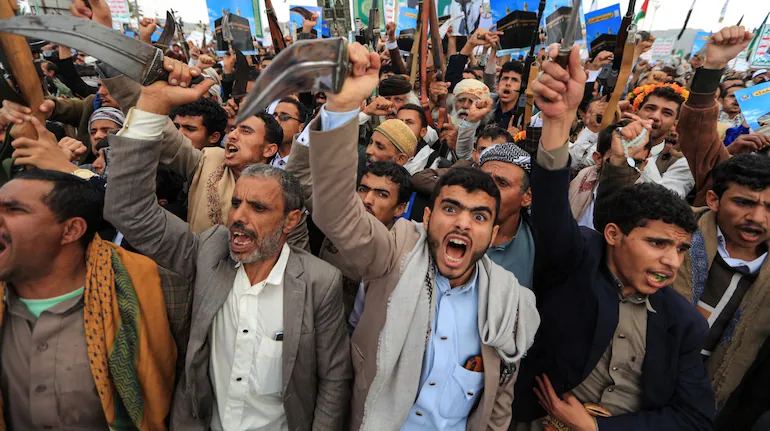
Saudi Arabia is facing a difficult new challenge in Yemen after Iran-backed Houthi rebels reportedly demanded $51 billion in compensation and recognition as the country’s legitimate rulers in exchange for easing tensions with Riyadh. The reported demands, conveyed during discussions aimed at preventing another escalation, come as the rebels intensify attacks on Saudi-linked oil infrastructure and advance towards Aden, the seat of Yemen’s internationally recognised government.
The proposal presents Saudi Arabia with a dilemma that goes far beyond money. Accepting the demand could mean paying billions of dollars to an armed movement that Riyadh has spent years fighting, while recognising the Houthis as Yemen’s rulers would undermine the government it intervened to protect in 2015.
Rejecting the proposal also carries serious risks. Continued Houthi attacks could threaten Saudi oil facilities, airports and investor confidence. A renewed military campaign, meanwhile, could drag the kingdom into another prolonged confrontation without reliable support from its regional allies.
Key Points: Why the Houthi Demand Matters
- The Houthis have reportedly demanded $51 billion in compensation for years of Saudi airstrikes and the blockade imposed during Yemen’s civil war.
- The rebels also want Riyadh to recognise them as Yemen’s rulers, potentially weakening the internationally recognised government.
- Houthi forces have reportedly advanced to within around 50 miles of Aden, increasing pressure on Saudi-backed forces.
- Saudi Arabia faces difficult military choices as regional allies remain reluctant to join another major offensive against the Houthis.
Why Are the Houthis Demanding $51 Billion From Saudi Arabia?
According to people familiar with the discussions cited by The Wall Street Journal, the Houthis have sought $51 billion from Saudi Arabia as compensation for years of airstrikes and the blockade imposed during Yemen’s civil war.
The financial demand reportedly emerged during discussions intended to prevent another escalation between the two sides. The negotiations gained urgency following Houthi attacks on Saudi-linked oil tankers in the Red Sea.
However, the proposed compensation is accompanied by a much bigger political condition. The rebels reportedly want Riyadh to recognise them as the legitimate rulers of Yemen.
That demand would represent a major diplomatic victory for the Houthis. It could also undermine the internationally recognised Yemeni government that Saudi Arabia has supported since entering the conflict in 2015.
The reported $51 billion figure is a negotiating demand, not an agreed settlement or a confirmed payment obligation. Saudi Arabia has not indicated that it is prepared to accept the proposal.
For Riyadh, the issue is therefore not simply whether it can afford the financial settlement. It must also consider what recognising the Houthis would mean for Yemen’s political future and Saudi Arabia’s regional influence.
Why Recognising the Houthis Could Become a Major Setback for Riyadh
Saudi Arabia intervened in Yemen in 2015 to prevent the Houthi movement from taking control of the country and to support the internationally recognised government. The intervention was also driven by concerns about the growing influence of Iran-backed forces near the kingdom’s southern border.
What began as a military campaign has developed into a prolonged confrontation. Despite years of Saudi-led operations, the Houthis have retained control over significant parts of Yemen and continue to possess the military capacity to threaten Saudi territory.
Recognising the movement as Yemen’s rulers would therefore represent a major shift in Riyadh’s policy. It could weaken the government Saudi Arabia has backed and give the Houthis the political legitimacy they have sought through years of conflict.
There is also a longer-term concern. If the Houthis secure financial compensation and political recognition after increasing military pressure, other armed groups could interpret the outcome as evidence that escalation can produce major concessions.
Yemeni analyst Maged Al-Madhaji warned that the precedent could become a bigger problem for Saudi Arabia than the immediate financial settlement.
“The bigger problem is establishing a precedent whereby the group can escalate militarily whenever it wants additional concessions or money,” he told The Wall Street Journal.
This makes the reported demand particularly difficult to accept. Riyadh would not simply be paying for the consequences of a past conflict; it could also be changing the political balance of power in Yemen in favour of the movement it originally sought to defeat.
Houthi Forces Move Within 50 Miles of Aden
The latest battlefield developments have added to Saudi Arabia’s concerns. Houthi forces have reportedly advanced to within approximately 50 miles of Aden, the southern port city that serves as the seat of Yemen’s internationally recognised government.
The reported advance brings the rebels closer to Aden than at any point since the early stages of the conflict. The city is strategically important because it remains a principal political base for the government backed by Saudi Arabia.
A further Houthi advance could put additional pressure on the administration and threaten its remaining territorial foothold. It would also complicate efforts by Saudi-backed forces to maintain their positions in southern Yemen.
For Riyadh, the military calculations are becoming increasingly difficult. Continued airstrikes have not been sufficient to reverse Houthi territorial gains, while deploying ground forces could expose Saudi Arabia to casualties and another prolonged campaign.
Kristian Coates Ulrichsen, an expert at Rice University’s Baker Institute, told The Wall Street Journal that the risks facing Saudi Arabia had increased compared with the earlier phase of the conflict.
“The imbalance of risk between the Houthis and Saudi Arabia is even greater now than it was in the earlier period of conflict between 2015 and 2022, as the impact of the strikes on civilian and energy infrastructure undermines investor confidence,” he said.
The assessment highlights an important problem for Riyadh: the Houthis do not necessarily need to defeat the Saudi military in a conventional war to impose significant economic and political costs on the kingdom.
Saudi Airports and Oil Infrastructure Under Pressure
The Houthi threat has increasingly extended beyond Yemen’s battlefield. Attacks targeting Saudi airports, oil installations and shipping routes have raised concerns about infrastructure that is essential to the kingdom’s economy and international connectivity.
According to The Wall Street Journal, the rebels carried out an almost daily campaign against Saudi Arabia during October, with attacks intensifying towards the end of the month.
Reported targets included civilian airports and facilities linked to Saudi Aramco, the kingdom’s state-controlled oil giant. Damage and fires were also reported at some installations connected to the country’s energy infrastructure.
The attacks reportedly disrupted aviation operations, with thousands of flights at Riyadh’s King Khalid International Airport cancelled during October.
Repeated disruptions to airports could affect passengers, airlines, tourism and international business activity. The pressure on oil facilities is particularly sensitive because energy exports remain central to Saudi Arabia’s economy.
The attacks also challenge the kingdom’s efforts to present itself as a secure destination for international investors, tourists and major global events. Even limited damage can create uncertainty if businesses begin to question whether critical infrastructure can be protected from repeated attacks.
Saudi Arabia has responded with airstrikes against Houthi positions. However, the rebels have also targeted potential staging areas and command centres that could be used by Saudi-backed forces in a ground offensive.
One such attack in Yemen’s Shabwah governorate reportedly killed at least 75 people and wounded more than 200, according to The Wall Street Journal. The incident was described as the deadliest attack since the civil war reignited.
Why Saudi Arabia’s Allies Are Reluctant to Join Another War
Saudi Arabia’s military options are further constrained by the limited willingness of its regional partners to participate in another major campaign against the Houthis.
Riyadh previously relied on regional allies to support its military intervention in Yemen. However, political disagreements and changing strategic priorities have weakened the possibility of assembling the same kind of coalition for another offensive.
UAE Withdrawal Weakened the Former Saudi Alliance
The United Arab Emirates was previously one of Saudi Arabia’s principal external partners in Yemen. However, the UAE withdrew from the anti-Houthi campaign last December as relations between the two Gulf powers deteriorated.
Their differences extend beyond military cooperation. Saudi Arabia has generally supported maintaining a united Yemeni state, while the UAE has backed forces seeking an independent South Yemen.
Tensions escalated further after Saudi Arabia bombed what it described as a weapons shipment intended for UAE-backed forces.
The disagreement has weakened cooperation between the two countries and reduced the likelihood of the UAE participating in another Saudi-led campaign against the Houthis.
Turkey and Pakistan’s Mecca Pact Has Limits
Saudi Arabia has also looked towards its Mecca Pact with Turkey and Pakistan. The agreement includes a commitment to treat an attack on one member as an attack on all, providing a framework for collective defence.
However, the agreement has yet to translate into an operational military coalition against the Houthis. Turkey’s parliament has not approved the pact, while Pakistan has declined to participate in offensive strikes inside Yemen.
The distinction between collective defence and offensive military operations is important. A commitment to help protect Saudi territory does not automatically mean that Turkey or Pakistan would send troops to fight the Houthis inside Yemen.
Both countries have broader regional interests to consider. Direct involvement in another Yemen campaign could increase tensions with Iran and expose them to wider security and diplomatic consequences.
Egypt and the United States Offer Limited Support
Egypt is another possible partner for Riyadh. Its parliament approved military support for Saudi Arabia in October, but President Abdel Fattah el-Sisi has emphasised that any Egyptian involvement would be defensive.
That position limits the possibility of Cairo joining an offensive campaign against Houthi positions.
Washington has also so far declined to provide direct support for a fresh Saudi military operation against the rebels. The United States conducted its own weeks-long confrontation with the Houthis in 2025, but has not committed to joining another Saudi-led campaign.
For Riyadh, the absence of dependable offensive support is a major obstacle. Regional partners may be willing to help defend Saudi territory, but that is different from committing forces and resources to a prolonged ground operation in Yemen.
Could a Wider Conflict With Iran Make Matters Worse?
The Yemen Conflict cannot be separated from the wider security situation in the Middle East. The Houthis are aligned with Iran, and any renewed confrontation involving Tehran could create additional risks for Saudi Arabia and other Gulf countries.
Any renewed US or Israeli military action against Iran could expose Gulf states to retaliatory attacks from Tehran-backed groups, potentially including the Houthis.
The rebels’ position near the Red Sea and the Bab el-Mandeb Strait gives them additional strategic importance. The group can threaten maritime security while also targeting infrastructure inside Saudi Arabia.
For Riyadh, a wider regional escalation could mean facing multiple security challenges simultaneously. The kingdom would need to protect its southern border, energy infrastructure, airports and shipping interests while monitoring the possibility of attacks connected to a broader confrontation with Iran.
This is another reason why a renewed offensive against the Houthis could become dangerous. Even if Saudi Arabia assembled a stronger military coalition, a wider regional conflict could make the campaign more difficult to control.
Why Accepting the Houthi Demand Could Set a Dangerous Precedent
The reported $51 billion demand is only one part of a much wider strategic challenge for Riyadh. Agreeing to the financial settlement and recognising the Houthis could reduce immediate tensions, but it would also give the movement significant political recognition and potentially strengthen its position in Yemen.
The concern is that accepting such demands could encourage the group to use military escalation as a negotiating tool in the future. If attacks on airports, oil facilities and shipping routes lead to major financial and political concessions, the Houthis could have an incentive to repeat the strategy whenever negotiations become difficult.
At the same time, rejecting the demand does not guarantee that Saudi Arabia can force the rebels to retreat. Years of military operations have failed to eliminate Houthi control over large parts of Yemen.
Riyadh must therefore balance three competing priorities: protecting Saudi territory, preserving its influence over Yemen’s political future and avoiding another expensive military campaign.
What Happens Next? Saudi Arabia Faces Three Difficult Choices
Saudi Arabia’s response will depend on whether it believes negotiations can reduce the immediate security threat without requiring major political concessions.
1. Accept the Financial and Political Demands
Accepting the reported proposal could potentially ease tensions and reduce the risk of further attacks. It might also allow Riyadh to avoid the financial and human costs of another military campaign.
However, recognising the Houthis as Yemen’s rulers would undermine the internationally recognised government and represent a major reversal of Saudi policy. The financial settlement could also establish a precedent for further concessions.
2. Reject the Proposal and Continue Negotiations
Saudi Arabia could reject the reported terms while keeping diplomatic channels open. This would allow Riyadh to avoid immediately accepting the Houthis’ political conditions while continuing to explore a settlement.
The problem is that negotiations may not stop attacks in the short term. Unless both sides find acceptable terms, Saudi airports, energy infrastructure and shipping interests could remain under pressure.
3. Increase Military Pressure
Riyadh could intensify airstrikes, increase support for Yemeni government forces and seek greater military cooperation with regional partners.
However, airstrikes have not been sufficient to reverse the Houthis’ position. A ground offensive could involve substantial casualties and require military resources that Saudi Arabia’s partners may not be willing to provide.
Any escalation could also trigger further Houthi attacks on Saudi infrastructure and increase the risk of a wider regional confrontation.
Why the Houthi Demand Could Shape Yemen’s Future
The reported $51 billion proposal highlights how the balance of power in Yemen has changed since Saudi Arabia entered the conflict in 2015. Despite years of military operations, the Houthis remain a powerful force capable of threatening Saudi territory and influencing regional security.
For Riyadh, the challenge is no longer simply how to defeat the rebel movement. It must find a way to protect its economic interests and southern border without granting the Houthis political recognition that could undermine its long-standing position in Yemen.
The financial demand may dominate headlines, but the political condition attached to it could have more lasting consequences. Recognising the Houthis as Yemen’s rulers would fundamentally change the country’s political balance, while rejecting the proposal could prolong attacks and increase the risk of renewed fighting.
Saudi Arabia is therefore caught between an expensive political compromise and the uncertain costs of another war. With regional allies divided and the Houthis retaining significant military capabilities, neither option offers Riyadh an easy way out.
The central question is whether Saudi Arabia can secure a lasting settlement that protects its territory and economic ambitions without strengthening the very movement it entered Yemen to contain.
For breaking news and live news updates, like us on Facebook or follow us on Twitter and Instagram. Read more on Latest World on thefoxdaily.com.





COMMENTS 0