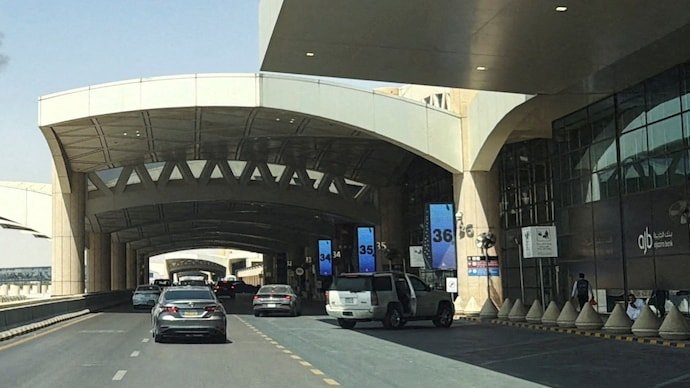
Riyadh’s King Khalid International Airport was disrupted on Thursday after Yemen’s Iran-backed Houthis claimed they had launched a ballistic missile towards the Saudi capital, while smoke was seen rising from a stationary aircraft at the airport.
The reported attack triggered flight disruptions and renewed concerns over commercial Aviation safety as Houthi attacks against Saudi targets intensify amid the wider conflict involving Yemen and the region.
Riyadh Airport Disrupted After Reported Missile Attack
Loud booms were heard in Riyadh on Thursday as the Houthis claimed responsibility for a ballistic missile launch directed towards the Saudi capital’s airport.
A witness and three people briefed on the matter said smoke was seen rising from a stationary aircraft at King Khalid International Airport. The reports came as flight activity at the airport was disrupted following the reported missile attack.
Flight-tracking service Flightradar24 said on X that Riyadh airport had been closed again. According to the service, the last landing had been recorded more than 80 minutes earlier, while the last take-off had occurred more than 90 minutes earlier.
The disruption affected both arriving and departing flights, with flight-tracking data showing numerous delays at the airport.
Houthis Claim Missile Was Fired at Riyadh Airport
The Houthis said they had launched a ballistic missile towards Riyadh airport, escalating their warnings against Saudi Arabia‘s airspace and critical Infrastructure.
The group has increasingly targeted Saudi cities and infrastructure after Riyadh backed forces loyal to Yemen’s internationally recognised government in renewed fighting against the Houthis.
The Houthis have also warned airlines and airports operating in the region, raising concerns about the potential impact of the conflict on civilian aviation.
The latest claim could not immediately establish whether the missile directly struck the airport or whether the reported smoke and flight disruption resulted from an interception or another incident connected to the attack.
Saudi-Led Coalition Says Two Ballistic Missiles Were Destroyed
The Saudi government did not immediately issue a detailed public response to the reported attack or the airport disruption.
However, the Saudi-led coalition said its forces had destroyed two ballistic missiles launched towards Riyadh.
The coalition has previously reported intercepting Houthi missiles aimed at the Saudi capital, making air defence systems a central part of Saudi Arabia’s response to the renewed attacks.
The conflicting elements of the reports a Houthi claim of a missile launch, the coalition’s statement that two missiles were destroyed and reports of smoke at the airport mean the precise circumstances surrounding the incident remained unclear.
Smoke Reported Near a Stationary Aircraft
The sight of smoke rising from a stationary aircraft at Riyadh airport added to the uncertainty surrounding the incident.
Reports from witnesses and people briefed on the situation indicated that the smoke was visible at the airport after the reported missile activity.
Footage circulating online also purportedly showed a large plume of smoke rising from the airport area. The footage was shared alongside claims about the missile attack, although the precise cause of the smoke was not immediately established.
The reported presence of smoke at an international airport is particularly significant because even an attack that is intercepted can force authorities to temporarily restrict flight operations as Security assessments are carried out.
Flight Operations Face Major Disruption
FlightRadar24 data showed substantial disruption at King Khalid International Airport following the incident.
Numerous arrivals and departures were delayed, while the airport was reported to have closed again during the period following the missile alert.
The interruption illustrates how missile attacks and air-defence activity can affect civilian aviation even when incoming projectiles are intercepted before reaching their intended targets.
Airports can be forced to pause or restrict operations while authorities assess potential threats to runways, aircraft, passengers and airport infrastructure.
For airlines, such interruptions can quickly create delays that extend beyond the immediate incident as aircraft and crews are displaced from their scheduled positions.
Houthis Renew Warning Over Saudi Airspace
The Houthis have warned that continued attacks could threaten the operation of Saudi airspace and potentially force further disruption to commercial flights.
The group’s latest claim comes as it steps up attacks against Saudi targets following Riyadh’s renewed support for forces fighting the Houthis in Yemen.
The warnings have placed airports and aviation infrastructure under increasing pressure because Riyadh is one of the region’s major air transport hubs.
Any sustained threat to the capital’s airport could have consequences extending beyond Saudi Arabia, particularly if airlines are forced to reroute, delay or suspend flights.
Yemen Conflict Spills Into Regional Aviation
The latest incident reflects how the renewed fighting in Yemen is affecting infrastructure outside the country’s borders.
The Yemen conflict had remained relatively dormant for years, but fighting has intensified again amid the wider US-Iran conflict, according to the information surrounding the latest attacks.
Saudi Arabia’s involvement in the renewed conflict has made its cities and infrastructure potential targets for Houthi attacks.
The use of ballistic missiles against targets near major population centres and airports also raises a separate concern over the safety of civilian infrastructure and international air Travel.
Previous Strikes Have Also Affected Saudi Airports
The latest incident follows reports from Saudi authorities that three people had been killed during strikes targeting Riyadh airport and Abha airport in the southwest of the kingdom earlier in the week.
The reported deaths underline the growing impact of the renewed attacks as the conflict moves beyond military positions and threatens infrastructure used by civilians.
Abha airport has previously been exposed to security threats linked to the Yemen conflict, while Riyadh’s King Khalid International Airport is a major hub for domestic and international passenger traffic.
The combination of attacks on both airports has increased concerns about the ability of commercial aviation to operate normally while missile threats remain active.
What the Riyadh Airport Incident Means for Flights
The immediate impact of Thursday’s incident was a significant interruption to flight operations at King Khalid International Airport.
With the airport temporarily closed again and numerous flights delayed, airlines and passengers faced uncertainty over when normal operations would resume.
The situation also highlights the broader challenge facing airports located within range of ballistic missile attacks. Even when air-defence forces intercept incoming missiles, the threat can still force airports to suspend operations as a precaution.
The Houthis’ warnings to airlines add another layer of risk because commercial carriers must consider not only the physical security of airport facilities but also the wider threat environment surrounding flight routes.
Regional Tensions Continue to Escalate
The reported attack on Riyadh airport comes as tensions involving Saudi Arabia, Yemen and regional powers continue to rise.
The Houthis’ decision to target or threaten major Saudi infrastructure represents an escalation from attacks confined primarily to the Yemen battlefield. Riyadh’s support for forces fighting the Houthis has further intensified the confrontation.
Saudi air-defence forces are now playing a critical role in protecting the capital and other strategic locations from missile and drone attacks.
For civilian aviation, however, the continuing attacks create a difficult operating environment in which even successful interceptions can result in airport closures, flight delays and disruption to passengers.
Riyadh Airport Attack Leaves Questions Unanswered
While the Houthis claimed a ballistic missile strike towards Riyadh airport and Saudi-led forces said they destroyed two missiles, important details of the incident remained unclear.
The source of the smoke seen rising from a stationary aircraft had not been conclusively established, and the full extent of any damage at the airport was not immediately clear.
What is clear is that the reported missile activity was serious enough to disrupt operations at one of Saudi Arabia’s most important airports.
As the renewed Yemen conflict continues to expand into a wider regional confrontation, the security of Saudi cities, infrastructure and commercial airspace is likely to remain a major concern for airlines, passengers and authorities.
For breaking news and live news updates, like us on Facebook or follow us on Twitter and Instagram. Read more on Latest World on thefoxdaily.com.




COMMENTS 0