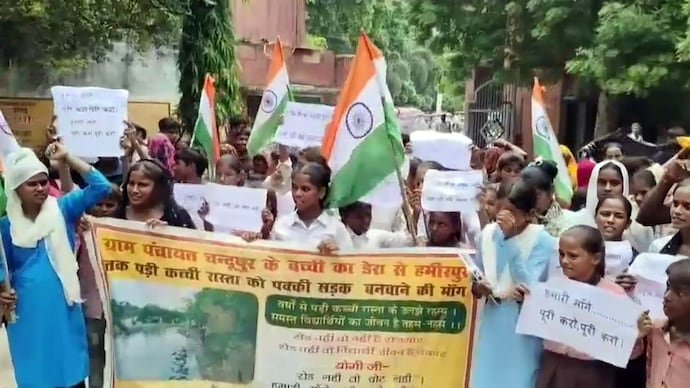
Students described as members of Gen Alpha joined villagers in Uttar Pradesh‘s Hamirpur district for an unusual protest over a basic Infrastructure demand: a paved road to their school.
Carrying the Tricolour, the students and residents of Chandu Pur gram Panchayat walked around 5 km in a ‘Tiranga Yatra’ before reaching the Collectorate. Once there, they raised slogans and staged a demonstration, demanding that authorities begin construction of a proper road connecting their area.
The protesters said students currently have to navigate a muddy and uneven route to reach school. They also claimed that no paved road has been constructed in the area since Independence.
The demonstration brought an everyday infrastructure problem into the district administration’s focus. While officials said a road project has already moved through some stages of approval, the villagers continued to demand that actual construction begin without further delay.
Why the students marched 5 km to the Collectorate
The students and villagers from Chandu Pur said the condition of the existing road creates difficulties for people travelling through the area, particularly during the monsoon.
The unpaved stretch reportedly becomes muddy when it rains, while accumulated water makes movement even more difficult. For schoolchildren WHO have to use the route regularly, the problem is not limited to occasional inconvenience.
The protesters therefore chose to take their demand directly to the district administration. Their march covered roughly 5 km before they reached the Collectorate and continued their demonstration near the District Magistrate’s gate.
Police personnel were deployed at the Collectorate as the protest continued, while the Sub-Divisional Magistrate handled the situation.
The students and residents said they would remain at the site until work on the road begins.
What the villagers are demanding
The central demand is the construction of a paved road over the existing uneven and unpaved route.
The protesters said the road is particularly difficult to use during the rainy season because water accumulates on the stretch. The condition can make routine Travel harder for students and residents alike.
According to Additional District Magistrate Rakesh Kumar, the residents submitted a memorandum formally requesting construction of the paved route.
The memorandum gives the administration a formal record of the demand, while the protest has brought greater public attention to the issue.
Administration says road project is already in process
ADM Rakesh Kumar said the administration has already taken steps toward the proposed road project.
According to Kumar, the Forest Department has provided a No Objection Certificate (NOC), removing one of the hurdles that had affected the project.
He said the proposed road is estimated to cost around Rs 1 crore. The proposal has been sent to the government, and the administration plans to invite a tender and proceed with construction after receiving the necessary approval.
This means the dispute is not necessarily over whether authorities have identified the need for a road. Instead, the immediate disagreement is over how quickly the project can move from administrative processing to actual construction.
For the villagers, the distinction offers little relief while the existing route remains difficult to use. Their demand is that the work should begin rather than remain at the proposal stage.
Why the project has remained pending
Kumar said the road project had remained pending for several years and had an estimated cost of about Rs 1 crore.
He also said the administration had previously informed villagers about the status of the matter during discussions held on different occasions.
The administration’s account suggests that the project has faced procedural delays rather than being completely ignored. The Forest Department’s NOC is now in place, while the proposal is awaiting government approval before the tendering process can move forward.
For residents, however, years of waiting have contributed to frustration. The protest indicates that they want the final administrative steps to translate into visible work on the ground.
Monsoon makes the road problem worse
The road dispute takes on greater urgency during the monsoon.
An unpaved road can become difficult to navigate when heavy rain turns the surface into mud. Water accumulation can further restrict movement and create additional challenges for people travelling on foot.
For school students, this creates a recurring problem because reaching school requires using the route regardless of Weather conditions.
The protesters’ focus on the school road also highlights how infrastructure deficiencies can affect Education indirectly. A school may be available within a village or nearby area, but reaching it safely and consistently still depends on basic connectivity.
The source material does not provide details about the school’s enrolment, the exact length of the road or the number of households that depend on it. What is clear is that students and residents regard the condition of the route as serious enough to warrant a public demonstration.
Students become the face of the protest
The participation of schoolchildren gave the demonstration a distinctive character. The students marched alongside villagers carrying the national flag and later joined the protest at the Collectorate.
Their presence also drew criticism from the administration.
Kumar alleged that some “anti-social elements” were unnecessarily escalating the issue by bringing children to the forefront of the demonstration. He pointed to family members standing behind the students during the protest.
The allegation adds another dimension to the dispute. While the villagers say they are demanding basic infrastructure, the administration has questioned the manner in which the protest was organised.
The two sides therefore present different perspectives: residents emphasise the need for a road, while the administration says the project is already progressing through the required procedures and questions the involvement of children in the demonstration.
What the Rs 1 crore road project involves
The administration has put the estimated cost of the proposed road at around Rs 1 crore.
The figure indicates that the project is being treated as a formal infrastructure proposal rather than a minor repair to the existing route. However, the source material does not specify the precise length, width or technical specifications of the proposed road.
The next administrative stages described by the ADM are government approval followed by tendering. Once the required approval is received, the administration intends to invite bids and proceed with the work.
The Forest Department’s NOC is another important step because it indicates that the administration has already obtained the clearance it said was necessary from that department.
The remaining process means that the protesters’ demand for immediate construction may not be fully aligned with the administrative timetable.
Why the protest matters beyond one village
The Hamirpur demonstration illustrates how a relatively local infrastructure issue can become a public accountability question.
For residents, a road is not simply a construction project. It determines how easily students can reach school and how residents move during periods of heavy rain.
For the administration, road construction involves approvals, funding, clearances and tendering procedures that can take time.
Both realities are visible in this dispute. The administration says the proposal is moving forward, while villagers are demanding evidence of progress in the form of actual construction.
The protest therefore reflects a common gap between administrative approval and visible delivery. A project can have a proposal, an estimated budget and a clearance while residents still experience the same infrastructure problem every day.
Gen Alpha and the language of local protest
The involvement of school-age children has also brought attention to the description of the protesters as Gen Alpha, a term commonly used for the generation born into an environment dominated by smartphones, social Media and digital communication.
But the substance of their demand is decidedly basic. Rather than seeking a digital service or Technology upgrade, the students are asking for a physical road that allows them to reach school more easily.
That contrast makes the protest notable. Children growing up in a highly connected digital era can still face gaps in basic physical infrastructure.
The use of the Tricolour and the ‘Tiranga Yatra’ format also gave the students’ demand a distinctly public and symbolic character. The march connected a local road issue with a broader appeal to the authorities to deliver essential infrastructure.
What happens next for the road project
The administration has indicated a relatively clear sequence for the project: government approval, tendering and then construction.
The key question is therefore when those stages will be completed and when physical work can begin.
If the government approves the proposal, the administration says it will invite a tender and proceed with the project. The NOC from the Forest Department has already been obtained, according to the ADM.
Until that process advances, the villagers are continuing to demand immediate action. Their stated position is that they will remain at the Collectorate until road work begins.
The administration’s response suggests that officials want residents to wait for the formal process to be completed, while the protesters want the process accelerated.
A road demand becomes a district-level issue
The Chandu Pur protest has turned a long-standing road problem into a visible confrontation between residents seeking immediate construction and officials pointing to an ongoing administrative process.
The students’ 5-km march carrying the Tricolour brought attention to the difficulties they say they face while travelling to school, particularly during the monsoon.
At the same time, the administration says the proposed project has already received a Forest Department NOC, carries an estimated cost of around Rs 1 crore and is awaiting government approval before tendering can begin.
The next stage will depend on whether that approval arrives and how quickly the tendering process can be completed. For the villagers, however, the measure of progress is likely to remain simple: whether a paved road finally appears on the route their children use to reach school.
For breaking news and live news updates, like us on Facebook or follow us on Twitter and Instagram. Read more on Latest India on thefoxdaily.com.





COMMENTS 0