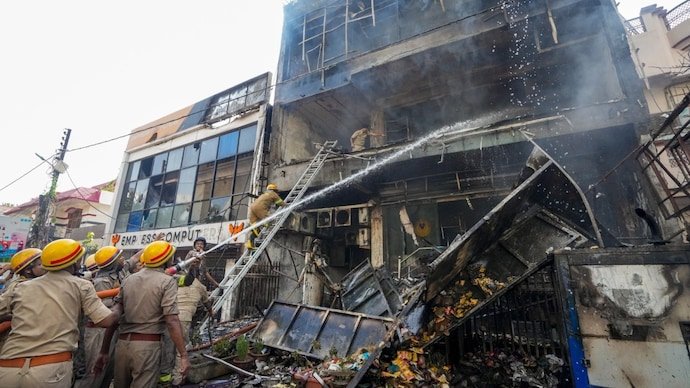
The Special Investigation Team (SIT) investigating the devastating Aliganj fire tragedy in Lucknow has uncovered multiple alleged safety failures that investigators believe significantly worsened the disaster and reduced the chances of survival for those trapped inside the burning building. According to the report submitted to the Uttar Pradesh government, critical fire safety infrastructure was either altered or absent, electrical systems were operating beyond authorized limits, and several structural irregularities existed within the commercial building.
The tragedy, which claimed the lives of 15 students and young professionals, has become one of the most closely examined fire incidents in Uttar Pradesh in recent years. Beyond determining the immediate cause of the blaze, investigators have sought to understand why evacuation proved so difficult and whether the deaths could have been prevented through compliance with established fire safety regulations.
The findings go beyond a single building. They raise broader questions about enforcement of building codes, periodic safety inspections, electrical load management, renewal of mandatory certifications, and accountability in rapidly growing urban centres where mixed-use commercial buildings often accommodate educational institutions, offices and retail businesses under one roof.
Key Findings of the SIT Investigation
| Investigation Area | SIT Findings | Potential Impact |
|---|---|---|
| Fire Exit | Emergency staircase replaced by a lift installation | Restricted evacuation during the fire |
| Additional Lift | Preparation for another lift reportedly found | Possible further violation of safety standards |
| Electrical Load | Authorized load: 20 kW; actual usage exceeded 35 kW | Possible contribution to fire intensity |
| Building Structure | Additional floor beyond approved plans | Potential violation of building regulations |
| Safety Certification | Electrical NOC reportedly not renewed after expiry | Reduced regulatory oversight |
Taken together, these findings suggest that the disaster may have resulted not from a single failure but from a combination of structural, electrical and regulatory shortcomings.
How the Missing Fire Exit Became a Critical Factor
Among the most significant observations in the SIT report concerns the building’s designated fire exit.
Investigators found that the area originally intended to accommodate an iron emergency staircase had instead been occupied by a lift installation. Emergency staircases are designed to provide occupants with an alternative escape route when smoke, flames or power failures make elevators unsafe or unusable.
According to the investigation, the absence of a functional emergency staircase severely limited evacuation options after the fire spread rapidly through the building.
The SIT concluded that if the approved fire exit had remained available and functional, many of those trapped might have been able to escape before smoke filled the upper floors.
Why Elevators Cannot Replace Fire Exits
Fire safety experts consistently advise against using elevators during building fires.
Elevators depend on electrical systems that may fail during emergencies. They can also stop between floors, expose occupants to smoke infiltration, or open directly into hazardous areas.
For this reason, modern fire safety regulations require protected emergency staircases that remain accessible throughout evacuation.
Replacing a designated emergency staircase with a lift fundamentally changes the building’s evacuation capability, particularly in multi-storey commercial structures.
Electrical Overload: A Serious Safety Concern
The SIT also highlighted significant discrepancies in the building’s electrical usage.
According to investigators:
- The authorized electricity connection was limited to 20 kilowatts.
- Actual consumption reportedly exceeded 35 kilowatts.
Operating electrical infrastructure beyond approved capacity can increase the likelihood of overheating, insulation failure, short circuits and electrical fires if systems are not upgraded appropriately.
While investigators believe excessive electrical load may have intensified the fire, the complete technical cause remains subject to the conclusions of the official investigation.
Understanding Electrical Load and Fire Risk
Electrical load represents the amount of power drawn by appliances, lighting, air-conditioning systems and equipment connected to a building.
When consumption consistently exceeds the designed capacity of wiring, switchgear and protective devices, several risks increase:
- Overheated electrical cables.
- Failure of insulation materials.
- Overloaded distribution panels.
- Greater probability of electrical arcing.
- Higher risk of short circuits.
Regular electrical audits and upgrades are essential whenever occupancy levels or equipment usage increase beyond the building’s original design assumptions.
Structural Violations Identified by the Lucknow Development Authority
A parallel investigation conducted by the Lucknow Development Authority (LDA) identified additional building-related irregularities.
Among the reported findings was the construction of an extra floor beyond approved building plans. Authorities imposed a financial penalty of nearly Rs 92 lakh in connection with these violations.
The LDA also provided the SIT with details of 18 engineers associated with approvals or oversight during different stages of the building’s development. According to the investigation, 12 of these officials have since retired.
The findings are expected to inform further examination of administrative processes and regulatory oversight.
Expired Electrical Safety Certification
The investigation further revealed concerns regarding electrical compliance documentation.
Records indicated that after the building received its 20-kilowatt electricity connection in 2000, an electrical safety-related No Objection Certificate (NOC) was issued.
However, investigators found that the certificate was not renewed after its prescribed validity period expired.
Periodic renewal of safety certifications allows authorities to verify that electrical systems continue meeting applicable standards as buildings age and usage patterns change.
Timeline of the Aliganj Fire Tragedy
| Date | Development |
|---|---|
| June 22 | Massive fire breaks out in a multi-storey commercial building in Aliganj, Lucknow. |
| Same Day | Fifteen people lose their lives while several others sustain injuries. |
| Following Days | State government orders a Special Investigation Team inquiry. |
| Subsequent Investigation | LDA identifies structural violations and imposes penalties. |
| Current Stage | SIT submits report identifying fire safety, electrical and structural lapses. |
How the Fire Spread
The building housed multiple commercial establishments, including a pet facility on the lower floors and educational and training facilities on upper levels.
According to preliminary findings, the fire spread rapidly through the structure during the afternoon.
As smoke accumulated inside the building, evacuation became increasingly difficult. Several occupants reportedly attempted to escape through windows, while others became trapped as visibility declined and exit routes became inaccessible.
Fire investigations worldwide consistently identify smoke inhalation as one of the leading causes of fatalities during building fires, often becoming life-threatening before flames reach occupants.
Why Commercial Buildings Require Multiple Layers of Fire Protection
Modern building safety relies on multiple independent systems working together.
| Safety Feature | Purpose |
|---|---|
| Emergency Staircases | Provide safe evacuation routes |
| Fire Detection Systems | Alert occupants quickly |
| Smoke Control Measures | Maintain breathable escape paths |
| Fire Extinguishers | Control small fires before escalation |
| Electrical Safety Audits | Reduce ignition risks |
| Regular Inspections | Ensure continued compliance |
When several of these safeguards fail simultaneously, the consequences can become significantly more severe.
Broader Lessons for Urban Fire Safety
The Aliganj tragedy highlights challenges faced by rapidly expanding urban centres across India.
Many commercial buildings evolve over time as owners add floors, modify layouts, install additional equipment or accommodate new businesses. Unless these changes receive proper approvals and safety assessments, original fire protection systems may no longer provide adequate protection.
Mixed-use buildings, where educational institutions, offices, shops and recreational facilities operate within the same structure, require particularly careful safety planning because occupancy patterns vary throughout the day.
The Importance of Periodic Fire Safety Audits
One important lesson emerging from the investigation is that obtaining approvals during initial construction is only part of long-term safety.
Buildings require continuous compliance through:
- Regular fire safety inspections.
- Electrical system upgrades.
- Renewal of statutory certificates.
- Maintenance of emergency exits.
- Testing of firefighting equipment.
- Periodic evacuation drills.
As buildings age and occupancy changes, these measures become increasingly important in reducing risks.
Potential Administrative and Regulatory Impact
The findings may influence broader regulatory reforms beyond this individual case.
Authorities have already initiated wider reviews of commercial building fire safety across Uttar Pradesh following the tragedy.
Possible areas of focus include:
- Stricter enforcement of approved building plans.
- Digital monitoring of safety certificate renewals.
- Improved coordination among development authorities, fire departments and electricity providers.
- More frequent inspections of high-occupancy commercial buildings.
- Enhanced accountability for unauthorized structural modifications.
Such measures could strengthen preventive oversight and reduce future risks.
Future Outlook
The SIT report represents an important step in understanding how multiple safety failures may have contributed to the Aliganj fire tragedy. As investigations continue, authorities will determine whether criminal liability, administrative action or further regulatory reforms are warranted based on the evidence gathered.
Beyond legal proceedings, the incident is likely to accelerate broader reviews of fire safety compliance across Uttar Pradesh. Greater emphasis on periodic inspections, electrical audits, emergency evacuation infrastructure and enforcement of building regulations may emerge as key priorities. For property owners, educational institutions and regulatory agencies alike, the tragedy underscores that fire safety is an ongoing responsibility rather than a one-time approval process.
Conclusion
The loss of 15 lives in the Aliganj commercial building fire has highlighted the devastating consequences that can arise when structural modifications, electrical irregularities and inadequate safety compliance converge. According to the SIT’s findings, missing emergency exits, excessive electrical load, expired safety certifications and unauthorized construction collectively created conditions that significantly reduced evacuation opportunities during the emergency.
While the legal process will determine accountability, the investigation has already delivered a broader lesson for urban development: effective fire safety depends not only on regulations but also on consistent enforcement, regular maintenance and strict adherence to approved building standards. Strengthening these safeguards will be essential to preventing similar tragedies and protecting lives in increasingly complex commercial buildings across India.
For breaking news and live news updates, like us on Facebook or follow us on Twitter and Instagram. Read more on Latest India on thefoxdaily.com.






COMMENTS 0