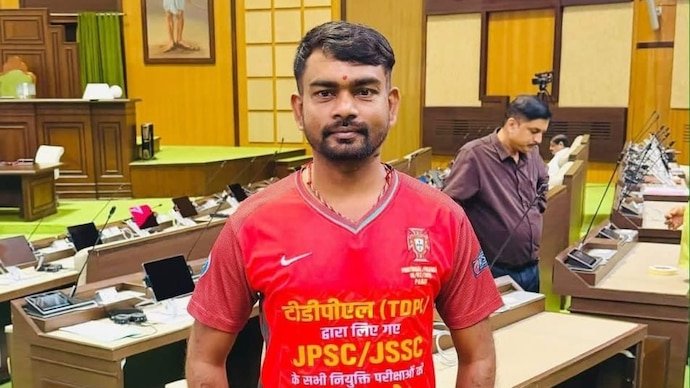
JLKM MLA Jairam Mahato will observe a day-long waterless fast in Ranchi on August 9 in support of protesting JPSC and JSSC aspirants, as negotiations with the Jharkhand government continue.
Jharkhand Loktantrik Krantikari Morcha (JLKM) MLA Jairam Mahato has announced a one-day nirjala anshan in support of students protesting over recruitment-related issues involving the Jharkhand Public Service Commission (JPSC) and Jharkhand Staff Selection Commission (JSSC).
Mahato said he would begin the waterless fast at 6 a.m. on Sunday, August 9, at the Old Assembly premises in Ranchi. His announcement comes as students continue their agitation at Jaipal Singh Munda Stadium and press the state government for concrete action on their demands.
The intervention by the Dumri MLA adds a political dimension to a protest that has already continued for nearly two weeks. The latest developments also come as the Jharkhand government prepares for another round of talks with representatives of the protesting students.
Jairam Mahato announces one-day nirjala anshan
Mahato said his decision to observe the fast was intended to express solidarity with the students and strengthen their ongoing movement.
The fast is scheduled to begin at 6 a.m. on August 9 and will continue for the day. By choosing a waterless fast, the JLKM legislator is directly associating himself with the seriousness of the students’ agitation, which has included an indefinite hunger strike.
Mahato has also indicated that his support will not necessarily end with Sunday’s symbolic protest. He said that if the students’ demands remain unresolved after the ongoing Assembly session concludes on August 12, he would intensify the movement in their support.
That statement could increase pressure on the state government at a time when the recruitment Controversy is already receiving attention inside and outside the Jharkhand Assembly.
Students continue protest over JPSC and JSSC recruitment
The student movement centres on concerns surrounding recruitment through JPSC and JSSC, the two institutions responsible for conducting important recruitment examinations for government positions in Jharkhand.
Protesting aspirants have raised allegations of irregularities and delays in the recruitment process and are demanding that their concerns be addressed by the state government.
The agitation has been continuing at Jaipal Singh Munda Stadium in Ranchi, where students have also been undertaking a hunger strike. The protest has now entered its second week, with the Health of some participants becoming an additional concern.
The dispute is significant because government recruitment examinations affect thousands of candidates who spend years preparing for limited numbers of posts. Delays, disputed examination procedures or questions over transparency can therefore have consequences well beyond a single examination cycle.
Another round of talks scheduled for Sunday
The political pressure comes as the state government continues negotiations with the protesting students.
State minister Sanjay Yadav said another round of talks between government representatives and a student delegation would take place at noon on Sunday.
The meeting is being closely watched because an earlier round of discussions ended on a positive note but did not produce a concrete resolution to the students’ demands. The continuation of talks indicates that the government and protesters have kept a channel for negotiations open, even as the agitation continues.
For the students, however, talks alone have not been enough to end the protest. Their continued presence at the stadium and plans for further mobilisation show that they are seeking specific action rather than simply another round of discussions.
Why Sunday’s talks could be important
The timing of Sunday’s meeting is significant because it comes on the same day Mahato plans to begin his fast.
The government will therefore face pressure on two fronts: negotiations with the student delegation and a political demonstration by an MLA supporting the protesters.
A successful agreement could help reduce tensions and create a path toward ending the hunger strike. Failure to make progress, on the other hand, could strengthen arguments from protesters that the government has not adequately addressed their concerns.
The precise outcome will depend on the issues discussed and whether the government can offer commitments that the student representatives consider concrete and acceptable.
Students plan Assembly march on August 10
The agitation is also expected to move closer to the state legislature.
Students have announced plans for a march toward the Jharkhand Assembly on August 10 while continuing their indefinite hunger strike. The proposed mobilisation comes during the ongoing Assembly session, increasing the political visibility of the recruitment dispute.
The timing means the Protests outside the legislature and the debate over recruitment issues inside the Assembly are likely to remain closely connected.
Recent reporting has indicated that the student movement has already attracted substantial participation in Ranchi, including a Tiranga March despite heavy rain. The protesters have continued to demand greater transparency and action over alleged problems in the recruitment system.
Recruitment dispute becomes a political issue
JPSC and JSSC recruitment have become increasingly prominent political issues as the student movement has continued.
The controversy is not limited to the demands of individual candidates. At its core is a broader question about confidence in the state’s public recruitment system.
For aspirants, recruitment examinations can determine access to government Careers after years of preparation. That makes transparency, predictable schedules and confidence in examination procedures particularly important.
When candidates believe that recruitment has been delayed or conducted unfairly, restoring confidence can require more than a political assurance. It may require clear explanations, examination-specific decisions and a transparent process for addressing individual grievances.
Mahato’s role adds political weight to the agitation
Mahato’s decision to participate directly in the protest gives the movement an additional political voice.
The JLKM legislator is the party’s lone MLA in the current Jharkhand Assembly, where he represents Dumri. His participation means the student agitation now has an elected legislator publicly committing himself to a form of protest traditionally associated with grassroots movements.
His announcement also goes beyond a statement of support. A waterless fast places the MLA physically at the protest site and gives his backing a visible public dimension.
His warning that he could intensify the movement after August 12, if the demands remain unresolved, could become more significant if Sunday’s negotiations fail to produce an agreement.
The government faces a difficult balancing act
The Jharkhand government now has to balance continued dialogue with the need to manage an increasingly visible student agitation.
Maintaining negotiations provides an opportunity to resolve the dispute without further escalation. At the same time, the government’s response will be closely watched by students and political groups seeking assurances that recruitment concerns will be addressed.
The situation is particularly sensitive because the protests are taking place during the Assembly session. That creates greater opportunities for opposition parties and individual legislators to raise the issue, while student mobilisation outside the Assembly can increase public attention.
For the government, a durable solution would need to address the substance of the students’ complaints rather than simply reduce demonstrations temporarily.
What the students are demanding
The current agitation involves concerns over the recruitment processes conducted through JPSC and JSSC. Protesters have alleged irregularities and delays and are demanding action to address what they describe as problems in the system.
The precise demands have developed around specific examinations and recruitment processes, meaning that the eventual solution may need to address multiple issues rather than a single decision.
The students’ continued hunger strike also means that the health of protesters has become part of the immediate concern surrounding the agitation.
As the fast continues, the government’s ability to demonstrate progress through negotiations could become increasingly important in preventing the protest from escalating further.
Why the dispute matters for Jharkhand’s job aspirants
Government recruitment is particularly important in a state where competitive examinations attract large numbers of candidates for a limited number of posts.
An examination is not simply a test conducted on a particular date. Candidates invest time, money and years of preparation in the expectation that the recruitment process will follow predictable and transparent rules.
When recruitment is delayed or questions are raised about examination procedures, candidates can face uncertainty over their age eligibility, preparation schedules and future Career plans.
That is why the current JPSC-JSSC agitation has gained momentum beyond a dispute over individual examinations. The protesters are seeking confidence that the recruitment system will operate fairly and transparently.
What happens after August 9?
The immediate focus will be Sunday’s government-student talks and Mahato’s planned waterless fast.
If the discussions produce a concrete roadmap for addressing the students’ demands, the government could have an opportunity to reduce tensions before the planned Assembly march on August 10.
If no agreement emerges, the protest could enter a more confrontational phase, particularly because Mahato has already indicated that he intends to intensify his support after the Assembly session if the demands remain unresolved.
The August 10 Assembly mobilisation could then become another major test for both the protesters and the administration.
A crucial few days for the JPSC-JSSC agitation
The next several days are likely to determine whether the Jharkhand government’s negotiations can produce a workable resolution or whether the student movement will expand further.
Mahato’s one-day nirjala anshan on August 9 gives the protesters a prominent political show of support, while the scheduled government-student meeting offers another opportunity for dialogue.
At the same time, the planned Assembly march on August 10 means the recruitment dispute will remain firmly in the political spotlight.
For the students, the central issue remains their demand for action on concerns surrounding JPSC and JSSC recruitment. For the government, the immediate challenge is to turn ongoing talks into concrete steps that can restore confidence among protesting aspirants.
Until that happens, the agitation is unlikely to disappear. Mahato’s announcement suggests that, if the negotiations fail to deliver a resolution, the movement could instead gain another layer of political support and become a larger issue in Jharkhand’s ongoing public and legislative debate.
For breaking news and live news updates, like us on Facebook or follow us on Twitter and Instagram. Read more on Latest India on thefoxdaily.com.





COMMENTS 0