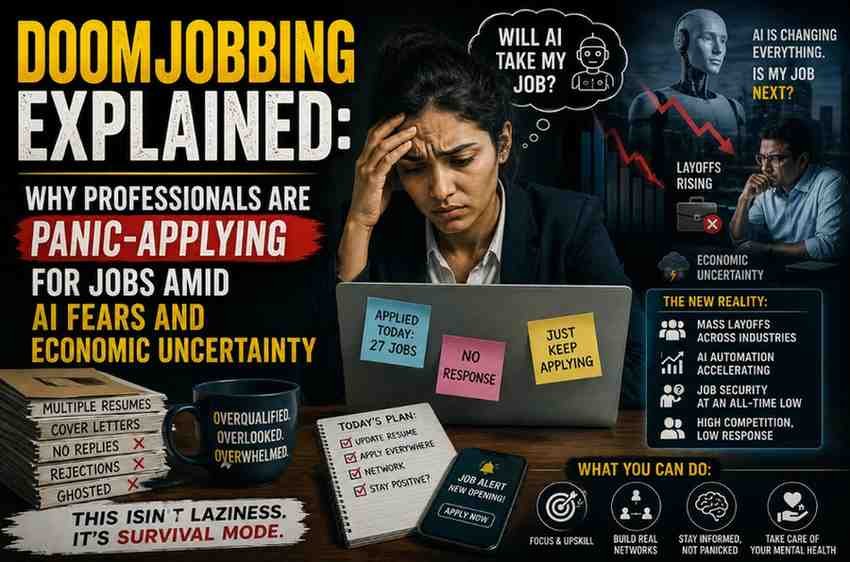
For years, people have spoken about doomscrolling the endless consumption of alarming news on social media. Now, career experts are seeing a similar phenomenon in the world of work. It is called doomjobbing, and it describes the growing tendency of employees to constantly search job listings and send applications out of fear rather than genuine interest.
The trend is being fueled by rapid advances in Artificial Intelligence, economic uncertainty, layoffs across multiple industries, and concerns about the future of work. Instead of waiting for a crisis to arrive, many professionals are trying to stay one step ahead even if that means applying to dozens of jobs they have little intention of accepting.
While the behavior may seem proactive, experts warn that doomjobbing can become emotionally draining and may actually increase career anxiety rather than reduce it.
What Is Doomjobbing?
Doomjobbing refers to the habit of repeatedly browsing job portals, updating resumes, and submitting applications compulsively, often without a clear goal or genuine desire to change roles.
Unlike strategic career planning, doomjobbing is usually driven by fear.
Common triggers include:
- Concerns about layoffs.
- Artificial intelligence replacing jobs.
- Economic uncertainty.
- Industry disruptions.
- Fear of missing opportunities.
- Social media discussions about job losses.
Many professionals describe feeling that they need to “keep moving” even when they are relatively satisfied with their current positions.
Why AI Is Fueling Career Anxiety
The rise of artificial intelligence has transformed conversations about employment. While AI promises greater productivity and new opportunities, it has also raised concerns about automation and changing skill requirements.
Workers increasingly wonder:
- Will my role still exist in five years?
- Should I switch industries?
- Am I learning fast enough?
- Will AI outperform certain tasks I perform today?
- Am I falling behind?
These uncertainties can create a persistent sense of vulnerability, even among highly skilled professionals.
The Career Version of Doomscrolling
Psychologists often compare doomjobbing to doomscrolling because both behaviors share a common pattern.
People repeatedly seek information in hopes of feeling more secure, but instead they become trapped in cycles of anxiety.
For example, someone may:
- Browse LinkedIn multiple times a day.
- Apply for jobs without reading descriptions carefully.
- Refresh job alerts obsessively.
- Compare themselves with peers constantly.
- Experience stress despite having stable employment.
The search itself becomes habitual rather than purposeful.
Comparison: Strategic Job Searching vs Doomjobbing
| Strategic Job Search | Doomjobbing |
|---|---|
| Driven by career goals | Driven by anxiety and uncertainty |
| Selective applications | Mass applications |
| Research-based decisions | Impulsive behavior |
| Long-term planning | Short-term emotional reactions |
| Improves career satisfaction | Often increases stress |
Why Even Successful Professionals Are Doomjobbing
Doomjobbing is not limited to people who are unemployed or dissatisfied.
Many individuals with stable jobs are engaging in it because uncertainty itself has become a source of stress.
Contributing factors include:
- Layoff headlines.
- Rapid technological change.
- Competitive job markets.
- Fear of becoming obsolete.
- Pressure to continuously optimize Careers.
- The culture of constant hustle.
Ironically, professionals who are performing well may still feel insecure about their future.
An Insight Competitors Often Miss: Doomjobbing Reflects a Crisis of Confidence, Not Necessarily a Crisis of Employment
One of the biggest misconceptions about doomjobbing is that it is caused solely by economic instability.
In reality, many people panic-apply despite being employed and relatively secure. The deeper issue may be psychological rather than financial.
Modern work culture rewards constant optimization. Employees are encouraged to always upgrade skills, seek promotions, build personal brands, and remain marketable.
As a result, careers increasingly feel like moving targets rather than stable journeys.
Doomjobbing may therefore reveal a crisis of confidence and predictability rather than a simple shortage of jobs.
The Role of Social Media in Career Anxiety
Professional networking platforms have transformed how people think about work.
Daily exposure to posts about:
- Layoffs.
- Career changes.
- High salaries.
- Success stories.
- AI disruption.
- Reskilling trends.
can create a distorted perception that everyone else is progressing faster.
This constant comparison may encourage unnecessary job searching.
How Doomjobbing Can Affect Mental Health
While preparing for future opportunities is healthy, compulsive job searching can become emotionally exhausting.
Potential consequences include:
- Burnout.
- Sleep disturbances.
- Difficulty focusing on current work.
- Imposter syndrome.
- Anxiety.
- Reduced job satisfaction.
Ironically, fear-driven job hunting may undermine performance in the very role a person hopes to protect.
Is AI Really Eliminating Jobs?
Artificial intelligence is undoubtedly transforming industries, but history shows that technological revolutions often change jobs rather than eliminate work entirely.
AI is likely to:
- Automate repetitive tasks.
- Create new types of employment.
- Increase demand for digital skills.
- Enhance productivity.
- Require continuous learning.
Rather than replacing entire professions overnight, AI is more likely to reshape how work is performed.
Prediction: Career Resilience Will Matter More Than Job Security
Experts increasingly believe that traditional job security is being replaced by something more valuable career resilience.
Future success may depend on:
- Adaptability.
- Lifelong learning.
- Digital literacy.
- Communication skills.
- Problem-solving abilities.
- Emotional intelligence.
The most resilient professionals may not be those who apply for the most jobs, but those who continuously evolve their skills and remain flexible.
How to Avoid Falling Into the Doomjobbing Trap
Career experts recommend adopting a more intentional approach.
- Set specific career goals.
- Update skills regularly.
- Limit compulsive job browsing.
- Focus on quality rather than quantity when applying.
- Build professional networks.
- Maintain perspective about AI and economic news.
Preparation is valuable, but panic rarely leads to good decisions.
Why This Trend Says More About Work Than Workers
Doomjobbing reflects broader shifts in the modern workplace.
The era of spending decades in one company is fading. Careers are becoming increasingly dynamic, and uncertainty has become part of professional life.
Workers are responding to that uncertainty the same way they respond to troubling headlines with endless searching.
The challenge is learning to distinguish between thoughtful preparation and fear-driven behavior.
Conclusion
Doomjobbing the habit of panic-applying for jobs in response to AI fears and economic uncertainty is emerging as the career equivalent of doomscrolling. While staying prepared and adaptable remains important, experts warn that compulsive job searching can increase anxiety rather than provide reassurance.
As artificial intelligence reshapes industries and work becomes more fluid, professionals may need to shift their focus from chasing absolute security to building resilience, skills, and confidence. In an unpredictable world, the most valuable asset may not be the number of applications sent, but the ability to adapt to change without being consumed by it.
After all, the future of work is uncertain but panic has never been a career strategy.
For breaking news and live news updates, like us on Facebook or follow us on Twitter and Instagram. Read more on Latest Lifestyle on thefoxdaily.com.






COMMENTS 0