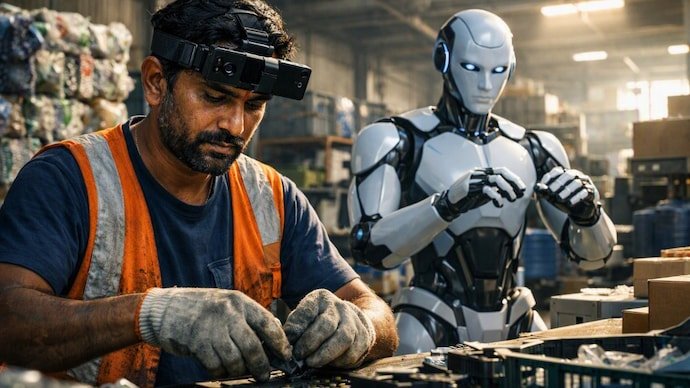
For some Indian Workers, earning a little more money now involves wearing a camera on their head while they do the job they were already hired to perform.
The arrangement sounds simple: record everyday physical tasks, follow normal work routines and receive additional compensation. But the footage has a much bigger purpose. It is being collected as training data for Artificial Intelligence systems and robots that need to learn how humans move through the physical world.
That makes India an increasingly important source of what the Robotics industry calls egocentric data first-person recordings that capture tasks from the worker’s perspective. Unlike the text and images used to train many AI systems, robots need data about hands, objects, movement, timing and physical environments.
The emerging business has created a new source of income for some workers. It has also created an uncomfortable question: are people being paid to help build machines that could eventually perform the jobs they currently depend on?
Recent reporting has documented workers across India using head-mounted cameras and other recording devices while performing tasks in factories, warehouses and other workplaces. The trend is part of a wider global race to gather enough real-world data to make humanoid and industrial robots more capable.
Why are Indian workers wearing cameras while they work?
Traditional AI systems can learn from enormous quantities of material already available online. Robots face a different problem.
A robot needs to understand how a human hand approaches an object, how much force is needed to pick it up, how fingers change position when an item slips and how a person adjusts movements when the environment changes.
Those small physical decisions are difficult to capture using ordinary written instructions.
A description such as “pick up the package and place it on the shelf” tells a robot very little about the hundreds of movements involved. First-person video can show the sequence in detail: where the worker looks, where the hands move, how the object is positioned and what happens when the expected movement does not go perfectly.
That is why companies developing embodied AI and humanoid robots are increasingly interested in recordings of real human activity.
Indian workers are particularly valuable to this effort because the country still has a huge workforce performing labour-intensive tasks in manufacturing, logistics, Agriculture, construction and other sectors. The variety of those tasks creates an enormous potential pool of training examples.
India’s labour market has become a source of robotics data
India’s role in the robotics data economy is not simply about low wages. Scale and variety are equally important.
Workers across the country perform thousands of different physical tasks every day. A factory worker may operate a sewing machine, adjust equipment or assemble components. A warehouse employee may scan products, pick items and pack orders. A recycling worker may sort materials by type and remove labels.
Each activity produces a different set of movements.
For robotics developers, that diversity is valuable because a machine trained only in a controlled laboratory may struggle when confronted with the unpredictability of an ordinary workplace.
Research and industry development increasingly focus on giving robots the ability to generalise what they have learned from one physical situation to another. Real-world recordings are therefore an important part of building systems capable of functioning outside carefully designed demonstrations.
Indian data companies and Technology startups have begun building pipelines that collect, clean, label and prepare this footage for customers developing AI and robotics systems.
What is “egocentric data”?
Egocentric data is information captured from a first-person perspective, typically through a camera worn by a person.
For robotics, the appeal is obvious. A head-mounted camera can record what a worker sees while simultaneously capturing the movement of the hands and interaction with objects.
But raw video is not automatically useful to a robot.
It may need to be cleaned, segmented and annotated. Individual actions can be identified, objects labelled and important movements marked so that machine-learning systems can associate what a person does with the environment in which the action occurs.
This makes the data pipeline much larger than simply asking someone to wear a camera.
There is the equipment, the recording process, storage, quality control, annotation, privacy management and eventual delivery of datasets to companies developing robotics systems.
How much extra money can workers make?
The additional income varies depending on the task, the company collecting the footage and the quality of the resulting data.
One example in the supplied reporting involves Delhi-area recycling worker Sunita Rathore, who was described as earning an additional Rs 150 an hour for recording her work while sorting plastic waste.
Other reported workers have received smaller daily payments for recording tasks at factories and warehouses.
For workers on relatively modest incomes, even a small hourly supplement can be meaningful. Extra earnings can help cover household expenses, Education or savings without requiring a completely separate job.
That economic incentive helps explain why the model is expanding.
For the companies purchasing the data, meanwhile, the value can be much greater than the immediate payment to the person wearing the camera. Once processed and incorporated into a commercial AI system, a large dataset can become part of the Infrastructure used to develop an automated product.
This creates an unusual economic relationship: a worker may receive a short-term payment for producing data that has potentially long-term commercial value.
The uncomfortable question: who benefits when robots learn?
The most striking aspect of this emerging business is its built-in contradiction.
A worker is paid to demonstrate how a task is performed. The recording is then used to help a machine learn that task. If the resulting technology becomes reliable enough, an employer could eventually have the option of automating some version of the same work.
That does not mean every job being recorded will disappear.
Robots remain limited by cost, reliability, maintenance requirements, safety rules and the difficulty of operating in unpredictable environments. A successful laboratory demonstration does not automatically translate into a commercially viable replacement for a human worker.
Nevertheless, the direction of the technology is clear: robotics companies want machines capable of performing increasingly complex physical tasks.
That creates a legitimate concern for workers who are helping supply the training data.
The paradox is particularly sharp in India because the country has a large supply of relatively low-cost human labour. The same economic conditions that make India attractive for data collection can also reduce the immediate financial incentive for companies to replace workers with expensive robots.
But if robotics costs fall, the equation could change.
Why human movement data is becoming valuable
The next stage of robotics development is not simply about making machines stronger or faster. It is about making them more adaptable.
A robot working in a highly structured factory can be programmed to repeat the same movement thousands of times. The challenge becomes much harder when objects vary in size, workers move around the machine, lighting changes or an item is placed incorrectly.
Humans handle these variations almost automatically.
Someone sorting waste does not need to calculate the exact coordinates of every plastic bag before picking it up. A warehouse worker can recognise a familiar product, adjust their grip and place it into a box without consciously calculating every step.
Those intuitive behaviours are precisely what robotics developers are trying to capture.
Real-world recordings can expose AI systems to the messy details of human work that cannot easily be reproduced through scripted demonstrations.
India offers something robotics companies need: scale
India’s manufacturing and services ecosystem provides an unusually broad range of physical activities within one country.
Workers sew clothing, assemble products, sort recyclable material, package goods, handle tools, prepare food and move objects through warehouses. The informal economy adds another layer of physical work that is rarely represented in conventional robotics datasets.
For AI developers, this creates a potentially valuable training environment.
The Indian Express has reported that head-mounted cameras are being used in Indian factories to capture workers’ movements, with the recordings forming part of a broader push to collect egocentric data. The reporting also highlighted concerns among workers about the possibility that the data could eventually contribute to Automation of their jobs. :contentReference[oaicite:0]{index=0}
The trend has also been documented beyond factory floors. Reporting has described companies seeking data from informal workers and other people performing everyday physical tasks, widening the potential pool of human-motion information available to robotics developers. :contentReference[oaicite:1]{index=1}
The privacy problem is bigger than a camera pointed at someone’s hands
Recording a worker’s movements may sound relatively harmless if the camera captures only hands and objects. In practice, first-person footage can reveal much more.
A head-mounted camera can capture faces, voices, workplace conversations, personal belongings, computer screens, homes and other people who never agreed to participate.
That creates a difficult question about informed consent.
A worker may agree to wear a camera because an employer or contractor offers additional pay. But agreeing to record a task does not necessarily mean the worker understands who will ultimately receive the footage, how long it will be retained, whether it will be resold or what future AI systems may be trained on it.
The workplace itself can make consent complicated. An employee who depends on a job may not feel completely free to refuse a request from management, even when the request involves recording personal activity.
Recent reporting has raised precisely these concerns, noting that some companies have relied on permissions obtained through factory management rather than seeking consent directly from individual workers. :contentReference[oaicite:2]{index=2}
India’s data-protection rules are changing, but not all provisions apply immediately
India’s Digital Personal Data Protection Act, 2023 provides the country’s statutory framework for processing digital personal data. The government notified the Digital Personal Data Protection Rules, 2025, in November 2025, establishing a phased implementation schedule. :contentReference[oaicite:3]{index=3}
The timeline is important because it is more complicated than simply saying that India’s data-protection law is either “in force” or “not in force.”
Some provisions took effect immediately, while consent-manager provisions are scheduled for the one-year stage and the main substantive provisions covering areas such as notice, consent, data-fiduciary obligations and data-principal rights are scheduled for the 18-month stage in May 2027. :contentReference[oaicite:4]{index=4}
That phased rollout matters for the robotics-data industry because the collection of worker footage is likely to involve questions about personal data, purpose, transparency, security, retention and the rights of individuals whose information appears in recordings.
It would be too broad to conclude that the law automatically resolves every issue surrounding worker-generated robotics data. The exact legal treatment depends on the Nature of the recording, the parties processing it and the applicable provisions at the time.
But the expanding data-collection industry makes those questions increasingly difficult to ignore.
Workers may be creating an asset they do not own
There is another economic issue beyond privacy: data ownership and compensation.
A worker traditionally sells time and physical effort to an employer. In the new model, that same worker can also produce a digital record of their skills and movements.
The recording may then be cleaned, labelled and incorporated into a dataset that is sold to another company.
That raises a fundamental question: should the worker’s compensation end with the hourly payment for recording, or should workers have some claim over the continuing commercial value of the data?
There is no simple answer.
Companies incur significant costs to collect, process, secure and commercialise datasets. Workers, meanwhile, provide the underlying physical knowledge that makes the recordings valuable. Traditional employment contracts were not necessarily designed for this type of relationship.
The issue becomes even more complicated when a factory negotiates directly with a data-collection company. A worker may not know whether the footage is being used internally, sold to an AI laboratory or incorporated into a commercial robotics system.
Could this actually cost Indian workers their jobs?
It could contribute to automation, but it would be misleading to say that the cameras alone will eliminate jobs.
Robot adoption depends on far more than training data. Machines must be affordable, reliable and capable of working safely in real environments. Businesses also need infrastructure to deploy, maintain and repair them.
In many sectors, robots are more likely to change jobs than immediately erase them. A worker could shift from manually performing a task to supervising machines, maintaining equipment, checking quality or handling exceptions that automation cannot manage.
At the same time, some repetitive tasks are particularly vulnerable if robotics systems become capable and economically competitive.
The impact will therefore vary by occupation.
| Type of work | Why robotics data matters | Potential impact |
|---|---|---|
| Factory work | Records repetitive and skilled physical movements | Some tasks could become easier to automate |
| Warehouse work | Captures picking, packing and scanning routines | Automation could reduce some repetitive handling tasks |
| Recycling | Shows robots how humans sort irregular objects | Machines may eventually assist with or automate selected sorting tasks |
| Agriculture | Provides examples of physical work in changing environments | Could support future agricultural robotics |
The paradox of India’s robotics opportunity
India could benefit significantly from becoming a hub for robotics data.
The industry creates new work in data collection, annotation, quality control, AI operations and robotics development. It also gives workers another way to earn income from skills they already possess.
But there is a difference between creating jobs around automation and ensuring that workers benefit from automation itself.
If Indian workers provide the data while the highest-value robotics companies and intellectual property remain elsewhere, the country could end up supplying a critical raw material without capturing a comparable share of the long-term economic value.
That is why the question should not be limited to whether workers receive Rs 150 or Rs 300 extra today.
The larger issue is who owns the resulting data, who can commercialise it, who controls its future uses and whether workers receive any continuing benefit from the technologies built using their recorded labour.
What happens when the robot learns the job?
For workers, the immediate incentive is straightforward: extra money for additional recording work.
The long-term picture is much harder to predict.
Some of the robots being trained today may never become commercially successful. Others may assist workers rather than replace them. Some could eventually take over specific repetitive tasks while creating new technical and supervisory roles.
But the possibility of displacement is real enough to make the economics of the arrangement worth examining now rather than after automation arrives.
A worker who records thousands of movements is not merely performing a task. They may be contributing to a digital representation of a skill developed over years of human experience.
That makes the payment structure important.
If the worker receives a small one-time or hourly supplement while a company obtains a dataset that can be reused across products and markets, the two sides may be assigning very different values to the same activity.
The next debate may be about a new kind of labour
The rise of robotics training data is creating a new category of work that sits between physical labour and digital labour.
The worker still performs the physical task, but a camera converts those actions into data. That data can then become part of an AI system capable of reproducing aspects of the same skill.
India’s advantage in this emerging market is clear: a huge and diverse workforce, established manufacturing and logistics industries, and companies capable of collecting and processing data at scale.
The challenge is ensuring that this advantage does not come at the expense of workers’ privacy, bargaining power or long-term economic interests.
The immediate story may be about an extra Rs 150 an hour. The bigger story is about the value of human movement in the age of robotics.
For decades, workers were paid because machines could not easily reproduce what they knew how to do with their hands. Now, cameras and AI systems are beginning to turn that knowledge into training data.
Whether that becomes a new opportunity for workers or simply another step toward automation will depend on what happens after the footage is recorded who owns it, who profits from it and whether the people who taught the machines receive a meaningful share of the future value their work helped create.
For breaking news and live news updates, like us on Facebook or follow us on Twitter and Instagram. Read more on Latest Technology on thefoxdaily.com.






COMMENTS 0