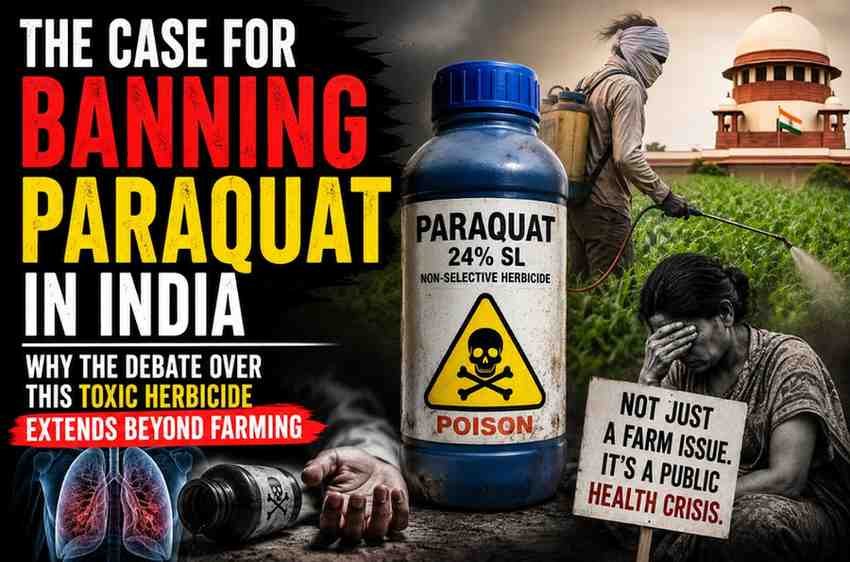
Few agricultural chemicals have sparked as much controversy worldwide as paraquat. Praised for its effectiveness and affordability, the herbicide has become an important tool for weed management in many countries, including India. Yet it is also among the most toxic chemicals used in Agriculture, and its association with fatal poisonings and potential long-term health risks has led dozens of nations to ban or severely restrict its use.
India now faces a difficult question: do the benefits of paraquat as an inexpensive and efficient weed killer outweigh its costs to human health and public safety?
The answer is not straightforward. It involves balancing agricultural productivity, farmer livelihoods, healthcare costs, and the ethical responsibility of preventing avoidable deaths.
What Is Paraquat and Why Is It So Widely Used?
Paraquat is a non-selective herbicide that kills unwanted weeds by disrupting photosynthesis. Farmers value it because it acts quickly, is relatively inexpensive, and helps reduce labor costs associated with manual weeding.
It is commonly used in:
- Tea plantations.
- Cotton farming.
- Fruit orchards.
- Rubber plantations.
- Various cereal and cash crops.
For farmers dealing with labor shortages and rising production costs, paraquat provides an effective means of controlling weeds and improving yields.
Why Is Paraquat So Controversial?
The controversy stems from one undeniable fact: paraquat is extremely toxic to humans.
Even small amounts can cause severe poisoning, leading to irreversible damage to the lungs, kidneys, liver, and other organs. Unlike many other toxic exposures, there is no specific antidote for paraquat poisoning.
Doctors often describe it as one of the most difficult poisonings to treat because survival rates remain low after ingestion.
Health experts point to several concerns:
- Accidental poisoning.
- Intentional self-harm using the chemical.
- Occupational exposure among agricultural workers.
- Inadequate protective equipment.
- Unsafe storage and handling practices.
Why Many Countries Have Banned Paraquat
More than 70 countries have prohibited or restricted paraquat use due to safety concerns. These decisions have been driven primarily by evidence showing the chemical’s role in poisoning deaths and the difficulties associated with safe handling.
Countries that have moved away from paraquat argue that the risks to Public Health outweigh its agricultural advantages.
Supporters of bans also note that highly toxic pesticides disproportionately affect low- and middle-income countries, where access to protective equipment and emergency medical care may be limited.
| Benefits of Paraquat | Risks Associated with Paraquat |
|---|---|
| Highly effective weed control | Extremely toxic to humans |
| Affordable for farmers | No specific antidote exists |
| Reduces labor requirements | Risk of accidental poisoning |
| Fast-acting herbicide | Potential occupational exposure |
| Helps improve crop productivity | Frequently involved in self-poisoning cases |
An Overlooked Issue: The Economic Cost of Poisoning
Discussions about paraquat often focus on farming economics, but experts argue that the healthcare burden associated with poisoning deserves equal attention.
Hospitalization, intensive care treatment, loss of productivity, and long-term disability can impose enormous costs on families and healthcare systems.
In cases of fatal poisoning, the social consequences extend far beyond medical expenses, affecting livelihoods and communities.
When these indirect costs are considered, the apparent affordability of paraquat becomes more complicated.
Can Paraquat Be Used Safely?
Supporters of continued use argue that proper training, protective equipment, and strict regulation can reduce risks.
Recommended safety measures include:
- Using protective clothing and gloves.
- Proper labeling and packaging.
- Secure storage away from homes.
- Farmer education programs.
- Restricted access and controlled sales.
However, critics question whether such safeguards can be consistently implemented across India’s vast and diverse agricultural landscape.
In smaller rural areas, limited awareness and insufficient resources may undermine even well-designed regulations.
The Link Between Paraquat and Public Health
Public health experts increasingly view pesticide policy as more than an agricultural issue. They argue that chemical safety should be considered part of a broader strategy to prevent poisonings and reduce avoidable deaths.
Studies from various countries have shown that restricting access to highly toxic pesticides can contribute to reductions in suicide mortality.
This perspective has shifted the paraquat debate from crop management to one involving mental health, emergency care, and preventive medicine.
What Are the Alternatives?
Several approaches can help reduce dependence on paraquat:
- Mechanical weed control.
- Integrated weed management strategies.
- Crop rotation techniques.
- Mulching and cover crops.
- Less toxic herbicides.
However, these alternatives may require additional labor, training, or financial investment, creating challenges for small-scale farmers.
Balancing Farmer Needs With Public Safety
India’s agricultural sector supports millions of livelihoods, making any policy changes highly sensitive. A sudden ban without affordable alternatives could increase production costs and create economic difficulties for farmers.
At the same time, public health experts argue that the value of human life and safety must remain central to regulatory decisions.
Some specialists advocate for a phased approach that combines:
- Gradual restrictions.
- Farmer education programs.
- Investment in safer alternatives.
- Improved poison control systems.
- Support for transitioning away from hazardous chemicals.
What Lies Ahead for India?
The debate over paraquat reflects a broader challenge facing modern agriculture: how to achieve productivity without compromising human health.
As scientific evidence, public awareness, and international regulatory trends continue to evolve, policymakers will likely face increasing pressure to reassess the herbicide’s future.
The decision will require weighing agricultural efficiency against healthcare costs, economic realities against ethical responsibilities, and immediate benefits against long-term consequences.
Conclusion
There is little doubt that paraquat is an effective and affordable herbicide. The more difficult question is whether its benefits justify the substantial risks it poses to human health.
For India, the debate is no longer simply about weeds. It is about how a country balances food security, farmer welfare, and public health in an era where the true cost of agricultural chemicals extends far beyond the fields where they are sprayed.
For breaking news and live news updates, like us on Facebook or follow us on Twitter and Instagram. Read more on Latest Health on thefoxdaily.com.






COMMENTS 0