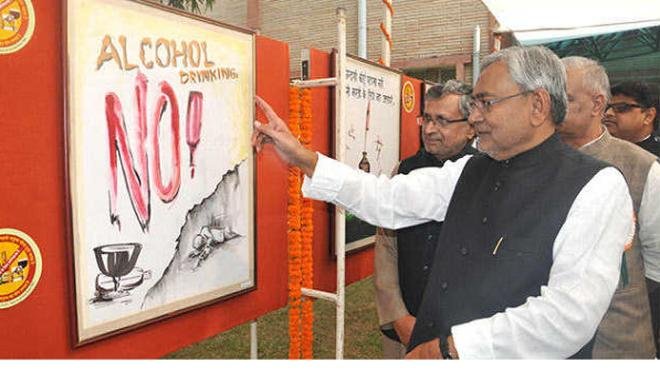
Bihar’s alcohol ban has returned to the centre of a heated policy debate after a recent report argued that prohibition has failed to reduce violence against women and has cost the state substantial revenue. But those conclusions do not capture the full evidence available on the policy’s social effects.
Bihar introduced complete prohibition in April 2016, banning the manufacture, sale, storage and consumption of alcohol. The policy was presented not merely as a revenue or law-and-order measure, but as a social intervention intended to improve household welfare, reduce alcohol-related harm and strengthen women’s wellbeing.
A decade later, the evidence is considerably more complicated than either side of the debate suggests. Some studies have found reductions in alcohol consumption and intimate-partner violence after prohibition. Other analyses have raised serious concerns about enforcement, illicit alcohol, alternative intoxicants, criminal-justice costs and lost government revenue.
The important question, therefore, is not simply whether Bihar’s alcohol ban “worked” or “failed”. The more useful question is: which outcomes improved, which problems emerged, and how should those competing effects be measured?
What changed after Bihar banned alcohol?
The Bihar government’s prohibition policy was introduced in 2016 with an unusually broad objective. It was intended to address alcohol consumption as a social and public-health problem rather than treating drinking only as an individual choice.
Before prohibition, alcohol consumption was widespread among men in Bihar. National Family Health Survey data from 2015-16 showed that nearly 30% of men aged 15-49 reported consuming alcohol. The same period was also associated with a substantial burden of intimate-partner violence among women.
That background matters because prohibition was never designed solely to increase government revenue or reduce recorded crime. It was also intended to alter household behaviour.
Research published after the ban has found evidence that drinking patterns changed. One study examining the first three years of prohibition reported a substantial reduction in self-reported alcohol use among both men and women, although it also found changes in the types of alcohol and intoxicants being consumed.
This distinction is important. A fall in reported alcohol consumption does not automatically mean that every health and social problem associated with substance use disappears. But it does indicate that prohibition changed behaviour in at least some parts of the population.
Did Bihar’s alcohol ban reduce violence against women?
This is perhaps the most contested part of the current debate.
A recent report has argued that Bihar’s prohibition did not produce the expected decline in crimes against women. That claim should not simply be dismissed, but neither should it be treated as definitive proof that prohibition failed to improve women’s safety.
The reason is methodological.
Recorded crime and actual violence are not the same thing. Police statistics depend on reporting, registration, policing practices, awareness of legal remedies and women’s willingness to approach authorities. Domestic violence, in particular, can remain hidden even when it occurs frequently.
Academic research using household survey data has produced a different picture from some analyses based on reported crime. A study using National Family Health Survey data found that women in Bihar reported that their husbands were less likely to drink after prohibition and that women were less likely to experience intimate-partner violence.
Another population-level analysis published in 2024 found relative reductions in emotional and sexual violence among women in Bihar after the alcohol ban. The study estimated a relative decline of 4.8 percentage points in emotional violence and 5.5 percentage points in sexual violence in its difference-in-differences analysis.
These findings do not prove that prohibition eliminated violence against women. They do, however, directly challenge the simple conclusion that the ban produced no improvement in women’s safety.
Why “crime against women” is a poor single test of prohibition
One of the biggest weaknesses in the current debate is the tendency to treat all violence against women as though it has one cause.
Alcohol can contribute to aggression and domestic violence, but it is not the underlying cause of every violent act against women. Gender inequality, coercive control, economic dependence, family conflict, social norms and access to justice can all influence violence.
Removing alcohol from a household can therefore reduce one important trigger without eliminating the structural conditions that permit violence.
This leads to a crucial distinction:
- Alcohol can be a risk factor for violence.
- Alcohol is not the sole cause of violence against women.
- Prohibition can reduce alcohol-related harm without eliminating violence altogether.
- Women’s safety requires interventions beyond alcohol policy.
In other words, expecting an alcohol ban by itself to solve violence against women sets an unrealistic standard for any public-health intervention.
The strongest argument for prohibition may be household welfare
The debate often focuses on crime and government revenue, but household economics may provide another important lens.
When a household member who previously spent a significant share of income on alcohol stops or reduces drinking, the money does not necessarily disappear. It can be redirected towards food, children’s education, healthcare, debt repayment, savings or household necessities.
Surveys reported in 2026 have highlighted such changes, with women reporting improvements in household financial management, decision-making and overall wellbeing following prohibition.
These outcomes are difficult to capture in conventional government revenue calculations.
A state may lose excise revenue when legal alcohol sales disappear, but households may simultaneously experience changes in spending patterns. The correct economic comparison therefore cannot simply be:
Liquor tax lost = policy cost.
A fuller analysis must also ask what happens to household expenditure, health costs, productivity, accidents, domestic conflict and children’s welfare.
The revenue argument is real—but incomplete
Critics of prohibition are correct about one fundamental issue: a government that prohibits legal alcohol sales gives up the excise and other revenues that would otherwise come from a regulated market.
For a state with substantial development needs, that is not a trivial consideration.
Revenue from alcohol taxation can theoretically finance public services such as healthcare, education, infrastructure and social protection. The argument for repealing prohibition therefore has an economic logic.
But comparing the lost excise revenue with the social benefits of prohibition requires a broader cost-benefit framework.
For example, policymakers would need to examine:
- healthcare costs associated with harmful alcohol use;
- household spending that would otherwise have gone towards alcohol;
- workplace productivity and absenteeism;
- road accidents and other alcohol-related harms;
- domestic violence and its economic consequences;
- costs of enforcing prohibition;
- court and prison-system burdens;
- losses associated with illegal alcohol markets; and
- the potential tax revenue from a regulated alcohol market.
Without considering both sides of that ledger, declaring the ban either an economic disaster or an unquestionable success is premature.
The biggest weakness of prohibition: the illegal market
No serious assessment of Bihar’s alcohol ban can ignore illicit supply.
When demand for an intoxicating product remains while legal supply is prohibited, an illegal market can emerge. Enforcement therefore becomes central to the policy.
Research and reporting from Bihar have documented concerns about illicit liquor and shifts towards other intoxicating substances. The existence of an illegal market creates several risks, including adulterated alcohol, criminal networks, corruption and additional pressure on police and courts.
This is one of the clearest areas where prohibition can create unintended consequences.
A legal alcohol market is visible and taxable. An illegal market is hidden, harder to regulate and potentially more dangerous.
That does not automatically prove that prohibition should be abandoned. It does mean that enforcement quality and treatment of substance-use disorders are critical to the policy’s success.
Prohibition versus regulation: the real policy comparison
The debate becomes more useful when Bihar’s model is compared with two broad alternatives: prohibition and regulated availability.
| Issue | Prohibition model | Regulated-market model |
|---|---|---|
| Legal alcohol availability | Highly restricted or prohibited | Permitted under licensing and taxation |
| Government excise revenue | Substantially reduced or absent from legal sales | Potentially significant |
| Control over legal supply | High in principle, but dependent on enforcement | Direct through licensing, taxation and regulation |
| Illegal-market risk | Potentially significant where demand persists | Can be reduced through legal availability and enforcement |
| Public-health objective | Seeks to reduce consumption by eliminating legal supply | Seeks to reduce harmful consumption through price, availability and regulation |
| Household effects | Potential savings for households where drinking falls | Depends on drinking patterns and taxation |
| Enforcement burden | High if illegal supply remains widespread | Focused on licensed sellers, violations and harmful use |
Neither model is automatically successful. A regulated market can still produce alcohol-related disease, addiction and domestic violence. Prohibition can reduce legal consumption while creating enforcement and illicit-market problems.
The policy question is therefore about which combination of interventions produces the greatest reduction in harm.
A better way to measure Bihar’s alcohol policy
The most useful insight missing from much of the public debate is that Bihar should not evaluate prohibition through a single headline indicator.
Instead, the state could establish a long-term alcohol harm dashboard covering multiple dimensions of health and social welfare.
Such a framework could track alcohol consumption, hospital admissions, liver disease, road injuries, domestic violence reported through surveys, police cases, household expenditure, school attendance, workplace productivity, illicit-liquor deaths, substance-use treatment and government enforcement costs.
That would allow policymakers to answer a much more important question: Is total alcohol-related harm falling?
This is a stronger measure than asking only whether liquor-tax collections have fallen or whether police-registered crimes against women have changed.
Women’s experiences deserve more weight in the evaluation
Another important lesson from the evidence is that policy evaluation should not depend entirely on administrative records.
Women living in households affected by alcohol consumption can experience changes that never become police cases or hospital records. Reduced financial stress, greater household spending on necessities, fewer drunken arguments and greater control over household decisions may not appear in crime statistics.
At the same time, women in households where illicit substances replace alcohol may experience new risks that official alcohol-consumption figures fail to capture.
This is why repeated household surveys are essential.
Women should be asked directly about household finances, alcohol use, physical and emotional violence, decision-making, safety and access to support services. These measurements can complement administrative data rather than replacing them.
Self-help groups could be an overlooked part of the solution
Research on Bihar has also pointed to the complementary role of women’s self-help groups in strengthening women’s empowerment and reducing vulnerability to intimate-partner violence.
This offers a broader lesson: alcohol policy works differently when combined with women’s economic and social empowerment.
If prohibition reduces household alcohol expenditure but women remain financially dependent and have limited access to support, the social gains may be smaller than expected.
Conversely, linking prohibition-related programmes with self-help groups, livelihood opportunities, financial literacy, domestic-violence support and healthcare could potentially convert a reduction in drinking into broader improvements in family wellbeing.
The next decade should focus on harm reduction, not just prohibition enforcement
Bihar has now accumulated roughly a decade of experience with prohibition. That makes it possible to move beyond the original political argument and examine the policy as a long-running public-health experiment.
The next phase should arguably focus on three questions.
- Is alcohol consumption actually lower?
- Are households and women demonstrably better off?
- Are the harms created by illegal markets and enforcement greater than the benefits achieved?
The answers may differ across districts, income groups and communities.
That variation matters. A policy can generate meaningful social benefits for some households while creating serious unintended consequences elsewhere. Recognising both realities is more useful than forcing Bihar’s experience into a simple success-or-failure narrative.
What the new debate gets right—and what it misses
The recent criticism of Bihar’s prohibition contains legitimate concerns. Revenue loss matters. Illegal alcohol markets matter. Enforcement costs matter. The possibility that alternative intoxicants may replace alcohol matters.
But the argument becomes incomplete when it treats crime statistics as the sole measure of women’s wellbeing.
Existing research provides evidence of reductions in certain forms of intimate-partner violence and alcohol consumption after prohibition. Studies have also identified changes in health and household outcomes. At the same time, the policy has clearly generated enforcement and economic challenges.
The evidence therefore supports a more nuanced conclusion: Bihar’s alcohol ban appears to have produced measurable social benefits alongside significant economic and enforcement costs.
Conclusion: Bihar’s alcohol ban needs a fuller scorecard
The debate over Bihar’s alcohol ban should not be reduced to a choice between “social welfare” and “government revenue”. Both matter, and both can be measured.
Evidence available from household surveys and academic studies suggests that prohibition has reduced reported alcohol use and was associated with reductions in some forms of intimate-partner violence. At the same time, the policy has sacrificed legal alcohol revenue and created serious challenges involving illicit supply, enforcement and the criminal-justice system.
The most credible position lies between the two extremes.
Calling prohibition an unquestionable success ignores the costs of illegal markets and lost revenue. Calling it an outright failure because recorded crimes against women did not disappear ignores evidence from household-level research showing improvements in alcohol consumption and certain forms of violence.
The next stage of Bihar’s policy should therefore be evidence-led. The state needs a comprehensive measure of alcohol-related harm that includes women’s safety, household welfare, health outcomes, illicit-market activity, enforcement costs and public revenue.
If the objective is genuinely social wellness, then the ultimate test should not be how much liquor tax Bihar collects—or how many prohibition cases police register. It should be whether families are healthier, women are safer, household finances are stronger and alcohol-related harm is genuinely declining.
That is the scorecard against which Bihar’s decade-long experiment should ultimately be judged.
For breaking news and live news updates, like us on Facebook or follow us on Twitter and Instagram. Read more on Latest Health on thefoxdaily.com.

COMMENTS 0