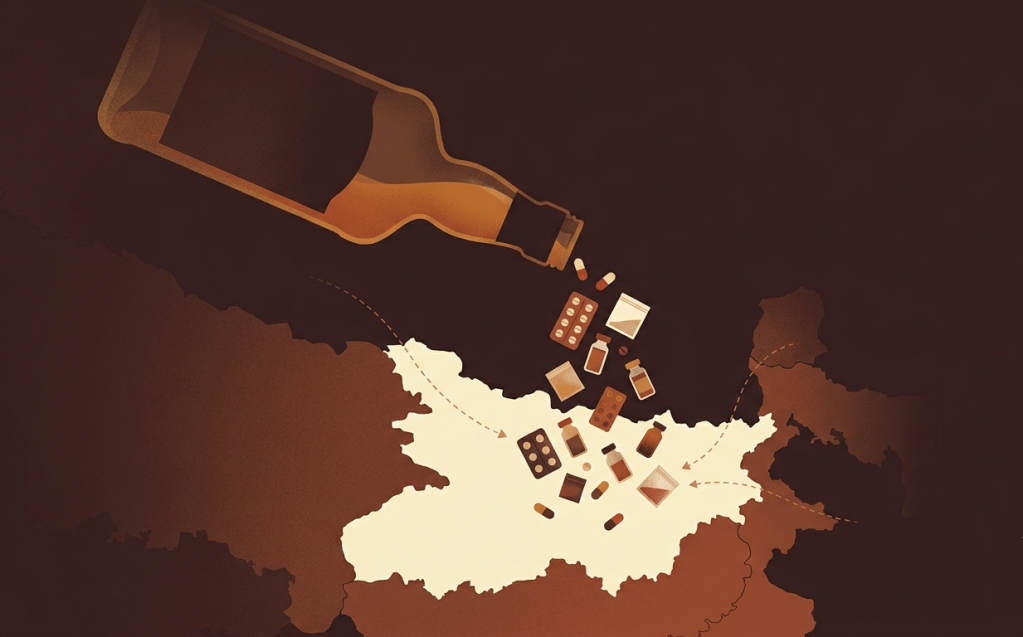
Nearly a decade after Bihar introduced prohibition in April 2016, the state is confronting a serious challenge beyond the illegal liquor trade: the growing availability of narcotics and pharmaceutical drugs. From heroin and brown sugar to tablets, injectable substances and a raw drug variant known locally as kota, a parallel illegal market appears to be expanding, raising concerns among police officials, doctors and social workers.
Police data cited in an investigation by The Indian Express show that Bihar has seized approximately 3.16 crore litres of liquor and made around 7.15 lakh arrests linked to prohibition over the past 10 years. That works out to an average of roughly 8,650 litres seized and 196 arrests every day.
Yet the figures tell only part of the story. The investigation points to the emergence of a different kind of illicit market, one in which small quantities of drugs can be concealed and transported more easily than bulky liquor consignments. Packets of brown sugar, tablets, injection vials and heroin can be hidden in everyday objects, complicating detection and enforcement.
A review of police records, government data and conversations with law enforcement personnel, doctors and social workers over three months also highlighted a sharp rise in cases registered under the Narcotic Drugs and Psychotropic Substances Act, 1985, commonly known as the NDPS Act. Police have expressed concern about the possible links between drug availability and juvenile crime, while the capacity of de-addiction services remains another major challenge.
Here is an overview of the major findings, the routes through which drugs enter Bihar, the changing seizure patterns and the questions surrounding treatment and prevention.
Bihar’s Drug Crisis in Numbers
The Numbers Behind the Growing Problem
The available figures illustrate the scale of enforcement under prohibition and the growing attention being paid to narcotics. Liquor seizures and arrests have accumulated over a decade, while NDPS cases, drug seizures and treatment-related figures have reportedly increased in more recent years.
- 3.16 crore litres: Approximate quantity of liquor seized in Bihar since prohibition began in April 2016.
- 7.15 lakh arrests: Approximate number of arrests linked to prohibition over the same period.
- About 8,650 litres daily: Average liquor seizures calculated across the 10-year period.
- About 196 arrests daily: Average based on the reported total number of prohibition-related arrests.
- 2021–2025: The period during which NDPS cases reportedly increased each year, according to the investigation.
These figures describe different aspects of the problem. Liquor seizures and prohibition-related arrests measure enforcement under Bihar’s alcohol ban, while NDPS cases concern offences involving narcotic drugs and psychotropic substances. They should not be treated as interchangeable indicators.
Similarly, an increase in registered cases does not automatically establish the precise scale of drug consumption. Case totals may reflect changes in trafficking, policing, reporting and enforcement practices. Seizure data also depend on where officers conduct operations and which substances they target.
Nevertheless, the reported upward trend in NDPS cases has brought renewed attention to the changing nature of Bihar’s illicit drug market.
Why Drugs Are Replacing Liquor in Bihar
The Price of a High: Why Cheaper Drugs Are Filling Liquor’s Gap
Bihar’s prohibition policy was introduced to restrict alcohol consumption and the sale of liquor across the state. However, the existence of an illegal alcohol market has meant that people seeking liquor can still encounter black-market supplies, often at significantly higher prices.
According to officers cited in the investigation, a bottle of illicit liquor can cost around Rs 1,500. That price has raised questions about whether some users are turning to other intoxicating substances that may be available in smaller, less expensive quantities.
Drugs can differ considerably in price, potency, duration of effect and health risks. The investigation’s central concern is that small doses of certain substances may offer users an alternative to expensive illicit liquor, creating a market that is easier to conceal and potentially harder for enforcement agencies to disrupt.
Unlike a bottle of alcohol, a small packet, tablet or vial can be carried without attracting immediate attention. Such substances can also be hidden in personal belongings or ordinary household items. These characteristics make searches and routine checks more challenging, particularly when traffickers move small quantities rather than large consignments.
However, the reported price difference does not establish that prohibition alone caused Bihar’s drug problem. Drug trafficking is influenced by several factors, including supply networks, demand, affordability, local availability and the ability of criminal groups to evade enforcement.
The broader policy challenge is therefore twofold: preventing illegal alcohol sales while ensuring that efforts to restrict one intoxicating substance do not overlook other forms of substance misuse.
How Drugs Reach Bihar: The Northeast Pipeline
From the ‘Death Triangle’ to Bihar’s Streets
The investigation identifies the Northeast as an important route for some of the heroin and kota reaching Bihar. According to the reporting, much of this supply originates in Myanmar before moving through northeastern India and onward to other parts of the country.
Myanmar lies within the region commonly known as the Golden Triangle, a longstanding centre of illicit drug production and trafficking in Southeast Asia. The term is sometimes used in public discussion alongside other labels for areas associated with the narcotics trade. The specific routes and networks used in individual seizures, however, require case-by-case verification.
The reported trafficking pattern suggests that Bihar may function not only as a destination market but also as a transit point for drugs moving to other states. This distinction matters because local seizures may capture only a portion of a larger supply chain.
Ganja and poppy husk are reported to reach Bihar through separate routes involving Nepal and neighbouring Indian states. These different supply channels mean that a single enforcement strategy is unlikely to address every substance or trafficking network equally effectively.
Drug routes can change as traffickers respond to surveillance, border checks, arrests and seizures. A route identified in police records should therefore be understood as part of an evolving network rather than a permanent or exclusive pathway.
Why the Northeast Connection Matters
When narcotics move across multiple states or international borders, effective enforcement requires coordination among agencies operating in different jurisdictions. A seizure in Bihar may be connected to a supplier, transporter or distribution network located hundreds of kilometres away.
Investigators may need to trace the origin of a consignment, identify financial links, examine communications and determine whether separate cases involve the same criminal network. Inter-state cooperation can help authorities move beyond the arrest of individual couriers to identify the people organising the trade.
At the same time, enforcement must distinguish between people involved in trafficking and individuals experiencing substance dependence. A public-health response focused on treatment and prevention is essential alongside efforts to disrupt illegal supply.
Inside Police Files: How Bihar Cops Map the Drug Trade
How Bihar Police Map the Drug Trade
A Bihar Police document reviewed by The Indian Express reportedly contains maps showing where different drugs are produced and the routes through which they travel. Three of the four maps described in the investigation depict Bihar as a corridor for drugs headed towards other states.
Such mapping can help investigators understand the relationships between production areas, transit points and destination markets. It can also help police compare seizure locations with suspected transport routes and identify areas where additional intelligence gathering may be necessary.
However, a route map is not necessarily a complete representation of the illegal market. It reflects the information available to investigators and may not capture every movement, concealed distribution network or emerging route.
Mapping also has practical limitations. A district with many recorded seizures may have a large trafficking problem, but it may also have more intensive policing or better detection. Conversely, fewer recorded cases do not necessarily prove that drug activity is limited.
For this reason, police maps are most useful when read alongside seizure quantities, case registrations, arrests, intelligence reports and information about local treatment needs.
What Bihar Police Are Seizing: From Ganja to Cocaine
From Ganja to Cocaine: What Bihar Police Seized Between 2022 and 2026
Seizure records covering 2022 to 2026 provide another way to examine the changing drug landscape in Bihar. The investigation reports that police have encountered a range of substances, including ganja, heroin, cocaine and pharmaceutical products in tablet and injectable forms.
One of the key findings is that pharmaceutical drugs, including tablets and injections, have reportedly recorded the fastest growth in seizures. This has raised concerns about the possible misuse of medicines and the distribution of products outside legitimate medical channels.
Not every pharmaceutical drug is an illegal narcotic, and not every medicine seizure indicates the same type of offence. The legal status of a product depends on its ingredients, classification, authorisation and the circumstances in which it is possessed or distributed. Some medicines have legitimate clinical uses but can be misused or sold unlawfully.
Injectable products also present particular public-health concerns when used without medical supervision. Depending on the substance and method of use, risks may include overdose, infection and other serious complications.
To understand the seizure trend fully, it is important to distinguish between the number of cases, the number of tablets or vials recovered, and the total weight of seized substances. These measurements answer different questions and cannot always be compared directly.
The supplied investigation summary does not provide a complete year-by-year breakdown of every substance or its exact seizure quantity. Those figures should be taken from the original data graphics or official records rather than estimated.
Where NDPS Cases Are Rising: Bihar’s District Drug Map
Bihar’s Drug Map: NDPS Cases by Police District, 2021 to 2026
According to the investigation, the number of NDPS cases in Bihar rose every year from 2021 through 2025. Some of the sharpest growth was reported in the state’s northeast, pointing to a changing geographical distribution of registered drug offences.
District-level mapping can help show where the recorded burden is increasing and whether patterns differ between areas. It may also help authorities identify locations requiring additional investigation, prevention programmes or access to treatment.
However, police districts with high case totals should not automatically be labelled the state’s biggest drug markets. Case counts can be affected by the number of people living in an area, the intensity of policing, the volume of transport passing through it and the methods used to register offences.
For a fair comparison, analysts would ideally examine several measures together: cases registered, seizures by substance, arrests, population, repeat offences and treatment demand. Trends over multiple years can be more informative than a single year’s total.
The investigation’s reported year-on-year increase through 2025 suggests that the problem requires sustained attention. The supplied summary does not state a final statewide NDPS case total for 2026, nor does it provide the full district-wise figures needed to rank every police district accurately.
Why District-Level Data Matter
Different districts may face different challenges. Areas used as transit corridors may require stronger intelligence-sharing and transport monitoring, while locations experiencing drug use among residents may need more prevention, outreach and treatment services.
District-level data can also help government departments assess whether health services are located near communities that need them. Police enforcement alone cannot address dependence if people have limited access to confidential counselling, medical assessment and appropriate rehabilitation support.
Who Is at Risk? The Young and the Untreated
Cheap Drugs and Concerns About Juvenile Crime
Police officials cited in the investigation have expressed concern that inexpensive drugs may be reaching younger people. They have also raised questions about a possible relationship between substance use and juvenile crime.
These concerns deserve attention, but a reported concern is not the same as proof that drug use is responsible for a particular increase in juvenile offences. Establishing such a connection requires reliable data and an examination of other factors, including family circumstances, poverty, peer influence, school participation and access to social support.
Early exposure to intoxicating substances can create serious risks, particularly when products are obtained illegally or used without medical supervision. Adolescents may also face barriers to seeking help because of stigma, fear of punishment or concerns about how disclosure will affect their families.
Prevention programmes can help by providing age-appropriate information, strengthening school and community support, and making it easier for young people to speak with trained professionals. Families and teachers can play a role by recognising warning signs and seeking qualified assistance rather than relying on punishment alone.
De-Addiction Services Struggle to Keep Pace
The investigation also highlights a gap between growing concern about substance misuse and the availability of treatment. According to the supplied report, central government-backed de-addiction facilities operate in fewer than one-third of Bihar’s districts.
This does not necessarily mean that no other treatment or counselling services exist in the remaining districts. Government-backed facilities are only one part of the wider healthcare system, which may include state-run hospitals, private providers, community organisations and other services. Nevertheless, the reported geographic gap raises questions about whether support is accessible to people who need it.
Effective treatment can require medical evaluation, counselling, continuing care and support for families. Depending on the substance involved and the individual’s circumstances, some people may need supervised medical treatment rather than an informal or unregulated rehabilitation arrangement.
Expanding treatment access involves more than opening facilities. Services need trained personnel, appropriate medical support, referral systems and follow-up care. Confidentiality and respectful treatment are also important because stigma can discourage people from seeking help early.
Public-health experts commonly distinguish between reducing the supply of illegal drugs and reducing the harm experienced by people who use them. A comprehensive response needs both approaches, with prevention and treatment working alongside law enforcement.
What Bihar’s Drug Crisis Means for Policy
Bihar’s experience illustrates the limits of evaluating a prohibition policy through liquor seizures and arrests alone. Those figures provide an indication of enforcement activity, but they do not reveal the entire pattern of substance use or the emergence of alternative illegal markets.
The reported rise in NDPS cases, changes in seizure patterns and limited distribution of central government-backed de-addiction facilities point to several areas that require attention.
- Improve intelligence-sharing: Coordination between Bihar Police and agencies in neighbouring states can help investigators trace supply chains that cross jurisdictional boundaries.
- Track substances separately: Data should distinguish narcotics, psychotropic substances and pharmaceutical products, rather than combining different categories into a single headline figure.
- Strengthen district-level monitoring: Comparing cases, seizures and treatment needs can help authorities identify emerging patterns without relying on raw case totals alone.
- Expand access to treatment: Better geographical coverage, trained staff and referral pathways can make professional help easier to obtain.
- Protect young people: School-based prevention, community outreach and accessible counselling can help address substance-related risks before they become more serious.
- Evaluate outcomes: Policy assessments should examine not only arrests and seizures but also prevention, treatment access, repeat offending and public-health outcomes.
These measures would help policymakers distinguish between disrupting trafficking networks and addressing the health and social consequences of drug dependence.
Frequently Asked Questions About Bihar’s Drug Market
Why Are Drug Cases Rising in Bihar After Prohibition?
The investigation reports that NDPS cases increased each year from 2021 to 2025. Possible factors include the expansion of illegal supply networks, the availability of smaller and easier-to-conceal substances, and changes in enforcement activity. The available summary does not establish that prohibition alone caused the rise.
What Is ‘Kota’ Drug in Bihar?
Kota is described in the investigation as a raw variant associated with the illegal drug market in Bihar. The supplied material does not provide a verified chemical composition or precise classification, so it would be inappropriate to identify its ingredients or effects without additional evidence.
How Do Drugs Reach Bihar?
The investigation identifies routes through the Northeast for heroin and kota, with some supplies reportedly originating in Myanmar. Ganja and poppy husk are described as arriving through separate routes involving Nepal and neighbouring Indian states. Specific trafficking routes can change over time.
How Many NDPS Cases Has Bihar Registered in 2026?
The supplied investigation summary does not state the final number of NDPS cases registered in 2026. It reports that cases rose annually from 2021 through 2025. A complete 2026 total would need to be checked against the original investigation’s graphics or official police data, including the period covered by the figures.
Which Districts in Bihar Are Drug Hotspots?
The investigation reports particularly sharp growth in some parts of northeastern Bihar. However, the supplied summary does not include the complete district-wise figures needed to identify or rank every hotspot. The number of cases should also be considered alongside population, policing intensity and seizure data.
How Much Liquor Has Been Seized Since Bihar Introduced Prohibition?
Police have seized approximately 3.16 crore litres of liquor since Bihar introduced prohibition in April 2016, according to the figures cited in the investigation. The reported total is accompanied by approximately 7.15 lakh prohibition-related arrests.
Is Drug Use Among Young People Rising in Bihar?
Police officials have raised concerns that cheap drugs may be reaching juveniles and may be linked to juvenile crime. However, the supplied material does not provide comprehensive age-specific prevalence data establishing the extent of drug use among young people. More detailed health and social research would be needed to quantify the trend.
What Is Bihar Doing to Tackle the Drug Trade?
Police are registering NDPS cases, conducting seizures and mapping suspected trafficking routes. The investigation also raises concerns about the availability of de-addiction services. The supplied material does not provide a complete list of current government initiatives, budgets or district-level treatment expansion plans.
What Is the NDPS Act?
The Narcotic Drugs and Psychotropic Substances Act, 1985, is India’s principal law governing narcotic drugs and psychotropic substances. It establishes legal controls and penalties concerning activities such as the production, possession, sale, purchase and trafficking of substances covered by the law, subject to the Act’s provisions and applicable rules.
Why Are De-Addiction Centres Important?
De-addiction services can provide medical assessment, counselling, treatment and ongoing support for people experiencing substance dependence. Their availability matters because enforcement measures alone cannot address the health consequences of drug use or ensure that people who need treatment can access it.
The Bigger Picture: From Alcohol Prohibition to a Wider Drug Challenge
Ten years of prohibition have produced substantial liquor seizures and arrests in Bihar, but the reported growth of the narcotics market has created a different and complex challenge. Small packets, tablets and injection vials are more easily concealed than large liquor consignments, while supply routes may stretch across international borders and several Indian states.
The rise in recorded NDPS cases, the reported increase in pharmaceutical drug seizures and concerns about access to treatment suggest that Bihar’s response must extend beyond traditional enforcement measures. Better intelligence, reliable data, prevention programmes and accessible healthcare will all be important in addressing the problem.
The central question is no longer only how much illegal liquor police can seize. It is also how effectively authorities can disrupt drug supply chains, protect vulnerable young people and ensure that people struggling with substance dependence can obtain professional help.
Note: The figures and findings in this article reflect the supplied summary of The Indian Express investigation. Exact 2026 case totals, full district rankings, detailed seizure quantities and the chemical composition of kota were not provided in that summary and should not be inferred.
For breaking news and live news updates, like us on Facebook or follow us on Twitter and Instagram. Read more on Latest India on thefoxdaily.com.


COMMENTS 0