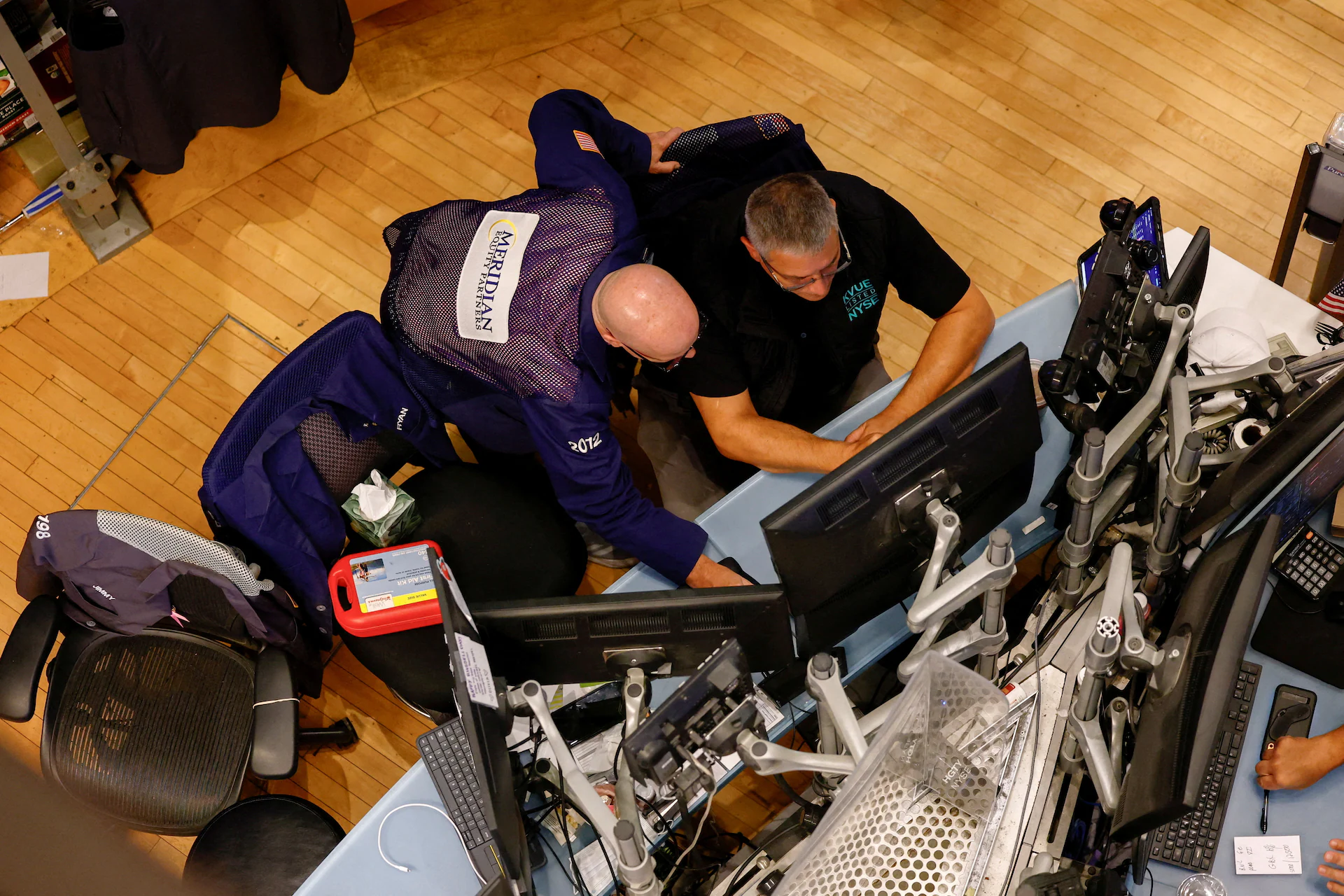
The S&P 500 traded near flat on Friday as renewed concerns about Artificial Intelligence (AI) investments weighed on semiconductor and technology stocks, while gains in banking and materials shares helped limit broader market losses. The Dow Jones Industrial Average climbed to its highest level in more than a month, supported by advances in Goldman Sachs and JPMorgan Chase.
Investors remained cautious about the financial risks surrounding AI infrastructure companies, particularly data-centre operators carrying substantial debt. Meanwhile, hotter-than-expected US inflation data and uncertainty over the Federal Reserve‘s next interest-rate decision added to market concerns.
Wall Street Indexes Show Mixed Performance
At 10:24 a.m. Eastern Time on Friday, the Dow Jones Industrial Average had risen 221.78 points, or 0.43%, to 52,401.89. The S&P 500 slipped 7.30 points, or 0.09%, to 7,736.76, while the Nasdaq Composite fell 185.88 points, or 0.70%, to 26,527.14.
The S&P 500’s information technology sector was the biggest drag on the benchmark, declining 0.9%. Losses in major technology companies also weighed on the Nasdaq, with Alphabet and Meta Platforms each falling around 1%.
By contrast, most other S&P 500 sectors advanced. Materials shares led the gains, rising 1.6%, while financial stocks climbed 1.1%. Strength in banking shares helped the Dow outperform the other major indexes.
AI Investment Concerns Pressure Semiconductor Stocks
Renewed doubts about the sustainability of the AI investment boom continued to weigh on chipmakers and companies providing infrastructure for AI services. Investors have become increasingly concerned about whether heavy spending on data centres will generate sufficient returns to justify the financing costs.
Nvidia-backed data-centre operator CoreWeave fell 7.6% as concerns about its debt burden persisted. The company’s bonds sold off sharply during the week, pushing yields above 15%, reflecting increased investor concern about its financing risks.
Other companies operating in the so-called neocloud sector also came under pressure. Nebius Group and Iren each declined more than 5.5% as investors reassessed the outlook for businesses expanding computing infrastructure to meet demand for AI services.
Semiconductor shares extended their recent losses. Micron Technology fell 3.9%, while Advanced Micro Devices declined 3.3%. The broader semiconductor index dropped 1.8% and was on course for its steepest eight-session percentage decline since the market sell-off associated with the US “Liberation Day” tariff announcements in April 2025.
The weakness followed concerns about intensifying Chinese competition in memory chips and the growing debt exposure of companies investing heavily in AI infrastructure.
David Morrison, senior market analyst at Trade Nation, said the developments had given investors a reason to reduce their exposure to companies linked to AI. He added that it remained unclear whether the pullback represented routine profit-taking following the previous session’s rebound or the beginning of a more serious market correction.
Anthropic Valuation Adds to AI Financing Concerns
Questions about the cost of financing AI development extended beyond infrastructure companies. According to a Reuters report citing people familiar with the matter, some existing Anthropic investors and prospective investors were considering a lower valuation for the company ahead of its planned initial public offering (IPO).
The reported discussions added to concerns about whether valuations across the AI sector can be sustained as companies face rising investment requirements and increased scrutiny of their potential returns.
Although demand for AI technology remains a major driver of investment, the latest market movements suggest investors are becoming more selective. Companies with significant borrowing requirements may face greater pressure if financing costs remain elevated or revenue growth fails to meet expectations.
Banking Shares Help Dow Reach One-Month High
While technology shares struggled, financial stocks provided support to the broader market. Gains in Goldman Sachs and JPMorgan Chase helped push the Dow to its highest level in more than a month.
Financial shares rose 1.1%, making the sector one of the strongest performers among S&P 500 industries. Materials stocks performed even better, advancing 1.6% and leading the market’s sector gains.
Tesla shares also edged higher after the electric vehicle manufacturer unveiled a redesigned Roadster developed in collaboration with SpaceX. The vehicle features rocket-style thrusters, drawing attention despite the wider weakness in technology-related stocks.
Elsewhere, Varonis Systems rose 2.8% after Thoma Bravo’s cybersecurity company Proofpoint agreed to acquire the data security firm in an all-cash transaction valued at $6.3 billion.
Netflix shares fell 2.3% after the streaming company appointed former Disney executive Peter Rice as its chief content officer on Thursday.
Inflation and Federal Reserve Policy Remain in Focus
Investors were also assessing the implications of stronger-than-expected US consumer and producer inflation figures released during the week. The data indicated that price pressures were extending beyond energy products, complicating the outlook for monetary policy.
Federal Reserve Chair Kevin Warsh said increased spending was contributing to inflation but also noted that the US economy remained resilient and was benefiting from the investment boom associated with artificial intelligence.
Markets increasingly expect the Federal Reserve to leave interest rates unchanged at its meeting this month. However, persistent inflation could complicate the outlook for future rate decisions, particularly if higher borrowing costs continue to weigh on businesses investing in capital-intensive technologies.
The combination of inflation uncertainty, financing pressures and concerns about AI valuations has encouraged investors to reassess their exposure to some of the market’s strongest-performing technology companies.
S&P 500 and Nasdaq Face Weekly Losses
Despite Friday’s gains in several sectors, the S&P 500 and Nasdaq were on course to record weekly losses. The AI-led sell-off, mixed bank earnings and persistent inflation concerns had weighed on sentiment throughout the week.
The Dow, in contrast, was positioned for a weekly advance, reflecting the relative strength of financial stocks and other companies outside the technology sector.
Market breadth showed that advancing shares outnumbered declining stocks by 1.87 to 1 on the New York Stock Exchange and by 1.12 to 1 on the Nasdaq.
The S&P 500 recorded 15 new 52-week highs and no new lows. The Nasdaq Composite registered 40 new highs and 119 new lows, highlighting continued weakness among a section of technology and growth stocks.
Friday’s mixed performance underscored a market increasingly divided between investors’ continued interest in AI-driven growth and concerns about the debt, valuations and financing costs associated with the investment boom. Whether technology shares stabilise will depend partly on companies’ ability to demonstrate sustainable returns and on the direction of inflation and interest rates.
For breaking news and live news updates, like us on Facebook or follow us on Twitter and Instagram. Read more on Latest Business on thefoxdaily.com.






COMMENTS 0