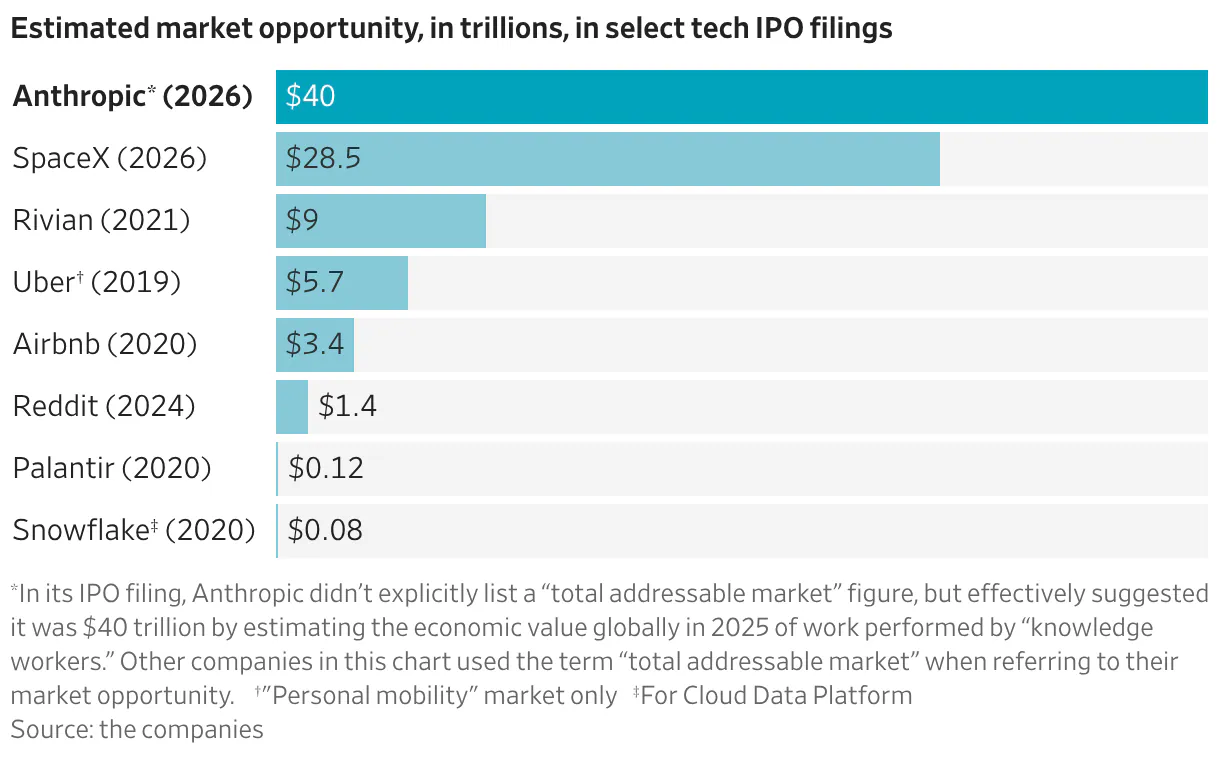
Artificial Intelligence company Anthropic has outlined a potential market opportunity valued at more than $40 trillion annually, illustrating how rapidly the business case for advanced AI is expanding beyond traditional software products and services. Rather than measuring its opportunity solely through existing AI spending, the company is looking at the economic value of work that artificial intelligence could help people perform more efficiently.
The figure, described in the company’s filing ahead of a planned initial public offering (IPO), highlights a broader trend among technology businesses: defining their potential markets in increasingly expansive terms to explain their long-term growth prospects to investors.
Anthropic did not explicitly present the $40 trillion figure as a conventional total addressable market (TAM). Instead, it said that knowledge workers’ activities represented more than $40 trillion in economic value during the previous year. The company believes advanced AI systems could make those workers substantially more productive, potentially expanding that economic value and supporting further growth.
What Is a Total Addressable Market?
Total addressable market, commonly known as TAM, refers to the total potential demand for a product or service if a company could serve every relevant customer in its defined market. Businesses use the measure to communicate the scale of an opportunity, evaluate growth potential and explain their long-term strategies to investors.
However, TAM is not a sales forecast. A market worth trillions of dollars does not mean a company will generate that amount in revenue, nor does it establish how much of the market the business can realistically capture. Actual performance depends on customer demand, competition, pricing, product capabilities, operating costs and other commercial factors.
Anthropic’s approach stretches the concept beyond the market for AI subscriptions, software licences or cloud-based services. Its argument is that AI could eventually contribute to a much larger economic market by helping people perform tasks that currently require substantial amounts of human time and expertise.
How Anthropic Built Its $40 Trillion Estimate
Anthropic’s calculation begins with the economic value associated with work performed by knowledge workers. This broad category includes activities that rely heavily on information, analysis, communication, research and specialised expertise.
The company argues that advanced AI systems could meaningfully increase productivity across these activities. If workers can complete tasks more quickly, analyse more information or produce more output with the same resources, AI could create economic value well beyond the revenue generated by selling AI products directly.
In its filing, Anthropic said the work performed by knowledge workers represented more than $40 trillion in economic value last year. It described its near-term opportunity as expanding that value and accelerating economic growth through the productivity improvements enabled by frontier AI.
This is a broader way of thinking about the market than simply estimating how much businesses and individuals might spend on AI tools. It treats the work that AI could assist with as the underlying opportunity, rather than limiting the calculation to spending on AI products themselves.
Why the Estimate Is Different From Traditional AI Market Forecasts
Many technology companies estimate their addressable markets by identifying prospective customers, the products those customers might buy and the amount they could spend. This approach can produce relatively direct estimates when a company sells a defined product into an established market.
Anthropic’s method is more expansive because it focuses on the economic activities AI might influence. The distinction matters: spending on AI software is not the same as the total value of the work that the software could help improve.
For example, a company might pay for an AI assistant to support research, customer service or software development. The purchase price represents revenue for the AI provider, while the resulting time savings or productivity improvements could create additional economic value for the customer. Anthropic’s argument looks toward this wider pool of value.
That approach also makes the estimate more difficult to verify independently. The economic value of knowledge work is not automatically equivalent to revenue available to an AI company. Turning productivity improvements into commercial returns depends on how AI is adopted, how much work can be automated or assisted, and how customers and providers share the resulting benefits.
Anthropic Cites a $22.5 Trillion Global AI Impact Estimate
Anthropic also cited estimates from research and advisory firm IDC suggesting that investment in AI solutions and services could lead to a cumulative global economic impact of $22.5 trillion by 2031. The company said it believes the impact could be even greater.
The distinction between these two figures is important. Anthropic’s $40 trillion figure describes the economic value of knowledge workers’ work in a single year, while the $22.5 trillion estimate refers to cumulative economic impact associated with AI investment through 2031.
Because the figures measure different things over different periods, they should not be treated as directly comparable forecasts. They nevertheless illustrate why AI companies see opportunities extending beyond the current market for software and computing services.
Economic impact estimates also depend on assumptions about how quickly businesses adopt AI, how effectively the technology improves productivity and how those gains are measured. The actual effects could vary across industries, occupations and countries.
How Other Technology Companies Calculate Their Market Opportunities
Anthropic’s approach follows a broader pattern in which companies define their potential markets according to the business models they pursue. The estimates can differ significantly because each company chooses a different starting point for measuring demand.
Snowflake: Customers and Spending
Cloud data company Snowflake uses a more conventional approach to market sizing. Its calculation focuses on the number of potential customers and how much each might spend on its products and services.
This method connects the estimate to a defined category of business expenditure. Although assumptions about future customer numbers and spending can still affect the result, the underlying calculation is more directly tied to a company’s products.
Airbnb: The Value of Travel-Related Activities
In its 2020 filing, Airbnb organised its estimated $3.4 trillion addressable market into three segments: short-term stays, long-term stays and experiences.
Rather than measuring only the revenue Airbnb could earn through its platform, this approach considers spending associated with the wider activities its services support. It therefore measures a broader pool of demand than the company’s own revenue alone.
Uber: Spending Across Its Underlying Market
Uber has also used the broader economic activity surrounding its services to explain its market opportunity. For a platform business, the relevant market can include spending on the underlying activity, rather than only the fees the company collects.
Such estimates can help explain the scale of demand available to a platform, but the value of the underlying market should not be confused with the revenue the platform can retain.
SpaceX: AI, Connectivity and Space
SpaceX has presented an ambitious market opportunity of its own, with an earlier estimate of $28.5 trillion. Its framework included three broad areas, with artificial intelligence representing the largest potential opportunity in the company’s assessment, ahead of connectivity and space-related activities.
The company described its total addressable market as the largest actionable market in human history. The estimate illustrates how AI has become central to some technology companies’ long-term growth narratives, even when their established businesses operate in different sectors.
SpaceX’s approach and Anthropic’s estimate both extend beyond the immediate revenue generated by existing products. However, Anthropic pushes the concept further by focusing on the value of knowledge work that AI could potentially improve.
Why a $40 Trillion Market Does Not Mean $40 Trillion in Revenue
The difference between an addressable market and a company’s actual revenue is central to understanding Anthropic’s claim. The $40 trillion figure represents the economic value of knowledge work, not a forecast that Anthropic will earn $40 trillion from selling AI systems.
For comparison, the company’s current revenue is measured in billions of dollars rather than trillions. Even if AI eventually influences a substantial share of global knowledge work, Anthropic would capture only a portion of the resulting economic activity through its products and services.
Several factors could limit the amount of that opportunity available to Anthropic:
- Competition: Other AI developers, software companies and cloud providers are also seeking to supply tools for knowledge-intensive work.
- Adoption rates: Businesses may adopt AI at different speeds depending on their budgets, technical infrastructure and operational needs.
- Technical limitations: AI systems may not be suitable for every task and may require human supervision, verification or specialised integration.
- Pricing and costs: The economic value created by AI does not automatically translate into revenue or profit for the technology provider.
- Regulation and trust: Privacy, security, reliability and regulatory requirements can affect where and how AI systems are deployed.
- Distribution of productivity gains: Businesses, employees, customers and technology providers may share the benefits of increased productivity in different ways.
These factors make the $40 trillion estimate best understood as a broad description of potential economic exposure to AI, rather than a prediction of Anthropic’s future financial performance.
What the Market Estimate Means for Anthropic’s Planned IPO
A very large market estimate can help investors understand why a company believes it has room to expand even after achieving significant growth. If AI tools become useful across many types of knowledge work, the demand for advanced models and related services could extend across numerous industries.
For a company preparing for a potential IPO, this framing can also explain the long-term ambition behind its business. Investors may be interested not only in current revenue but also in the range of tasks AI could support, the number of organisations that might adopt the technology and the potential for recurring demand.
However, the size of a potential market is only one part of an investment assessment. Investors would also need to evaluate revenue growth, customer concentration, operating expenses, computing costs, competition, profitability prospects and the risks associated with developing and deploying advanced AI.
The filing’s market discussion does not, by itself, establish what Anthropic’s valuation should be or whether its shares would be attractive at a particular IPO price. Those questions depend on the company’s financial performance, future expectations and the terms of any offering.
Why Anthropic’s Estimate Is Difficult to Verify
Traditional market estimates can often be assessed by examining customer numbers, average spending and the products included in the calculation. Anthropic’s approach relies on a more complex set of assumptions because it starts with the economic value of work rather than a clearly defined category of spending.
To estimate how much of that value could become an AI market, analysts would need to assess which tasks AI can perform, how much productivity it can add, how widely the technology will be adopted and how those improvements translate into commercial demand.
There is also a difference between the value of work that could potentially be affected by AI and the value that AI actually creates. Some tasks may be only partially automated, while others may require substantial human involvement. In certain cases, the costs of deploying AI could reduce the net economic benefit.
As a result, the $40 trillion figure provides a sense of the scale of work Anthropic believes could be influenced by advanced AI, but it does not independently establish how much revenue the company or the AI industry will generate.
What Comes Next for the AI Market?
The broader significance of Anthropic’s estimate is that AI companies are increasingly presenting their technology as a tool that could influence entire areas of economic activity. Instead of competing only for existing software budgets, they are positioning AI as a way to change how businesses conduct research, communicate, analyse information and carry out specialised work.
If AI systems deliver substantial and measurable productivity gains, demand could expand across industries that have not traditionally been considered part of the technology market. The scale and timing of that expansion, however, remain uncertain and will depend on real-world performance, adoption and the economics of implementation.
For investors, the central question is not simply whether the potential market is enormous. It is how much of that potential can become sustainable demand, how effectively Anthropic can compete for it and how much economic value the company can convert into revenue.
Key Takeaway
Anthropic’s $40 trillion market opportunity is based on the economic value of knowledge work that advanced AI could potentially make more productive, rather than a conventional estimate of spending on AI products. The figure highlights the technology’s possible reach across the global economy, but it should not be interpreted as a revenue forecast or a guarantee of future growth. The real opportunity will depend on AI adoption, measurable productivity gains, competition and Anthropic’s ability to turn technological capabilities into a commercially sustainable business.
For breaking news and live news updates, like us on Facebook or follow us on Twitter and Instagram. Read more on Latest Business on thefoxdaily.com.






COMMENTS 0