- The Core Idea: Universal Income in an Automated World
- Why Musk Believes Inflation Won’t Spiral
- AI Is Moving Faster Than Governments
- Not a New Idea: From Stimulus Checks to UBI
- Challenges: Why Universal Income Isn’t Simple
- Beyond Jobs: AI’s Impact on Entire Industries
- Comparison: Human Workforce vs AI Workforce
- Unique Insight: From “Work-Based Identity” to “Purpose-Based Living”
- Prediction: Hybrid Economic Models Will Emerge
- Global Implications: A Shift in Economic Power
- Conclusion: A Bold Idea for an Uncertain Future
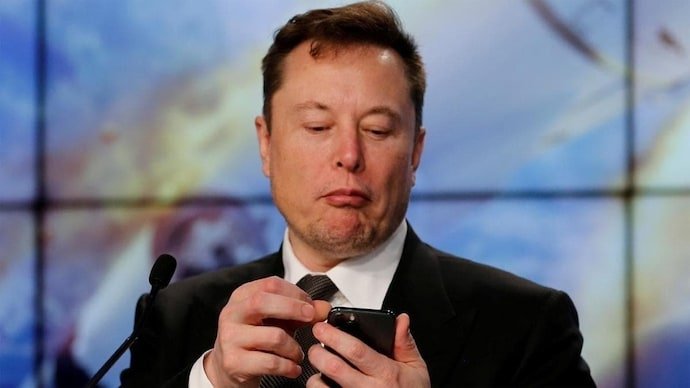
What happens when machines do most of the work and humans are left without Jobs? According to Elon Musk, the answer may be simple, yet controversial: governments should provide people with direct income support, often described as “free money.”
Who: Elon Musk and global policymakers. What: Proposal for universal income support. When: Amid rapid advancements in AI and robotics. Where: Global economies facing Automation disruption. Why: To offset job losses caused by AI. How: Through government-issued payments funded by increased productivity.
Musk’s idea sometimes framed as Universal Basic Income (UBI) or his preferred term “Universal High Income” is gaining renewed attention as Artificial Intelligence reshapes industries faster than governments can respond.
The Core Idea: Universal Income in an Automated World
Musk’s argument is rooted in a fundamental shift: AI and robots could replace a significant portion of human labor. As machines take over repetitive, complex, and even creative tasks, traditional employment structures may weaken.
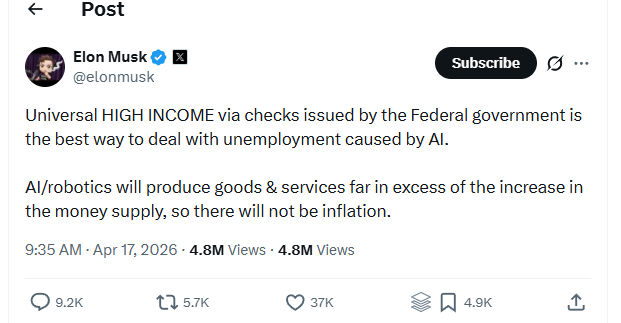
To prevent economic collapse and social instability, Musk suggests:
- Governments provide regular cash payments to citizens
- Income is not tied to employment
- Funding comes indirectly from increased productivity driven by automation
In simple terms, if robots generate wealth, that wealth should be redistributed to society.
Why Musk Believes Inflation Won’t Spiral
One of the biggest criticisms of giving people money is Inflation. More money chasing the same goods typically leads to higher prices.
Musk challenges this assumption with a key argument:
If AI and robots dramatically increase the supply of goods and services, prices may remain stable even if more money enters the system.
This flips traditional economics on its head. Instead of scarcity driving inflation, abundance created by automation could keep costs low.
Illustration: Supply vs Money Flow
| Scenario | Traditional Economy | AI-Driven Economy |
|---|---|---|
| Production Capacity | Limited by human labor | Expanded by automation |
| Money Supply Increase | Leads to inflation | Balanced by higher output |
| Price Impact | Rising costs | Potential stability or decline |
However, economists remain divided on whether this balance would hold in reality.
AI Is Moving Faster Than Governments
A major concern highlighted by Musk is the speed gap between Technology and policy.
AI development is accelerating rapidly due to:
- Advances in machine learning models
- More powerful computing hardware
- Breakthroughs in robotics engineering
Meanwhile, governments operate through layered processes debates, regulations, approvals that can take years.
This mismatch creates a dangerous lag where:
- Jobs disappear faster than policies adapt
- Workers lack safety nets
- Economic inequality widens
Musk’s solution? Skip the delay and directly support citizens financially.
Not a New Idea: From Stimulus Checks to UBI
While Musk’s proposal sounds radical, elements of it already exist.
Real-World Examples
- COVID-19 stimulus payments in multiple countries
- Direct cash transfers during economic crises
- Various UBI pilot programs globally
These programs showed that governments can distribute money quickly when needed. Musk’s idea extends this concept into a permanent economic model.
Challenges: Why Universal Income Isn’t Simple
Despite its appeal, implementing universal income raises serious questions:
1. Funding the System
Where will the money come from? Options include higher taxes on corporations, AI systems, or wealth but each comes with trade-offs.
2. Eligibility and Fairness
Should everyone receive the same amount? Or should it vary based on income, region, or needs?
3. Work Incentives
Will people still choose to work if basic income is guaranteed? Evidence from pilot programs is mixed.
4. Political Resistance
Large-scale redistribution policies often face ideological opposition and require broad consensus.
Beyond Jobs: AI’s Impact on Entire Industries
Musk’s concerns extend beyond employment into sectors like Healthcare.
He suggests that AI-powered robots could eventually:
- Perform complex surgeries
- Diagnose diseases more accurately
- Reduce the global shortage of skilled doctors
This could make high-quality healthcare more accessible but it also raises questions about trust, ethics, and accountability.
Comparison: Human Workforce vs AI Workforce
| Factor | Human Workforce | AI & Robots |
|---|---|---|
| Training Time | Years | Rapid scaling |
| Cost | High (education, salaries) | High upfront, lower long-term |
| Consistency | Variable | Highly consistent |
| Availability | Limited hours | 24/7 operation |
This comparison highlights why automation is not just an upgrade it’s a fundamental shift in how work is defined.
Unique Insight: From “Work-Based Identity” to “Purpose-Based Living”
One overlooked aspect of universal income is its impact on human identity.
For centuries, work has been central to how people define themselves. But if AI handles most jobs, society may need to rethink:
- What gives life meaning?
- How do people contribute without traditional jobs?
- What replaces career-driven identity?
This could lead to a shift toward:
- Creative pursuits
- Community involvement
- Lifelong learning
In other words, the debate is not just economic it’s deeply philosophical.
Prediction: Hybrid Economic Models Will Emerge
Rather than a full transition to universal income, the future may involve a hybrid system:
- Partial income support from governments
- Flexible, AI-assisted jobs
- New industries built around human creativity and empathy
This approach could balance Innovation with stability, avoiding extreme disruption.
Global Implications: A Shift in Economic Power
If universal income becomes reality, it could reshape global economics:
- Developed nations may adopt it first due to resources
- Developing countries may face challenges in funding it
- Tech companies could gain even greater influence
This raises an important question: Who controls the wealth generated by AI?
Conclusion: A Bold Idea for an Uncertain Future
Elon Musk’s proposal for government-backed income reflects a growing concern: the traditional link between work and survival may be breaking down.
As AI and robotics continue to advance, societies will need to adapt not just economically, but culturally and politically.
Universal income may not be a perfect solution, but it highlights a critical reality:
The Future of Work is changing faster than ever and the systems we rely on today may not be enough for tomorrow.
Whether governments embrace this idea or not, one thing is clear: the conversation around “free money” is no longer theoretical it’s becoming a practical necessity in an AI-driven world.
For breaking news and live news updates, like us on Facebook or follow us on Twitter and Instagram. Read more on Latest Technology on thefoxdaily.com.






COMMENTS 0