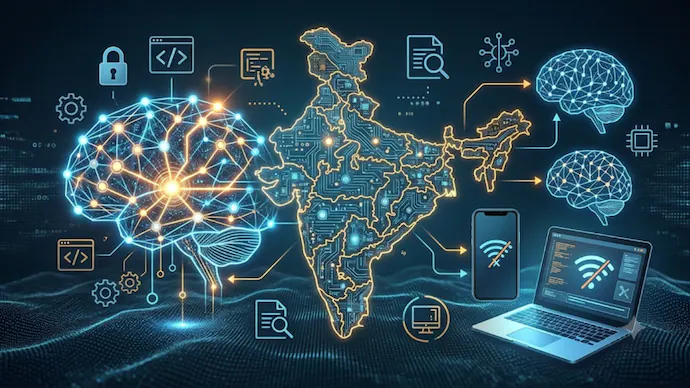
India has taken another step towards developing its own Artificial Intelligence ecosystem with the launch of three indigenous AI models under the government’s IndiaAI Mission. The models, named EKA-1, Dhīr 2B and Dhīr 5B, have been developed by Indian technology companies Soket Labs and ZenteiQ AiTech Innovations, with a focus on Indian languages, business requirements and practical applications.
Announced by the Ministry of Electronics and Information Technology (MeitY) on November 3, 2026, the models are designed for different purposes. EKA-1 focuses on advanced mathematics, software coding, reasoning and AI-agent tasks, while Dhīr 2B and Dhīr 5B are smaller, open-source models designed for document-based work, information retrieval and automation.
One of the most significant features of the launch is that both Dhīr models can operate without an internet connection. They are designed for local deployment on compatible devices, including laptops and edge hardware, allowing organisations to process information without sending every request to an external cloud server.
The launch is part of India’s wider effort to develop AI systems that understand local languages and address domestic requirements, particularly in government, education, banking, cybersecurity, defence and industry.
Which Three AI Models Has India Launched?
The IndiaAI Mission has released three foundation models developed by two Indian companies. Soket Labs Technology and Research developed EKA-1, while ZenteiQ AiTech Innovations introduced Dhīr 2B and Dhīr 5B.
The models were unveiled at an event in New Delhi attended by S. Krishnan, Secretary of the Ministry of Electronics and Information Technology, along with senior officials from MeitY, IndiaAI and the two companies.
Here is a quick comparison of the three models:
| AI Model | Developer | Main Purpose | Language Support | Offline Capability |
|---|---|---|---|---|
| EKA-1 | Soket Labs | Mathematics, coding, reasoning and agentic tasks | English and 22 scheduled Indian languages | Not specified in the launch announcement |
| Dhīr 2B | ZenteiQ | Document processing, information retrieval and automation | English and 10 Indian languages | Yes |
| Dhīr 5B | ZenteiQ | Document-based assistance, automation and knowledge retrieval | English and 10 Indian languages | Yes |
Although all three models are designed for Indian users and organisations, they are not intended to perform exactly the same tasks. EKA-1 is a larger foundation model focused on technical and reasoning capabilities, whereas the Dhīr models prioritise compact deployment and practical applications.
What Is EKA-1? India’s 26.3-Billion-Parameter AI Model
EKA-1 is the largest of the three newly released models. Developed by Bengaluru-based Soket Labs Technology and Research, it is an open, sparse hybrid language model designed to handle demanding technical and reasoning tasks.
According to the government announcement, EKA-1 features 26.3 billion parameters and was trained on approximately 7.5 trillion tokens of text data. Parameters are the internal values a neural network learns during training, while tokens are the smaller units of text that an AI model processes.
Its capabilities are designed around four major areas:
- Advanced mathematics: Handling mathematical problems and calculations that require structured reasoning.
- Software programming: Supporting coding-related tasks and software development workflows.
- Logical reasoning: Processing complex instructions and analysing information to produce structured responses.
- Agentic use: Supporting AI-agent workflows in which a system can carry out connected tasks rather than responding to only one instruction at a time.
EKA-1 Supports All 22 Scheduled Indian Languages
One of EKA-1’s important features is its multilingual capability. The model is designed to work in English and all 22 languages listed in the Eighth Schedule of the Indian Constitution.
These languages include Hindi, Bengali, Tamil, Telugu, Marathi, Gujarati, Kannada, Malayalam, Punjabi, Odia, Assamese, Urdu and Sanskrit, among others.
Language support is particularly important in India, where people use different languages across education, public services, business and everyday communication. AI systems that work effectively across Indian languages could help organisations reach users who are less comfortable interacting with English-language software.
Soket Labs has also positioned EKA-1 for sectors such as banking, financial services and cybersecurity. Its CEO, Abhishek Upperwal, said the model was developed with India’s digital ecosystem and sector-specific requirements in mind.
However, the government announcement does not establish that EKA-1 is designed to run entirely offline on ordinary consumer devices. The offline deployment feature specifically highlighted during the launch relates to the two Dhīr models.
What Are Dhīr 2B and Dhīr 5B?
Dhīr 2B and Dhīr 5B are two open-source AI models developed by ZenteiQ AiTech Innovations. Unlike EKA-1, which focuses on advanced technical and reasoning tasks, the Dhīr models are designed as compact multilingual assistants that can be deployed on local hardware.
They support English and 10 Indian languages, including Hindi, Bengali, Tamil, Telugu, Marathi, Gujarati, Kannada, Malayalam, Punjabi and Odia.
Their main applications include document-grounded automation, knowledge retrieval and assistance with citizen or enterprise services. In practical terms, organisations can use them to search through documents, retrieve relevant information and automate certain repetitive tasks.
Dhīr 2B: A Compact AI Model for Local Deployment
Dhīr 2B is a dense transformer model with approximately 2.03 billion parameters. Its relatively compact architecture is designed to make it suitable for deployment on laptops and other compatible computing devices.
According to ZenteiQ’s technical information, the model supports a context window of 16,384 tokens. This determines how much text the model can consider within a single processing context.
Its downloadable model files are available in different precision formats. The four-bit version is approximately 1.21GB, while the 16-bit weights require around 4.06GB of storage.
These characteristics make Dhīr 2B relevant for organisations that need a multilingual AI assistant without depending on a continuously connected cloud service.
Dhīr 5B: A Mixture-of-Experts AI Model
Dhīr 5B uses a mixture-of-experts architecture rather than a conventional dense model. It contains approximately 5.09 billion parameters in total, with around 1.79 billion active for each token processed.
A mixture-of-experts model uses specialised components within its architecture, activating only a portion of them for a particular input. This approach can help balance model capacity and computational requirements.
Dhīr 5B also supports a context window of 16,384 tokens. Its four-bit model file is approximately 2.95GB, while the 16-bit weights require around 10.19GB of storage.
Compared with Dhīr 2B, the larger model has a different architecture and a higher total parameter count. ZenteiQ’s published evaluations also show differences in performance across language, coding, mathematics and agentic benchmarks.
How Can Dhīr AI Models Work Without the Internet?
The most notable feature of Dhīr 2B and Dhīr 5B is their ability to run locally without requiring an active internet connection. Instead of sending every question to a remote cloud server, users can install the models on compatible hardware and process requests on the device itself.
Ordinary cloud-based AI services typically send user prompts and relevant information to servers operated by the service provider. The server processes the request and returns a response. This arrangement requires network connectivity and can involve sending sensitive information outside an organisation’s own systems.
Local AI deployment works differently. Once a model and the required software are installed, the device can process supported requests without continuously communicating with an external server.
This approach can be useful in locations where internet access is unreliable or where organisations need greater control over sensitive information.
Why Offline AI Matters for Data Privacy
Many organisations handle information that should not be casually transferred to external services. Government departments, defence establishments, research institutions and businesses may work with confidential documents, internal records or sensitive operational data.
Running an AI model locally can reduce the need to transmit such information to an external cloud provider. When processing remains on the organisation’s own hardware and the deployment is properly configured, documents and prompts can stay within its controlled environment.
This is one reason ZenteiQ has highlighted applications in defence, government, industrial operations and education.
However, offline operation does not automatically guarantee complete security. Organisations still need to protect devices, control access, secure stored information and manage software updates. Local deployment can improve data control, but it does not replace wider cybersecurity practices.
Can Dhīr Run on Ordinary Laptops and Mobile Phones?
ZenteiQ says both Dhīr models are designed for deployment across different computing platforms, including laptops, embedded boards and edge devices. The company also highlights their potential for on-device use on mobile phones.
The actual performance depends on the hardware, model format and available computing resources. A model that can technically run on a device may not deliver the same speed or responsiveness across every laptop or smartphone.
ZenteiQ’s published performance information includes tests on Intel Iris Xe integrated graphics, NVIDIA Jetson Orin NX hardware and Raspberry Pi 4 processors. The company reports that the models can operate on these different platforms, although processing speeds vary considerably.
Therefore, the offline feature should not be interpreted as meaning that every smartphone or low-cost computer can run the models smoothly. Users and organisations need to check hardware compatibility before deployment.
How Can India’s New AI Models Be Used in Different Sectors?
The three models have been introduced with applications across government, education, research and private industry in mind. Their different capabilities allow them to address different types of work.
1. Government Offices and Public Services
Government departments manage large volumes of documents, applications, regulations and administrative records. Multilingual AI assistants could help employees search these documents, retrieve relevant information and automate certain routine tasks.
The Dhīr models’ ability to operate offline could also be useful in government environments where network connectivity is restricted or sensitive information must remain within local systems.
2. Defence and Sensitive Operations
Defence organisations often operate in environments where reliable internet access cannot be assumed. They may also have strict requirements for handling operational information.
Locally deployed AI systems could support document retrieval and internal knowledge-management tasks without requiring continuous access to external cloud infrastructure.
However, the launch announcement does not establish that these models are already approved for specific classified defence operations. Their suitability would depend on testing, security assessments and deployment requirements.
3. Schools, Colleges and Research Institutions
Educational institutions could use multilingual AI assistants to search learning materials, organise documents and help students access information in different Indian languages.
Research institutions may also find local deployment useful when working with internal documents or operating in environments with limited network access.
EKA-1’s focus on mathematics, coding and reasoning could support technical research and software-related work, while the Dhīr models are aimed more towards document-based assistance and information retrieval.
4. Banking, Financial Services and Cybersecurity
Soket Labs has specifically identified banking, financial services and cybersecurity as important application areas for EKA-1.
These sectors work with complex information and often require systems capable of analysing technical material, processing instructions and supporting specialised workflows. EKA-1’s mathematics, coding and reasoning capabilities are intended to address some of these requirements.
Any use in financial decision-making or cybersecurity operations would still require appropriate testing, human oversight and safeguards. The launch of a model does not by itself establish that it is suitable for every high-risk application.
How the IndiaAI Mission Helped Develop These Models
Developing foundation models requires substantial computing resources, large training datasets and specialised technical expertise. For smaller Indian companies, the cost of accessing the infrastructure needed to train large AI systems can be a major obstacle.
The government’s IndiaAI Mission is intended to help build a domestic AI ecosystem by supporting computing infrastructure, research, startups and the development of indigenous models.
Under the mission, selected developers receive subsidised access to computing resources and support for research-related expenses. This assistance helped Soket Labs and ZenteiQ develop their respective models.
The mission was approved by the Union Cabinet on March 7, 2024, and operates through seven pillars:
- IndiaAI Compute Capacity: Expanding access to computing infrastructure for AI development.
- IndiaAI Innovation Centre: Supporting the development of indigenous foundation models.
- IndiaAI Datasets Platform: Providing access to datasets through the AIKosh platform.
- IndiaAI Application Development Initiative: Encouraging AI applications that address practical needs.
- IndiaAI FutureSkills: Developing AI-related skills and training opportunities.
- IndiaAI Startup Financing: Supporting companies working on AI Innovation.
- Safe and Trusted AI: Promoting responsible and reliable AI development and deployment.
The release of EKA-1 and the two Dhīr models falls under the IndiaAI Innovation Centre’s foundation-model development efforts.
Are the Three Models Open Source and Available to Download?
The two Dhīr models have been introduced as open-source models under the Apache 2.0 licence, according to ZenteiQ’s published model information. The company provides access to model downloads and technical documentation for developers and organisations interested in testing or deploying them.
Soket describes EKA-1 as an open model, although its licensing and usage conditions should be checked separately before commercial or technical deployment.
The models are also listed for access through the government’s AIKosh platform, which is part of the IndiaAI Mission’s datasets and resources ecosystem.
Developers should review the relevant model documentation, hardware requirements and licence conditions before integrating any of the models into applications. Availability does not necessarily mean that every model can be installed and operated without technical configuration.
What Are the Limitations of the New Dhīr Models?
Although offline AI offers practical advantages, smaller models have limitations that users should understand before relying on them for important tasks.
ZenteiQ’s published technical information identifies factual recall without supporting sources as a weaker area for the Dhīr models. The company recommends using retrieval from authoritative sources and human review for areas such as law, finance, agriculture, medicine and history.
The models are also text-based. Their published documentation does not describe image, audio or speech input and output capabilities. In addition, larger models may perform better on certain demanding mathematics and coding tasks.
These limitations mean Dhīr 2B and Dhīr 5B should be viewed as compact multilingual assistants rather than direct replacements for every large, cloud-based AI system.
For organisations considering local deployment, the most important factors will include the task being performed, available hardware, language requirements, accuracy testing and the need for human verification.
What India’s Three New AI Models Mean for the Country
The launch of EKA-1, Dhīr 2B and Dhīr 5B represents another step in India’s effort to build AI systems around domestic languages and practical requirements.
The models address different needs: EKA-1 focuses on technical reasoning and agentic applications, while the Dhīr models provide smaller multilingual systems that can run locally without continuous internet access.
The offline capability is particularly relevant for organisations that operate in low-connectivity environments or need greater control over where their information is processed. Meanwhile, support for Indian languages could help make AI tools more accessible across different regions and user groups.
However, the launch is an early stage in the wider development of India’s domestic AI ecosystem. Real-world adoption will depend on performance, reliability, developer support, hardware compatibility and the ability to meet the requirements of organisations using these systems.
Conclusion
India has launched three indigenous AI models under the IndiaAI Mission: EKA-1 from Soket Labs and Dhīr 2B and Dhīr 5B from ZenteiQ AiTech Innovations. The models are designed for different applications, ranging from mathematics and software development to multilingual document processing and automation.
The most notable feature is that Dhīr 2B and Dhīr 5B can run locally without an active internet connection, allowing compatible devices to process information without relying on continuous cloud connectivity. Both models support English and 10 Indian languages, while EKA-1 is designed to work across all 22 scheduled Indian languages alongside English.
Supported by the IndiaAI Mission, the launch highlights India’s effort to develop homegrown AI technology for its languages, industries and security requirements. Whether these models achieve widespread adoption will depend on how effectively they perform in real-world applications, but their release adds new options for developers and organisations looking to build and deploy AI systems within India.
For breaking news and live news updates, like us on Facebook or follow us on Twitter and Instagram. Read more on Latest Technology on thefoxdaily.com.






COMMENTS 0