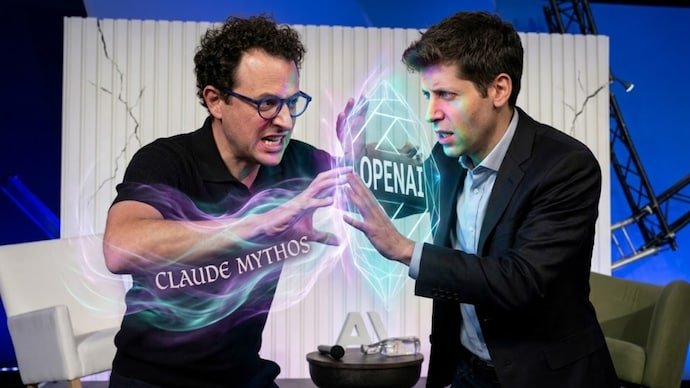
OpenAI has announced the limited rollout of its latest Artificial Intelligence model, GPT-5.4-Cyber, designed specifically for Cybersecurity applications. The release comes just days after Anthropic introduced its competing model, Claude Mythos, marking a significant escalation in the AI-driven cybersecurity race. The new model is being made available to a select group of companies and researchers under a controlled access programme, reflecting both its advanced capabilities and the sensitivity of its use cases.
What is GPT-5.4-Cyber?
GPT-5.4-Cyber is a specialised version of OpenAI’s existing GPT-5.4 model, tailored to assist cybersecurity professionals in identifying vulnerabilities, analysing malware, and strengthening digital defenses.
Unlike general-purpose AI systems, this model is designed to operate with fewer restrictions in legitimate security contexts. OpenAI stated that it “lowers the refusal boundary” for cybersecurity-related tasks, allowing researchers to investigate potential threats more effectively.
This means professionals can use the model to:
- Detect software vulnerabilities without direct access to source code
- Analyse potential malware behavior
- Identify security weaknesses in systems and applications
- Assist in proactive threat mitigation
In simple terms, if traditional AI models sometimes say “I can’t help with that” for safety reasons, GPT-5.4-Cyber is trained to understand when such tasks are legitimate and necessary for security research.
How It Compares to Claude Mythos
The launch of GPT-5.4-Cyber closely follows Anthropic’s release of Claude Mythos, which has already gained attention for reportedly identifying thousands of zero-day vulnerabilities.
While both models focus on cybersecurity, there are notable differences in their design and deployment strategies.
| Feature | GPT-5.4-Cyber | Claude Mythos |
|---|---|---|
| Base Model | Derived from GPT-5.4 | New-generation model |
| Access Model | Trusted Access for Cyber programme | Project Glasswing (limited consortium) |
| Primary Focus | Cybersecurity analysis & vulnerability detection | Advanced vulnerability discovery |
| Availability | Selective, with verification | Limited to select companies |
In essence, GPT-5.4-Cyber builds on an existing foundation, while Claude Mythos represents a fresh architectural leap. Both approaches reflect different strategies in tackling cybersecurity challenges through AI.
Access and Eligibility: Who Can Use It?
OpenAI has restricted access to GPT-5.4-Cyber through its Trusted Access for Cyber programme, launched earlier in 2026. The model is currently available only to a select group of verified users and organisations.
To gain access, individuals and companies must meet strict criteria:
- Verification through government-issued identification (for individuals)
- Additional authentication and compliance checks
- Approval via OpenAI representatives (for organisations)
This controlled rollout reflects the sensitive nature of cybersecurity tools. After all, a tool that can identify vulnerabilities could be misused if placed in the wrong hands so think of it as giving a master key only to trusted locksmiths.
Why Cybersecurity-Focused AI Matters
The emergence of models like GPT-5.4-Cyber highlights a growing trend in the AI industry: the development of specialised systems tailored for high-impact domains.
Cybersecurity, in particular, has become a critical focus area due to increasing threats such as:
- Ransomware attacks
- Data breaches
- Zero-day vulnerabilities
- State-sponsored cyber operations
Traditional methods of identifying vulnerabilities often rely on manual processes, which can be time-consuming and prone to oversight. AI models can significantly accelerate this process by analysing large datasets and identifying patterns that humans might miss.
Industry Impact and Growing Concerns
The rapid advancement of cybersecurity-focused AI has sparked both excitement and concern across industries.
On one hand, these tools offer unprecedented capabilities in detecting and preventing cyber threats. On the other, they raise questions about misuse, regulation, and ethical deployment.
Claude Mythos, for example, has already drawn attention from financial institutions and government agencies after reportedly uncovering thousands of vulnerabilities. This has prompted discussions at high levels of economic and regulatory leadership.
With GPT-5.4-Cyber entering the space, similar conversations are expected to intensify, particularly around access control and responsible use.
Key Questions Being Raised
- How can access to such powerful tools be safely managed?
- What safeguards are needed to prevent misuse?
- How should governments regulate AI-driven cybersecurity tools?
These are not just technical questions they are policy challenges that will shape the future of AI governance.
The Competitive Landscape: AI Giants in Cybersecurity
The launch of GPT-5.4-Cyber signals intensifying competition between major AI companies. As organisations like OpenAI and Anthropic push the boundaries of what AI can do, cybersecurity is emerging as a key battleground.
This competition is likely to drive rapid innovation, leading to more advanced tools capable of detecting increasingly sophisticated threats.
At the same time, it may also lead to a race to balance capability with responsibility a challenge that will define the next phase of AI development.
Conclusion: A Turning Point for AI in Cybersecurity
The introduction of GPT-5.4-Cyber marks a significant step forward in the use of artificial intelligence for cybersecurity. By enabling deeper analysis of vulnerabilities and threats, the model has the potential to transform how organisations defend their digital Infrastructure.
However, its limited release and strict access controls also highlight the risks associated with such powerful Technology. As the competition with models like Claude Mythos intensifies, the focus will not only be on innovation but also on ensuring responsible use.
Looking ahead, the integration of AI into cybersecurity is expected to grow rapidly, shaping the future of digital safety. Whether this leads to a more secure online world or new challenges will depend on how these tools are developed, deployed, and governed.
For breaking news and live news updates, like us on Facebook or follow us on Twitter and Instagram. Read more on Latest Technology on thefoxdaily.com.






COMMENTS 0