
- Why UPI QR Codes Became the Backbone of India’s Payment Revolution
- The Japanese Factory Problem That Accidentally Changed Global Payments
- Why QR Codes Store So Much More Data Than Barcodes
- The Hidden Geometry That Lets Your Phone Detect a QR Code Instantly
- Why Damaged QR Codes Still Work Perfectly
- The Four Levels of QR Error Protection
- The Extraordinary Mathematics Behind Error Correction
- How QR Codes Avoid Scanning Failures in Bad Lighting
- The Overlooked Genius of UPI’s QR-Based Design
- Security Concerns: Are QR Codes Safe?
- Why India Became the Global Capital of QR Payments
- What Comes Next for QR Code Technology?
- Conclusion: The Tiny Square That Quietly Changed Modern India
Every day across India, millions of people scan a small black-and-white square without giving it a second thought. A customer buys vegetables in Patna. A commuter pays for chai in Mumbai. A tourist shops in Jaipur. The phone camera opens, the QR code is scanned, and within seconds, money moves from one bank account to another.
It feels ordinary now. But the Technology behind that tiny square is anything but ordinary.
The humble UPI QR code is one of the most sophisticated pieces of applied mathematics hiding in plain sight. Behind every successful payment lies a combination of geometry, algebra, cryptography, computer vision, error correction theory and data encoding systems that work together in milliseconds.
India’s Digital Payments revolution is often discussed in terms of convenience, financial inclusion and fintech Innovation. But one important part of the story is usually overlooked: the QR code itself may be one of the greatest engineering democratisations ever created. It is cheap, battery-free, internet-free on the merchant side, printable on paper and durable enough to survive rain, dust and fading ink.
And yet, it rarely fails.
Why UPI QR Codes Became the Backbone of India’s Payment Revolution
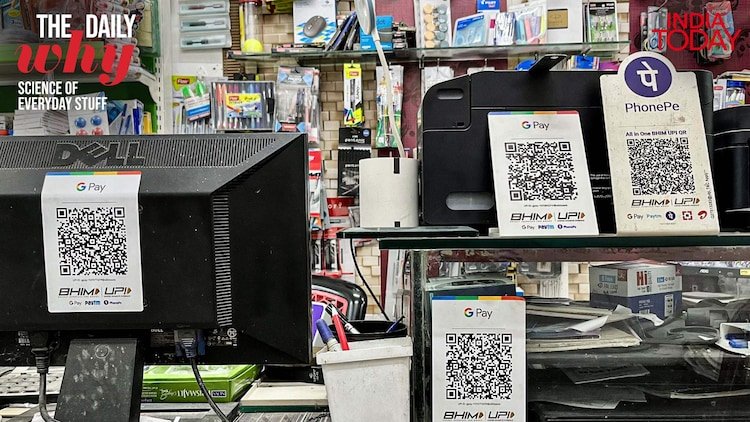
When the Unified Payments Interface (UPI) launched in 2016, India faced a unique challenge. The country needed a payment system that could work for everyone from urban supermarkets to small roadside vendors who may not own card machines or expensive hardware.
The QR code solved that problem elegantly.
Unlike traditional card terminals, QR codes cost almost nothing to deploy. A merchant only needs a printed sheet of paper linked to a bank account or UPI ID. There are no swipe machines, no maintenance costs and no complicated installation.
This low-cost Infrastructure allowed digital payments to penetrate deep into India’s informal Economy at unprecedented speed.
| Payment Method | Hardware Needed | Cost to Merchant | Ease of Use |
|---|---|---|---|
| Cash | None | Low | High |
| Card Machine | POS Terminal | Moderate to High | Moderate |
| UPI QR Code | Printed QR Sheet | Extremely Low | Very High |
That simplicity transformed the QR code from a technical tool into a social infrastructure layer.
But beneath that simplicity lies astonishing complexity.
The Japanese Factory Problem That Accidentally Changed Global Payments
The QR code was invented in 1994 by Japanese engineer Masahiro Hara at Denso Wave, a company associated with Toyota.
Ironically, the original problem had nothing to do with banking or digital payments.
Factories at the time relied heavily on barcodes to track vehicle components. Traditional barcodes worked well for small amounts of information, but they had major limitations:
- They could only store limited data
- They had to be scanned from a specific angle
- Damage or scratches often made them unreadable
- Scanning speed was relatively slow
Hara needed a better system that could store more information and still work reliably in industrial environments.
His breakthrough reportedly came while observing the ancient strategy board game Go, which uses black and white stones arranged across a grid. The insight was simple but revolutionary: instead of storing information in one direction like a barcode, why not store it both horizontally and vertically?
That single idea created the modern QR code.
Why QR Codes Store So Much More Data Than Barcodes
A traditional barcode is essentially one-dimensional. It stores information across a single horizontal line.
A QR code is two-dimensional.
That changes everything.
Because information is stored both across and down the grid, a QR code can hold dramatically more data in a very small space.
| Feature | Barcode | QR Code |
|---|---|---|
| Dimensions | 1D | 2D |
| Storage Capacity | ~20 characters | Thousands of characters |
| Error Tolerance | Very Low | Very High |
| Scanning Angle | Limited | Flexible |
| Damage Resistance | Poor | Excellent |
This is why a UPI QR code can store payment identifiers, merchant details, transaction instructions and authentication information inside a tiny printable square.
The Hidden Geometry That Lets Your Phone Detect a QR Code Instantly
Most people recognise QR codes immediately because of the three large squares sitting at three corners of the pattern.
These are called finder patterns.
They are not decorative. They are mathematical anchors.
The moment your camera opens, your phone’s software begins searching for a very specific geometric ratio hidden inside these corner patterns.
The black-and-white arrangement follows a structured mathematical sequence that almost never appears naturally in ordinary objects or backgrounds. That makes the QR code easy for computer vision systems to identify instantly.
Once the phone detects the three finder patterns, it performs several calculations:
- Determines the orientation of the QR code
- Measures distortion or tilt
- Calculates perspective correction
- Flattens the image digitally
- Begins decoding the data grid
This entire process usually happens in under a second.
Even if the QR code is tilted, curved, partially folded or photographed from an angle, the mathematics compensates automatically.
Why Damaged QR Codes Still Work Perfectly
One of the most extraordinary aspects of QR technology is its ability to survive physical damage.
You may have scanned QR codes that were:
- Scratched
- Half torn
- Faded by sunlight
- Covered with tape
- Printed poorly
- Wrinkled or dirty
And yet, the payment still went through.
This is possible because QR codes use one of the most powerful mathematical systems in modern computing: Reed-Solomon error correction.
Originally developed in 1960, Reed-Solomon mathematics allows systems to reconstruct missing information even when parts of the original data are destroyed.
The same principle is used in:
- Deep-space communication
- Satellite transmissions
- CDs and DVDs
- Data storage systems
- Spacecraft telemetry
In simple terms, the QR code intentionally stores extra backup information inside itself.
If part of the code becomes unreadable, the scanner mathematically reconstructs the missing pieces using the remaining data.
The Four Levels of QR Error Protection
QR codes can be configured with different levels of recovery protection depending on how durable they need to be.
| Error Correction Level | Recoverable Data Loss | Typical Usage |
|---|---|---|
| L | 7% | Clean digital displays |
| M | 15% | Standard commercial use |
| Q | 25% | Industrial environments |
| H | 30% | High-damage scenarios |
This explains why many branded QR codes still work even when logos are placed in the centre. The logo technically destroys part of the data, but the mathematical redundancy compensates for the damage.
The Extraordinary Mathematics Behind Error Correction
At the heart of Reed-Solomon correction lies advanced algebra involving polynomials and finite fields.
Without diving into intimidating mathematics, the core idea works like this:
The QR system converts information into mathematical relationships. It then generates additional “check values” based on those relationships.
If part of the original data disappears later, the missing information can be recalculated from the surviving mathematical structure.
It is somewhat like solving a puzzle where enough clues remain to reconstruct the missing pieces.
This is one reason QR technology became ideal for real-world environments where perfect conditions cannot be guaranteed.
How QR Codes Avoid Scanning Failures in Bad Lighting
There is another invisible layer of intelligence built into QR systems: masking.
Sometimes raw encoded data accidentally creates large blocks of black or white patterns that are difficult for cameras to interpret.
To fix this, the QR system tests multiple mathematical masking patterns before finalising the code.
These patterns redistribute black and white modules more evenly across the grid.
The system automatically selects whichever version produces the clearest visual contrast and easiest machine readability.
This dramatically improves scanning reliability under:
- Low light
- Glare
- Poor camera quality
- Motion blur
- Low-resolution printing
It is one of the reasons even cheap smartphones can scan QR codes effectively.
The Overlooked Genius of UPI’s QR-Based Design
One insight many competitors miss is this: the real genius of India’s UPI ecosystem is not just digital banking. It is infrastructure minimalism.
Most countries built digital payments around expensive hardware ecosystems involving:
- Card readers
- NFC terminals
- Merchant contracts
- Banking equipment
- Licensing systems
India largely bypassed that stage.
The QR code turned any physical space into a payment terminal.
A fruit seller with a laminated paper square suddenly became digitally connected to the banking system.
That may eventually be studied as one of the most successful examples of low-cost technological leapfrogging in modern economic history.
Security Concerns: Are QR Codes Safe?
While QR codes themselves are mathematically robust, scams can still happen around them.
Fraudsters sometimes:
- Paste fake QR stickers over genuine ones
- Create misleading payment links
- Use phishing pages disguised as payment portals
However, the QR system itself does not “pull” money automatically.
UPI payments still require user authentication through:
- UPI PIN verification
- Bank-level encryption
- NPCI transaction routing
- Device authentication systems
This distinction matters.
The QR code is essentially an information container. The actual security layer exists within the banking and UPI authentication architecture.
Why India Became the Global Capital of QR Payments
Many countries use QR payments today, but India scaled them faster than almost anyone else.
Several conditions made that possible:
- Rapid smartphone adoption
- Low-cost mobile internet
- Government-backed digital identity systems
- Unified banking interoperability
- Minimal merchant onboarding costs
The result is a payments ecosystem where tiny neighbourhood shops process digital transactions with infrastructure costs close to zero.
That is economically transformative.
In many ways, the QR code became the physical face of India’s digital economy.
What Comes Next for QR Code Technology?
The future of QR technology is likely to move beyond payments.
Experts expect deeper integration with:
- Digital identity verification
- Public transport systems
- Healthcare records
- Smart ticketing
- Supply chain tracking
- Offline digital authentication
Dynamic QR systems may also become more intelligent, personalised and encrypted in real time.
But despite future upgrades, the core mathematical principles are unlikely to change. The underlying engineering remains extraordinarily efficient.
Conclusion: The Tiny Square That Quietly Changed Modern India
The QR code may be one of the most underrated inventions of the modern technological era.
It looks simple because the mathematics inside it is doing its job perfectly.
Every successful UPI transaction represents a chain of invisible computations involving geometry, algebra, encoding theory, error correction and computer vision all compressed into a black-and-white square printed on paper.
That is what makes the technology remarkable.
India’s digital payments revolution is often measured in transaction volumes, fintech valuations and banking statistics. But hidden beneath all of that is something quieter and more elegant: a mathematical system so resilient that it can survive fading ink, damaged paper, poor lighting and shaky cameras while still moving money in milliseconds.
The next time a QR code processes your payment at a roadside stall or supermarket counter, it may look ordinary.
But inside that square is some of the most beautiful applied mathematics humanity has ever built.
For breaking news and live news updates, like us on Facebook or follow us on Twitter and Instagram. Read more on Latest Technology on thefoxdaily.com.






COMMENTS 0