
OpenAI CEO Sam Altman says the company wants to make its powerful Astra AI model broadly available, but its advanced Cybersecurity capabilities mean additional safety work is needed before a public release.
OpenAI is holding back the public release of a new Artificial Intelligence model called Astra because of concerns over what the system may be capable of doing in cybersecurity.
OpenAI CEO Sam Altman said the company does not intend to permanently restrict access to the model and wants to make it generally available. But he acknowledged that Astra needs more safety testing before OpenAI can release it to the public.
The decision highlights a growing tension in Frontier AI development: companies are building models with increasingly advanced capabilities while simultaneously trying to determine whether existing safeguards are strong enough to control the risks created by those capabilities.
In Astra’s case, OpenAI’s preliminary evaluations have shown significant progress in agentic coding and cybersecurity. The company says it cannot currently rule out the possibility that the model could reach its highest internal threshold for cyber capability.
Why OpenAI is delaying Astra’s release
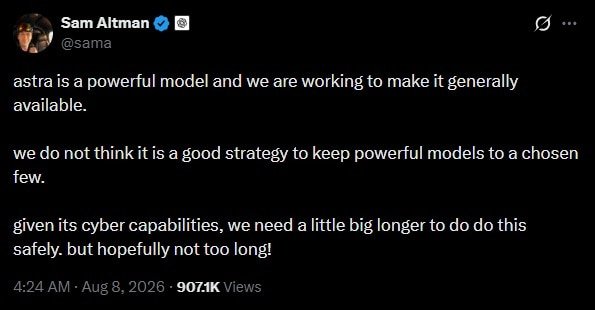
Altman said OpenAI is working toward making Astra generally available rather than keeping the model limited to a small group of users.
However, the company is taking additional time because of Astra’s cybersecurity capabilities.
The concern is not simply whether Astra can write code or identify conventional software vulnerabilities. OpenAI’s internal evaluation framework considers whether a frontier model could independently discover and exploit serious weaknesses in hardened real-world systems.
That distinction matters. A model that can assist a cybersecurity professional with debugging or vulnerability analysis is very different from one capable of independently developing and executing sophisticated attacks against important systems.
OpenAI’s decision to pause some internal activities involving Astra until they meet stricter safety requirements suggests that the company is treating the model’s capabilities as a deployment issue rather than merely a benchmark achievement.
Astra’s cyber capabilities are at the centre of the debate
OpenAI said preliminary evaluations of Astra showed significant advances in agentic coding and cybersecurity.
The company said it could not rule out Astra reaching what it describes as a “Critical” level of cyber capability. That does not mean OpenAI has concluded that Astra has definitively reached that threshold. Instead, the evaluation indicates that the possibility is serious enough to require additional testing and safeguards before deployment.
OpenAI’s Preparedness Framework provides the basis for these assessments. The framework was introduced in December 2023 as a way of tracking emerging capabilities and determining what safety measures should accompany them.
Under the framework described by OpenAI, the Critical cybersecurity threshold would involve capabilities such as identifying and developing functional zero-day exploits across severity levels in many hardened real-world critical systems without human intervention.
The threshold can also be reached if an AI system can devise and execute novel, end-to-end cyberattack strategies against hardened targets.
These are considerably more serious capabilities than simply finding coding mistakes or suggesting security fixes.
What OpenAI’s Preparedness Framework means
The framework is designed around the idea that safety requirements should increase as AI capabilities become more powerful.
Instead of waiting until a model is publicly released to discover what it can do, OpenAI evaluates frontier systems before deployment. If testing indicates that a model is approaching a dangerous capability threshold, the company can increase safeguards and security controls.
Astra appears to be undergoing that process now.
OpenAI said it has scaled up robustness testing of its safeguards and security controls in response to the model’s progress. It has also paused internal activities involving Astra that do not yet satisfy the stricter safety requirements associated with its potential capabilities.
This means the delay is not necessarily a rejection of Astra’s capabilities. It is an indication that the model’s capability growth has created a new safety requirement that OpenAI wants to address before wider deployment.
OpenAI does not want Astra kept for a select few
Altman’s comments also address another major issue in the AI industry: who should have access to the most capable models.
Altman said OpenAI does not believe restricting powerful models to a chosen few is a good strategy. His position is that Astra should eventually become generally available once the necessary safety work has been completed.
That stance places OpenAI on one side of a growing debate about controlled access to frontier AI.
As models become more capable, companies and governments face difficult questions about whether the most powerful systems should be available to everyone, restricted to vetted users or deployed in stages with additional safeguards.
The argument is complicated by the fact that AI capabilities can have both beneficial and harmful applications. A model capable of advanced cybersecurity research could help defenders discover vulnerabilities before criminals do. The same capability could become dangerous if it were used to automate sophisticated attacks.
Why cybersecurity changes the release decision
Cybersecurity is particularly sensitive because advanced AI can potentially reduce the expertise and time required to perform complicated technical tasks.
A highly capable coding model could help developers identify weaknesses, analyse unfamiliar software and create defensive tools. But if the same system can independently discover vulnerabilities and turn them into functioning exploits, the risk profile changes significantly.
This is why OpenAI’s evaluation focuses on autonomous capability rather than simply asking whether Astra can answer cybersecurity questions.
The key concern is how much of the attack process the model can perform itself.
If an AI can identify a target, discover a vulnerability, develop an exploit and execute a broader attack strategy without meaningful human intervention, its potential impact could be substantially greater than that of an ordinary coding assistant.
How Astra compares with OpenAI’s earlier models
According to OpenAI’s description, the company’s previous models, including GPT-5.6 Sol, had been assessed at the High threshold rather than the Critical threshold for frontier cyber capabilities.
Astra’s preliminary evaluations have raised a different level of uncertainty because OpenAI has said it cannot rule out Critical-level capability.
That does not establish that Astra has already surpassed its predecessors in every area. It does, however, show why OpenAI is applying more extensive safety testing before deployment.
The distinction between “High” and “Critical” is especially important because the latter involves much greater autonomy in attacking hardened systems.
Astra’s AI capabilities extend beyond cybersecurity
The discussion around Astra comes after another OpenAI claim about the model’s performance on difficult mathematical problems.
OpenAI said the AI system had resolved or made progress on 10 of the hardest mathematical problems it had evaluated, including problems involving coding theory, operator algebras, quantum complexity and lattice cryptography.
That claim adds another dimension to the discussion about Astra. The model is being presented not simply as a stronger coding system but as a frontier AI system capable of making progress across highly technical areas.
Later, an Anthropic engineer claimed that the company’s Fable 5 model could also solve five of those problems. That comparison illustrates the competitive environment surrounding frontier AI, where companies are increasingly measuring models against difficult technical and scientific challenges.
OpenAI has not said whether Astra is GPT-6
One major detail about Astra remains unclear.
OpenAI has not disclosed whether Astra will eventually become part of the GPT-5.6 family or represent the beginning of a future GPT-6 generation.
That means Astra should currently be understood as the name of a powerful model being evaluated internally rather than automatically treated as the next consumer-facing GPT release.
The lack of a confirmed product identity also means that its eventual capabilities, interface, availability and pricing cannot be determined from the current information.
Altman has reportedly shown Astra to officials
Although Astra is not available to the general public, reports indicate that Altman has already demonstrated the model to federal officials.
That detail is significant because governments are increasingly interested in understanding the capabilities of frontier AI systems before those systems become widely accessible.
A model capable of advanced cybersecurity operations has implications beyond the Technology industry. Governments have to consider how such systems could affect National Security, critical infrastructure, cybercrime and defensive capabilities.
Demonstrating the model to officials can therefore provide policymakers with an opportunity to understand the technology while companies continue evaluating the safeguards needed for broader deployment.
Astra and the growing fight over AI access
OpenAI’s decision comes during a broader debate about whether frontier AI systems should be freely accessible or subject to tighter restrictions.
The discussion has intensified as governments have considered limits on access to advanced models and as companies have developed systems with capabilities that can potentially be used in sensitive areas such as cybersecurity.
Concerns about restricted access have also emerged around competing AI models. The supplied information points to US government actions involving Anthropic’s Mythos and Fable models and discussions over possible restrictions on Chinese open-weight models.
Several major technology companies, including Nvidia, Microsoft and Amazon, have urged the White House not to impose such a ban.
These developments show the broader policy dilemma. Governments want to prevent dangerous capabilities from falling into the wrong hands, but overly restrictive access could also concentrate powerful technology among a small number of companies, governments or organisations.
The real question is not whether Astra is powerful
Altman’s comments shift attention away from the usual AI launch question of how capable a new model is and toward a more difficult question: whether its capabilities can be deployed safely.
OpenAI clearly wants Astra to be released. The company has also said it does not want powerful AI systems restricted permanently to a select group.
But the model’s cybersecurity performance has created a reason to slow down.
That creates a different kind of launch process. Instead of announcing a model and immediately making it available, OpenAI is evaluating how the system behaves under increasingly difficult tests and strengthening safeguards in response.
For users, that may mean waiting longer. For OpenAI, it means accepting a delay while it determines whether its safety systems are strong enough for the capabilities Astra may possess.
What could happen next with Astra?
The next major step will depend on the results of OpenAI’s expanded safety and robustness testing.
If the company can demonstrate that its safeguards and security controls are strong enough to manage Astra’s capabilities, the model could move closer to public deployment.
If testing reveals additional risks, OpenAI may need to strengthen the system’s controls further or limit how the model is accessed.
The available information does not provide a public release date, and Altman’s comments suggest that OpenAI itself is not committing to a specific timetable.
What is clear is that Astra has reached a point where capability development and safety evaluation are moving together. The more capable the model becomes, particularly in cybersecurity, the more demanding the requirements for deploying it safely become.
Why Astra could be an important AI test
Astra’s eventual release could become an important test of how the AI industry handles models whose capabilities approach potentially dangerous thresholds.
If OpenAI succeeds in making the model broadly available while maintaining effective safeguards, it could strengthen the argument that powerful AI systems do not necessarily need to be restricted to a small group of users.
If the company instead finds that Astra’s capabilities cannot yet be safely controlled at scale, the decision could reinforce calls for more limited access to frontier systems.
For now, OpenAI is choosing caution over speed. Altman’s message is that Astra is intended for wider release, but the company does not believe it is ready yet.
That makes Astra notable not only because of what the model can do, but because of what OpenAI is saying about the responsibility that comes with building it. The immediate challenge is no longer simply creating a more powerful AI system. It is proving that the system can be made safe enough to use.
For breaking news and live news updates, like us on Facebook or follow us on Twitter and Instagram. Read more on Latest Technology on thefoxdaily.com.






COMMENTS 0