Vastra Utsav 2026: India’s handloom story is often told through its most recognisable fabrics Kanjeevaram silk, Chanderi, khadi, matka silk or regional cottons. But the survival of these traditions depends on something much less glamorous: whether today’s consumers are willing to understand, buy and wear the work produced by the people who keep those traditions alive.
That is the larger significance of Vastra Utsav 2026, the annual textile and craft exhibition organised by Friends of DakshinaChitra as a fundraiser for DakshinaChitra, the living museum of South Indian art, architecture, lifestyles, crafts and performing arts at Muttukadu near Chennai.
Now in its long-running tradition of bringing India’s textile communities together, the 2026 edition expands the event to a larger venue with nearly 50 stalls. Visitors can meet master weavers and artisans, purchase directly from participating makers and explore products ranging from saris and fabrics to home furnishings, jewellery, children’s clothing and traditional foods.
But the event is more than a shopping opportunity. Its deeper purpose lies in narrowing the distance between the person who makes a textile and the person who buys it.
That relationship is becoming increasingly important as India’s handloom sector confronts shrinking artisan communities, competition from mechanised production and changing consumer habits. Vastra Utsav offers one possible answer: make heritage crafts visible, accessible and commercially relevant without stripping them of their identity.
What is Vastra Utsav 2026?
Vastra Utsav is an annual textile and craft exhibition organised by Friends of DakshinaChitra to raise funds for DakshinaChitra. The event brings together weavers, artisans, craft revivalists, designers and women-led enterprises from different parts of India.
The 2026 edition features nearly 50 stalls and represents a wide range of textile traditions and contemporary craft practices. Participating makers include representatives from Rajasthan, West Bengal, Andhra Pradesh, Odisha and Madhya Pradesh, alongside established textile businesses from Chennai and elsewhere.
The event also expands beyond textiles this year. Visitors can find millet-based foods from southern states and products made by women self-help groups, including pickles and spice blends.
This broader format reflects an important reality about traditional craft: cultural heritage rarely exists in neat categories. Textiles are connected to food, agriculture, livelihoods, regional identities and community economies.
Why direct interaction with weavers matters
One of the strongest features of Vastra Utsav is the presence of master weavers at several stalls.
That changes the shopping experience fundamentally.
When consumers buy a sari through a conventional retail chain, the finished garment may appear detached from the labour involved in producing it. The yarn, dyeing, weaving, finishing and design decisions become invisible once the product reaches a showroom.
Meeting the maker restores some of that missing context.
A customer can ask how a fabric was woven, understand why two pieces differ slightly, learn about a regional technique and appreciate the time involved in making the product. Such conversations can turn a purchase from a simple transaction into an introduction to a craft tradition.
There is also an economic advantage. Direct interaction can strengthen the relationship between artisan and consumer and potentially reduce the distance between production and sale.
For handloom to survive, that connection needs to become more common rather than remaining limited to occasional exhibitions.
The central challenge: heritage must also provide a livelihood
There is a romantic tendency to describe traditional crafts primarily as cultural treasures. While that language recognises their importance, it can overlook a crucial fact: artisans need sustainable incomes.
A weaving tradition cannot survive merely because museums preserve old examples of it. It survives when people continue to practise the skill because doing so provides a viable livelihood.
This distinction is at the heart of the handloom debate.
If young members of weaving communities conclude that other occupations offer more stable earnings, the number of people entering the craft can decline. Once specialised skills disappear, rebuilding the production ecosystem can be extremely difficult.
Vastra Utsav’s direct-to-consumer model therefore has significance beyond the exhibition itself. It attempts to make traditional craft commercially visible while allowing consumers to see the people and processes behind it.
West Bengal’s handloom traditions take centre stage
Among the participating labels is Yuti’s Handlooms from West Bengal, which focuses on the state’s handloom heritage while creating livelihood opportunities for women weavers.
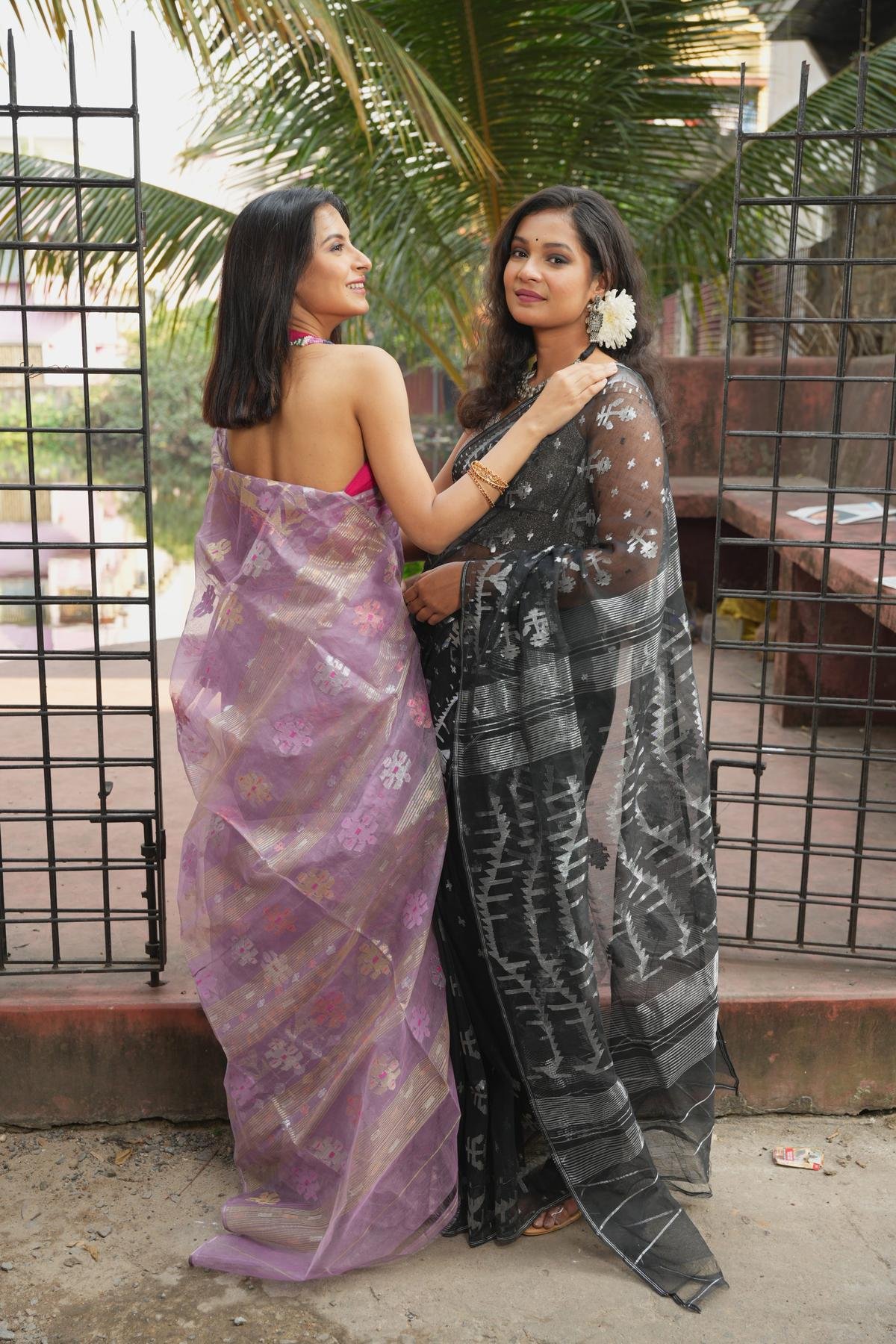
The collection includes saris, fabrics, stoles and blouse materials made using fibres and textiles such as khadi cotton, linen, matka silk, khadi silk and ketiya silk.
The diversity of materials is important because contemporary handloom demand cannot rely on a single definition of traditional clothing.
Consumers increasingly use handwoven fabrics across different contexts, from everyday dressing to occasion wear. Stoles, blouse materials and fabrics also allow customers to incorporate handloom into existing wardrobes without committing to a complete traditional ensemble.
That flexibility can help make handloom relevant to younger buyers.
Hastkaar demonstrates how tradition can be redesigned
Hastkaar by Bhartesh Vaibhav represents another direction at Vastra Utsav: the transformation of traditional techniques into contemporary design.
The label works with techniques including ajrakh block printing, shibori dyeing and hand embroidery, while using fibres such as cotton, bamboo and hemp.
This combination illustrates why the future of Indian craft does not necessarily depend on preserving traditional products exactly as they were.
A craft technique can remain authentic while its application changes.
That distinction is essential. Preservation does not have to mean freezing a tradition in time. A textile practice can survive by adapting to contemporary wardrobes, new silhouettes and changing expectations about sustainability.
Affordable luxury and the changing handloom customer
Suqoon, known for its affordable luxury positioning, brings another perspective to the exhibition through linen shirts, embroidered tops, trousers, co-ord sets and dresses.
Such products matter because the future of handloom depends partly on expanding the audience beyond consumers who already buy traditional saris.
A young customer may not purchase a Kanjeevaram or Chanderi sari frequently. But the same consumer might be interested in a linen shirt, a contemporary dress or a coordinated outfit made using craft-based techniques.
This is where sustainable fashion and handloom can intersect.
Traditional weaving does not have to be confined to ceremonial dressing. It can become part of everyday wardrobes if designers understand how consumers actually dress today.
Reimagining the sari without abandoning it
Aalta Designs, led by Tanima Roy Choudhary, approaches the sari by combining traditional weaves with contemporary motifs.
This represents a wider evolution in the Indian fashion market. The sari itself has proved remarkably adaptable, but designers increasingly need to make it relevant to consumers who want traditional clothing without necessarily wanting conventional styling.
Modern motifs, different draping approaches and lighter fabrics can make handwoven saris more accessible to a new generation.
The challenge is to modernise without erasing the qualities that make the textile distinctive.
That balance — innovation without cultural flattening — is likely to become one of the defining questions for Indian craft-led fashion.
Minimalism puts the weave itself in focus
Saaral Handloom Studio takes a quieter approach, allowing the weave, texture and craftsmanship to become the primary visual features.
This approach is especially relevant in a fashion environment increasingly interested in understated luxury.
For years, premium Indian fashion was often associated with elaborate embroidery, heavy embellishment and conspicuous ornamentation. But a growing appreciation for fabric quality and craftsmanship has created room for a different definition of luxury.
A handwoven textile does not always need to announce its value through decoration.
Sometimes its value lies in the texture, drape, weave structure and subtle variation that becomes apparent only when the wearer interacts with the fabric.
Chanderi: Lightweight luxury with centuries of identity
Threads of Chanderi from Madhya Pradesh brings one of India’s best-known lightweight weaving traditions to the exhibition.
The collection includes handwoven Chanderi saris, dupattas and fabrics in silk and cotton. Chanderi is widely valued for its lightness, delicate appearance, fine texture, zari work and distinctive motifs.
Its versatility makes it suitable for both everyday dressing and special occasions, illustrating another important principle of successful handloom: a textile becomes more commercially resilient when it can move between different parts of a consumer’s life.
Chanderi also demonstrates why fabric knowledge matters.
Consumers may recognise a name but still struggle to understand differences in weave, fibre composition, finishing and craftsmanship. Events that allow them to speak directly with sellers and makers can help develop that knowledge.
Kanjeevaram remains central to Chennai’s textile identity
Vastra Utsav also features Chennai-based Palam Silks, the Kanjeevaram boutique founded by Jeyasree Ravi.
Its collection includes bridal Kanjeevarams, lightweight Kanjeevarams, soft silk saris as well as linen and tussar silk.
The range illustrates how even an iconic traditional textile needs multiple formats to remain relevant.
The bridal Kanjeevaram occupies a very different space from a lightweight sari intended for more frequent use. By offering both, a textile brand can connect the heritage of Kanjeevaram with the changing practical needs of consumers.
This is particularly important for younger buyers, who may admire traditional weaving but prefer lighter clothing and more versatile wardrobes.
Why slow fashion needs more than the word ‘sustainable’
Vastra Utsav’s emphasis on sustainable fashion is timely, but the term deserves careful examination.
A product does not automatically become sustainable simply because it is handmade.
Sustainability involves several factors: how materials are sourced, how long products last, how they are produced, how workers are treated, how far goods travel and whether consumers actually use them for a long period.
Handloom can offer advantages because production is often less dependent on industrial machinery and because a well-made textile can have considerable longevity. But sustainability also depends on the economic sustainability of the person making it.
If an artisan cannot earn enough to continue weaving, the craft system is not sustainable regardless of how environmentally attractive the finished product may be.
The missing link in sustainable fashion: the artisan
Much of the sustainable fashion conversation focuses on materials and consumer behaviour. There is another dimension that deserves equal attention: the sustainability of livelihoods.
For traditional crafts, the human being behind the product is part of the sustainability equation.
Fair payment, predictable demand and recognition of specialised skills are therefore not peripheral issues. They are essential to keeping craft ecosystems alive.
Vastra Utsav’s model, by bringing artisans and consumers into the same space, makes that relationship visible.
It also gives customers an opportunity to ask a more meaningful question before buying: not simply “Is this sustainable?” but “Who made this, and does my purchase help sustain their work?”
Women-led enterprises add another layer to the exhibition
The inclusion of women self-help groups and women-led enterprises broadens the economic significance of the event.
Products such as pickles, spice blends and homemade specialities may appear unrelated to handloom at first glance. In reality, they demonstrate how community-based economic activity can create multiple income streams.
For women in particular, self-help groups can provide a platform for entrepreneurship and collective production.
Including these enterprises alongside artisans and designers creates a more complete picture of cultural economies: craft, food, agriculture, entrepreneurship and traditional knowledge can coexist within the same ecosystem.
Millets bring food heritage into the conversation
The addition of millet-based snacks from southern states is another noteworthy feature of the 2026 edition.
It expands the meaning of heritage beyond textiles.
India’s cultural traditions are not isolated objects. The same regions that developed distinctive weaving practices also developed food traditions shaped by local crops, climate and community knowledge.
Putting textiles and regional food together allows visitors to experience heritage through multiple senses rather than treating it purely as a museum subject.
Why events like Vastra Utsav matter in the digital age
It may seem paradoxical that a physical exhibition is becoming important in an era when consumers can buy almost anything online.
But precisely because online shopping removes physical contact with products, exhibitions can provide something digital commerce cannot easily reproduce.
Visitors can touch a handwoven sari, examine the texture, compare fabrics under natural movement and speak to the person selling or making it.
For textiles, this sensory experience matters.
Two fabrics may look similar in a photograph but feel entirely different in weight, texture and drape. A physical event can therefore educate consumers as well as sell products.
What consumers should look for when buying handloom
Events such as Vastra Utsav can also help consumers become more informed buyers.
- Ask about the fibre: Understand whether the fabric is cotton, silk, linen or a blend.
- Learn about the weaving technique: Ask what makes the textile distinctive.
- Understand care requirements: Proper maintenance can significantly extend a textile’s life.
- Ask who made it: Knowing the producer adds context to the purchase.
- Buy for long-term use: A sustainable textile is most useful when it becomes part of a durable wardrobe rather than a short-lived trend.
These questions do not need to turn shopping into homework. A few conversations can significantly change how a buyer understands the product.
From exhibition to long-term craft ecosystem
The biggest challenge for events like Vastra Utsav is ensuring that interest does not disappear when the exhibition ends.
A two-day or short-duration event can introduce consumers to artisans, but long-term craft survival requires continuing demand.
This is where the exhibition can have an important secondary role. It can create relationships between customers and makers that continue beyond the event, encourage repeat purchases and help consumers discover brands they may otherwise never encounter.
For artisans, the value of such exposure can therefore extend beyond immediate sales.
The strongest outcome would be a customer who discovers a handloom label at Vastra Utsav and continues buying from that producer in the future.
Why contemporary design may be the key to handloom’s future
Traditional textiles often face a difficult choice between preservation and relevance. If they remain unchanged, they risk becoming occasional ceremonial purchases. If they change too dramatically, their original identity may disappear.
The designers participating in Vastra Utsav demonstrate a possible middle path.
Traditional techniques can be retained while silhouettes, motifs, fibres and applications evolve.
That approach allows handloom to enter contemporary wardrobes without demanding that consumers abandon modern fashion preferences.
The future of Indian handloom may therefore belong not to products that look frozen in history, but to textiles that carry history into the present.
The larger lesson for Indian fashion
India’s fashion industry has increasingly recognised the commercial potential of its craft traditions. But the long-term success of that movement will depend on whether craft becomes part of everyday consumption rather than merely an aesthetic reference used by designers.
Events like Vastra Utsav help close that gap.
They bring together the maker, the designer and the customer. They create space for conversation. They encourage direct buying. And, through the fundraising connection with DakshinaChitra, they tie commercial activity to cultural preservation.
That model is particularly valuable because it treats heritage not as something that belongs exclusively in museums, but as something that can remain economically active.
Conclusion: Handloom survives when people keep choosing it
Vastra Utsav 2026 offers a useful reminder that preserving India’s textile heritage is not simply about documenting old techniques or celebrating famous fabrics. It is about keeping the economic and cultural ecosystem surrounding those techniques alive.
From West Bengal’s handlooms and Madhya Pradesh’s Chanderi to Kanjeevaram from Chennai, ajrakh, shibori, khadi, linen and contemporary slow-fashion collections, the exhibition shows how diverse India’s craft landscape remains.
Its most important feature may be the opportunity to meet the people behind the products. That interaction gives consumers something increasingly rare in mass-market fashion: a direct connection with the source of what they buy.
The future of handloom will not be secured by nostalgia alone. It will depend on design innovation, informed consumers, fairer livelihoods and markets willing to pay for craftsmanship.
Ultimately, India’s textile heritage survives not because we admire it, but because we continue to choose it. Vastra Utsav turns that choice into a tangible experience — one that connects heritage, sustainable fashion and livelihoods in the same marketplace.
For breaking news and live news updates, like us on Facebook or follow us on Twitter and Instagram. Read more on Latest Lifestyle on thefoxdaily.com.

COMMENTS 0