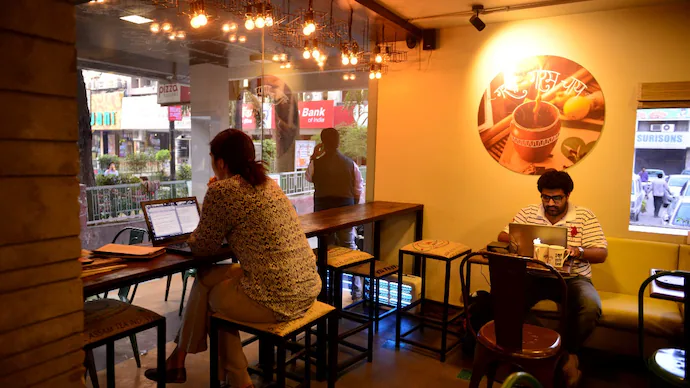
A cup of coffee, a comfortable chair and a laptop have become familiar features of modern urban life. For many professionals, cafes offer an alternative to working from home, a place to meet clients or simply an opportunity to escape the monotony of the same surroundings. But as work-from-cafe culture becomes increasingly popular, an uncomfortable question is emerging: how long is it reasonable to occupy a cafe table after ordering just one drink?
The debate is about more than the price of a cappuccino. It touches on customer expectations, Hospitality, business economics and the changing role of cafes in Indian cities. Some customers believe that buying a beverage gives them the freedom to enjoy the space for as long as they need. Cafe owners, meanwhile, must balance that expectation against rent, electricity, staff salaries and the possibility of serving several paying customers at the same table.
A discussion on X recently brought the issue into focus, attracting opinions from people who supported cafe owners as well as those who defended customers working for hours after making a purchase. Suggestions included ordering one item every hour, introducing time-based charges and establishing clear limits on laptop use.
But there is no universal answer. For some establishments, long-staying customers are part of the business model. For others, the expectation that every cafe should function as a coworking space is precisely the problem.
How work-from-cafe culture became the new normal
The popularity of working from cafes grew significantly after the Covid pandemic, when remote and hybrid working arrangements changed how people used public spaces. Professionals who once spent most of their working day in offices began looking for alternative environments that offered reliable internet, refreshments and a change of scenery.
Cafes naturally became attractive options. Unlike traditional offices, they provide a relaxed atmosphere, easy access to food and drinks, and opportunities for informal meetings. A person can work independently, meet a colleague or spend a few hours completing assignments without having to book a formal workspace.
For some customers, the attraction is also psychological. Working from home can become repetitive, particularly for people who live alone or have limited opportunities to interact with others during the day. A busy cafe offers background activity without necessarily requiring conversation.
However, this shift has created an expectation that cafes should provide the facilities and flexibility of an office. Customers may arrive with laptops, headphones and chargers, order a single coffee and settle in for several hours. What feels like an affordable and convenient arrangement for the customer can become a business challenge when tables remain occupied without generating additional sales.
The disagreement becomes particularly noticeable during busy periods, when customers waiting for a table may see someone working comfortably with an almost-empty cup.
Four hours over one cappuccino: a customer’s perspective
For Pune-based marketing professional Sanvi Sharma, spending several hours in a cafe with just one drink is not an unfamiliar experience. She admits that she once occupied a table for four hours with a single cappuccino.
She says she had never given much thought to how long she was staying because nobody had asked her to leave or encouraged her to place another order. Once she became absorbed in her work, she simply lost track of time.
Sharma also explains why customers may not immediately recognise that their extended stay could create a problem. From their perspective, they have paid for something and are using the space while enjoying it. Being asked to order again or leave might therefore feel uncomfortable.
Her experience reflects a broader issue in cafe etiquette: customers and owners may have very different assumptions about what a purchase entitles someone to expect.
For customers, one coffee may seem like sufficient payment for a few hours of sitting. For a cafe, however, the transaction involves more than the drink itself. The table is a limited resource, and keeping it occupied can prevent other customers from placing orders.
Why some cafes do not want customers working on laptops
Not every cafe wants to become a workplace. Some establishments deliberately build their identity around conversation, relaxation and social interaction rather than productivity.
Altry Coffee Roastery in Gurgaon follows a no-laptop policy. Its founder, Sahil Bhambri, argues that cafes should not automatically be expected to accommodate remote workers simply because some businesses began allowing laptop use after the pandemic.
His central question is straightforward: who decided that every cafe must function as a workspace?
Bhambri’s position comes from his own experience running a previous cafe. He recalls customers occupying tables for extended periods, taking office calls and refusing to share space with other visitors. In some instances, customers reportedly brought food from home and did not want to order anything from the cafe.
For a business that depends on selling food and beverages, such behaviour can create an obvious imbalance. Customers receive the benefit of the space, electricity and atmosphere, while the establishment earns little or nothing beyond the initial purchase.
Bhambri believes cafes should also remain places where people can socialise, relax and spend time without turning every visit into a work session. He wants customers to take a break from professional responsibilities rather than automatically opening their laptops whenever they enter a coffee shop.
He says that even after the cafe displayed its no-laptop policy, some visitors continued to ignore the rule or argue about it. The experience highlights why businesses need to communicate their expectations clearly before customers settle in.
Not every cafe follows the same rules
The growing popularity of Remote Work has created different kinds of cafe experiences. Some chains have established themselves as laptop-friendly destinations, while independent establishments may prefer to preserve a more traditional atmosphere.
Bintesh Kumar, Senior Marketing Manager at Pass Code Hospitality, believes that defining a brand’s culture is essential. Customers should understand whether a cafe welcomes extended working sessions or is primarily designed for dining and socialising.
He points to chains such as Blue Tokai and Starbucks, which have developed an environment where customers can work for extended periods without a minimum spending requirement. People increasingly associate these establishments with laptop-friendly spaces.
However, a standalone cafe that has not positioned itself as a work-friendly destination may find that long working sessions affect its business. If customers assume that every coffee shop offers the same facilities, disagreements can arise when the establishment has different expectations.
One way to avoid confusion is to communicate policies in a friendly and visible manner.
At The Drop in Delhi, a cafe by day and a bar by night, customers are informed that laptop use is permitted only until 5 pm. Small cards placed on tables communicate the rule, which applies throughout the week, including weekends.
Kumar says the approach is intended to establish the character of the space rather than confront customers. Clear communication helps visitors understand what kind of experience the business offers and reduces the likelihood of misunderstandings.
The hidden business cost of occupying a cafe table
For customers, the price of a coffee may seem like a reasonable payment for spending time in a comfortable environment. But running a cafe involves a much wider set of expenses.
Rent, electricity, employee salaries, ingredients, equipment, cleaning and maintenance all contribute to operating costs. These expenses continue regardless of whether a customer orders one beverage or several items during a long visit.
For smaller cafes, table availability can be particularly important. A customer who occupies a four-person table for several hours may prevent a group of friends or a family from using the space. The potential loss is not limited to another cup of coffee; it may involve an entire table’s worth of orders.
Kumar acknowledges that extended stays can affect average spending per customer. However, he also identifies an interesting business advantage. A cafe filled with people working on laptops can appear popular and successful to anyone looking in from outside. That impression may encourage other customers to visit.
This creates a business paradox. Long-staying customers may reduce immediate revenue per table, but they can also contribute to the atmosphere and visibility that attract new visitors.
The challenge is finding a balance between maintaining a welcoming environment and ensuring that the business can operate sustainably.
Why some cafe owners prefer loyalty over immediate spending
Not all cafe owners view a customer spending several hours over one drink as a problem. Some believe that building long-term relationships is more valuable than maximising the amount earned from every individual visit.
Dhruv Singh, founder and CEO of Chelvies Coffee, describes the establishment as a work-friendly cafe and says the business would not ask a customer to leave simply because they had spent 10 hours with one beverage.
His approach is based on the value of repeat customers. Singh argues that a person who returns regularly over several years can be more valuable to a business than the additional revenue that might have been generated by asking them to vacate a table after a few hours.
He explains that if someone continues visiting Chelvies and ordering their favourite drink for nine or 10 years, that relationship represents the kind of long-term profitability he wants to build.
For Singh, hospitality sometimes means accepting a short-term opportunity cost to maintain customer loyalty. Pressuring someone to order more or leave could damage a relationship that might otherwise continue for years.
His position also reflects the way work-friendly cafes operate. Customers may spend long periods at their tables, but they can become regular visitors who develop relationships with employees and feel connected to the establishment.
That familiarity can make it easier to manage busy periods. Singh says loyal customers generally understand when a cafe becomes crowded and are more willing to make room for families or groups waiting for tables.
Customer-first hospitality at Kathe Cafe
Suresh Sharma of Kathe Cafe in Bengaluru shares a similarly customer-friendly approach. He believes that people should not be pressured into spending beyond their budgets simply because they want to spend time at the establishment.
Sharma says he would not ask customers to leave or order more. In his view, if most visitors spend comfortably and a small proportion choose to stay longer with just one coffee, that is not necessarily a problem.
His philosophy is rooted in the idea that hospitality should accommodate different customers and their financial circumstances. Not everyone can afford repeated purchases, and a cafe should not automatically treat a lower-spending visitor as an inconvenience.
However, this approach does not eliminate the need for consideration from customers. A person who regularly visits a cafe may understand when the business becomes busy and when other people need access to tables.
Mutual respect is therefore central to the arrangement. Customers appreciate being allowed to work or relax without pressure, while businesses benefit when visitors recognise that tables are shared spaces rather than permanently reserved personal offices.
Should cafes charge customers by the hour?
One suggestion emerging from the online debate is to charge customers according to the time they spend at a cafe. Under this approach, visitors would pay not only for food and beverages but also for the duration of their stay.
Another proposal is a one-coffee-per-hour rule, which would encourage customers to place additional orders during extended visits.
However, Kumar is not convinced that hourly charging is the right solution for Indian cafes. He argues that introducing such a system could blur the distinction between a conventional cafe and a coworking space.
A cafe typically sells food, beverages and hospitality, while a coworking facility charges customers for access to a working environment and its associated services. Introducing time-based fees could change the expectations attached to a cafe visit.
It could also create a different kind of customer experience, where visitors constantly monitor the time rather than relaxing or enjoying their surroundings.
For businesses that want to accommodate remote workers, a clearly communicated time limit may be a more practical option than charging by the hour.
So, how long is too long to sit with one coffee?
There is no fixed rule that applies to every cafe. The reasonable length of a visit depends on the establishment’s business model, its seating capacity, the time of day and whether it actively welcomes people working on laptops.
Bhambri suggests that work-friendly cafes could consider recommending a maximum stay of two to three hours. Such a guideline would allow customers to complete a reasonable amount of work while giving other visitors an opportunity to use the space.
For cafes that operate primarily as social or dining destinations, a different approach may be appropriate. They can establish no-laptop policies, restrict working hours or communicate that tables are intended for shorter visits.
Customers also have a role to play. Spending time at a cafe means benefiting from more than the beverage itself. Ordering something additional when staying for several hours, avoiding unnecessary table occupation during busy periods and respecting clearly displayed policies can help maintain a positive relationship with the business.
That does not mean customers should feel obliged to spend money they cannot afford. It simply means recognising that a cafe is a business with operating costs and limited seating.
For work-friendly establishments, the relationship can be different. A regular customer who returns frequently may provide long-term value even if individual visits do not generate substantial revenue. In those cases, loyalty and familiarity can matter more than the number of drinks ordered during a single session.
Keeping cafe culture comfortable for everyone
The debate over one coffee and several hours of laptop use reflects how dramatically the role of cafes has changed. They are no longer just places to grab a quick drink or meet friends. For many people, they have become informal offices, creative spaces and extensions of their daily routines.
But that does not mean every cafe must offer the same experience. Some owners want customers to work without worrying about time, while others want to protect an environment designed around conversation and relaxation.
The most practical solution is transparency. Cafes should communicate whether laptops are welcome, whether working hours are restricted and whether customers are expected to make additional purchases during longer visits. Customers, in turn, should respect those conditions.
Ultimately, the question is not simply whether four hours over one cappuccino is too long. It is whether the customer’s expectations match the experience the cafe intends to provide.
A little consideration on both sides can help preserve what makes cafe culture appealing in the first place: a comfortable place to enjoy a drink, spend time and feel welcome without making the business behind that experience unsustainable.
For breaking news and live news updates, like us on Facebook or follow us on Twitter and Instagram. Read more on Latest Lifestyle on thefoxdaily.com.






COMMENTS 0