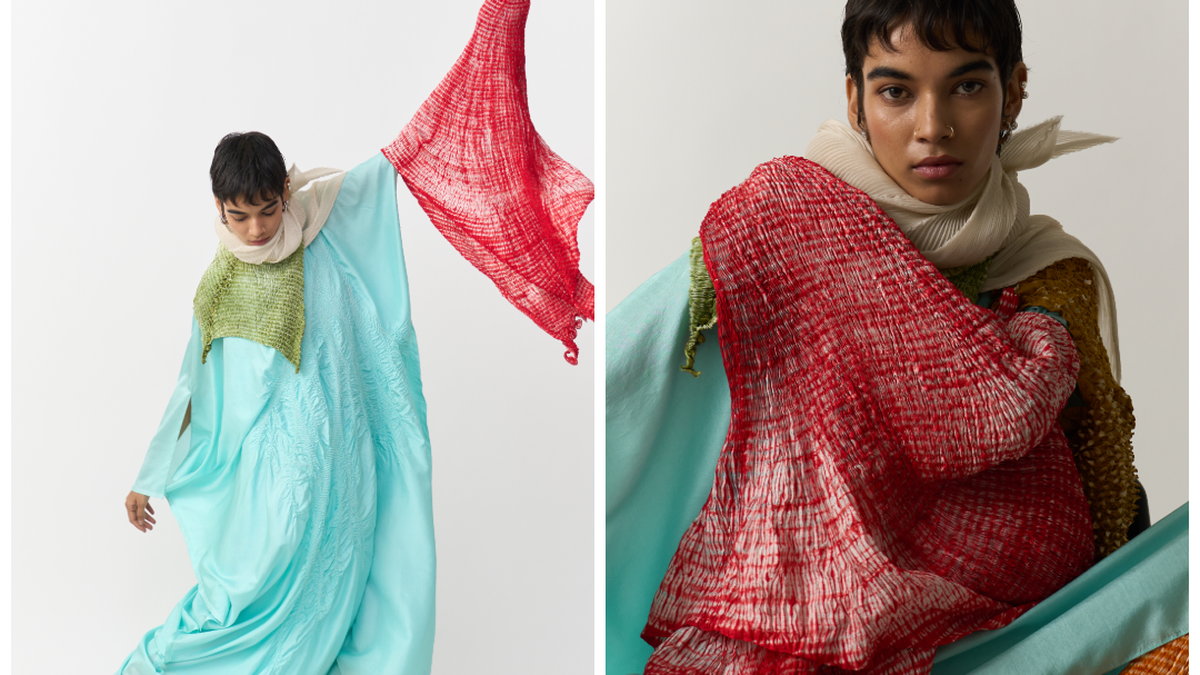
Beat, Repeat collection:What does the monsoon look like when it is translated into cloth rather than painted on a canvas? For Studio Medium, the answer lies not in literal images of clouds or rain, but in movement, rhythm, repetition, colour and texture.
Riddhi Jain and Dhruv Satija’s Beat, Repeat, the studio’s Pre-Festive 2026 collection, approaches the Indian monsoon as a sensory experience. Instead of treating rain as a decorative theme, the collection investigates the visual and physical qualities associated with it — dark skies, wet surfaces, rhythmic downpours, shifting shadows and the repetition of natural patterns.
Presented at Collage in Chennai and hosted by architect and interior designer Gowri Adappa, the collection was displayed inside a 60-year-old Chennai home. That setting is important because Beat, Repeat is not simply a clothing collection. It is an exploration of the relationship between textiles and built spaces.
At the centre of the presentation was a seven-foot shibori canopy in deep blues and greens. Suspended overhead like a cloud, it transformed the room’s white walls through changing shadows and filtered light. The installation effectively turned the architecture itself into part of the collection.
The result is an approach to fashion in which the process of making is as important as the final garment.
What is Studio Medium’s Beat, Repeat collection?
Beat, Repeat is Studio Medium’s Pre-Festive 2026 textile and clothing collection created by Riddhi Jain and Dhruv Satija.
The collection includes saris, kurtas, dresses, kaftans and shirts and draws upon traditional textile techniques including bandhani, arashi, shibori and mothra.
Rather than reproducing these techniques purely as heritage details, the designers use them to explore the visual language of the monsoon.
The collection’s central idea is repetition. Rain falls repeatedly. Water creates patterns on surfaces. Clouds gather and disperse. Shadows move across buildings. Drops strike windows and roofs in rhythms that can be almost musical.
By translating these sensations into dyeing and textile manipulation, the designers turn an environmental experience into a design system.
The monsoon becomes a design process rather than a print
Fashion collections inspired by nature often rely on obvious visual references: floral motifs for spring, leaves for botanical themes or blue prints for water.
Beat, Repeat takes a more interesting route.
Instead of simply drawing rain onto fabric, it uses techniques capable of creating irregularity, movement and repetition. The textile itself becomes the representation of the weather.
This distinction matters.
A printed raindrop is an image of rain. A repeatedly folded, bound, twisted or dyed textile can communicate something closer to the experience of rain — its unpredictability, rhythm and accumulation.
That makes the collection conceptually stronger because the technique and the theme reinforce each other.
Why shibori is central to the collection
Shibori is a resist-dyeing tradition associated with Japan in which fabric is manipulated through folding, binding, twisting, stitching or other forms of compression before dye is applied.
The areas protected from the dye create patterns once the textile is opened.
This process naturally introduces an element of anticipation. The maker controls the preparation, but the final pattern can contain variations and surprises.
That quality makes shibori particularly appropriate for a collection inspired by rain.
No two moments of rainfall are identical. Light changes. Clouds move. Water gathers differently across surfaces. The visual experience is always shifting.
Shibori’s combination of control and unpredictability can reproduce a similar tension in cloth.
The seven-foot canopy changes how the collection is understood
The seven-foot shibori canopy is arguably one of the most important elements of the presentation because it expands the collection beyond clothing.
Suspended above the visitors, the canopy resembles a large atmospheric form. Its deep blue and green tones suggest storm clouds, wet vegetation and rain-heavy skies, while the shadows it casts introduce movement into the surrounding architecture.
This transforms the viewing experience.
Visitors are not simply looking at garments on display. They are standing inside an interpretation of the collection’s central idea.
That is where the relationship between architecture and textiles becomes especially clear.
Why the 60-year-old Chennai house matters
The choice of a 60-year-old Chennai home as the setting adds another layer to the collection.
Older buildings often carry their own rhythms: corridors, windows, courtyards, walls, shadows and transitions between interior and exterior spaces. These architectural elements can become active participants in how textiles are experienced.
In a conventional white-box gallery, fabric can appear isolated from everyday life. Inside a lived architectural environment, clothing interacts with doors, walls, light and space.
That makes the location particularly appropriate for Studio Medium’s interest in architecture.
The collection effectively asks viewers to consider clothing not merely as something worn on the body but as another form of spatial design.
Architecture and textiles share a surprising language
At first glance, architecture and fashion appear to belong to different worlds. One shapes buildings; the other shapes bodies.
Yet both disciplines rely on structure, proportion, repetition, surface and movement.
A wall can create a rhythm through repeated openings. A textile can create rhythm through repeated motifs or folds. A building can control light through windows and screens. Fabric can filter light through its weave, colour and transparency.
Beat, Repeat uses these similarities to create a dialogue between the garment and its surroundings.
The shibori canopy is the clearest expression of that idea, but the concept extends to the garments themselves. The textile techniques become architectural marks translated onto a softer, movable surface.
Bandhani brings another form of repetition
Bandhani is a traditional Indian tie-dye technique in which sections of fabric are tied or otherwise manipulated before dyeing to create characteristic patterns.
The technique depends heavily on repetition. Tiny interventions accumulate across a larger piece of fabric to create an overall visual rhythm.
That makes bandhani a natural fit for the collection’s title.
Beat, Repeat suggests that repetition is not boring when every repetition contains small differences. In hand processes, the human hand introduces variation into patterns that might otherwise appear mechanically identical.
For contemporary fashion, this quality is increasingly valuable because it separates crafted textiles from industrial uniformity.
Arashi and the beauty of controlled movement
Arashi shibori is associated with pole-wrapping and diagonal patterning, creating effects that can suggest movement across the fabric.
Visually, such patterns can resemble streaks, currents or rain moving through a landscape.
Within the conceptual framework of Beat, Repeat, this technique allows the designers to create a sense of direction rather than relying entirely on static motifs.
The cloth appears to carry movement within it.
This is one of the collection’s most compelling ideas: textiles can communicate motion even when the garment itself is hanging still.
Mothra adds another layer to the textile vocabulary
Mothra, another resist-dyeing tradition used in the collection, contributes to Studio Medium’s broader exploration of pattern and repetition.
Rather than treating each textile technique as an isolated craft reference, the collection brings different methods into a common visual conversation.
That approach is important for contemporary textile design because it prevents heritage techniques from becoming decorative labels.
The techniques are instead used as tools for creating a new visual language.
The importance of process in contemporary fashion
One of the most interesting aspects of Beat, Repeat is its insistence that the making process deserves as much attention as the finished garment.
In mass-market fashion, consumers often encounter the final product without knowing how it was made. Production is deliberately separated from consumption.
Craft-based fashion operates differently.
The method of folding, binding, dyeing, stitching or manipulating fabric directly affects the final appearance. Small decisions made during production can alter the finished pattern.
This makes the process part of the aesthetic.
For Studio Medium, that process becomes part of the story the collection tells.
Why repetition does not mean uniformity
The title Beat, Repeat offers another useful way to understand the collection.
Repetition can create rhythm, but it does not necessarily create sameness.
In nature, repeated events constantly produce variation. Waves repeat but never arrive in exactly the same way. Raindrops fall continuously but create changing patterns. Clouds may return to familiar shapes without ever perfectly reproducing themselves.
Handmade textiles work similarly.
A repeated process produces an identifiable visual language, while the human hand ensures that each piece retains individual characteristics.
This tension between repetition and difference is particularly relevant to fashion, where consumers want both recognisable design and individuality.
The colour palette carries the emotional weight
The deep blues and greens of the canopy immediately establish the collection’s atmospheric character.
These colours can suggest several aspects of the monsoon simultaneously: dark skies, rainwater, dense foliage and the cooler visual environment that often accompanies a storm.
Against the white walls of the Chennai home, the darker textile creates a strong contrast.
But the real effect comes from the shadows. Colour is no longer restricted to the surface of the fabric. It becomes part of the surrounding room.
This is another reason the installation matters: it allows the collection’s palette to become environmental rather than merely sartorial.
From sari to kaftan: making craft relevant to different wardrobes
The collection includes a broad range of garments, including saris, kurtas, dresses, kaftans and shirts.
This variety is important because textile innovation can reach a much wider audience when it is not limited to one traditional garment category.
The sari remains a powerful canvas for Indian textile traditions, but contemporary wardrobes increasingly include multiple silhouettes.
By applying craft techniques to dresses, kaftans and shirts, designers can introduce textile heritage to consumers who may not wear traditional clothing every day.
That can help move craft-based fashion from occasional consumption towards regular use.
Why contemporary craft needs new applications
Traditional textile techniques face a familiar challenge. They are admired culturally but are sometimes purchased only for specific occasions.
That creates a gap between appreciation and economic sustainability.
Contemporary applications can help close that gap.
If a craft technique appears on garments that consumers can wear to work, travel, informal gatherings or everyday social occasions, the potential market becomes broader.
This does not mean traditional garments should disappear. It means traditional techniques can acquire additional lives.
Beat, Repeat demonstrates how this can happen through design rather than through abandoning craft.
The Chennai setting also connects the collection to the monsoon experience
Chennai has a distinctive relationship with seasonal rain, making the city’s architectural and environmental context an especially appropriate backdrop for a collection built around the monsoon.
The choice of an older Chennai house makes the theme feel grounded rather than abstract.
Instead of presenting the monsoon as a generic Indian aesthetic, the installation places the viewer inside a specific environment where architecture, weather and textile intersect.
That local grounding gives the collection a stronger sense of place.
What Studio Medium is doing differently
The strongest aspect of Beat, Repeat is that it does not depend on novelty for its own sake.
Its innovation comes from combining familiar craft techniques with a contemporary conceptual framework.
Bandhani, shibori, arashi and mothra are not new inventions. What is new is the way they are assembled around a single idea — the rhythm of the monsoon — and presented through a dialogue with architecture.
This is a useful model for contemporary Indian fashion.
Heritage does not always need to be modernised by radically changing the technique. Sometimes the more powerful approach is to change the question asked of the technique.
Beat, Repeat and the future of textile-led fashion
There is growing interest in fashion that reveals its making process rather than hiding it.
Consumers increasingly encounter terms such as slow fashion, artisanal production, hand dyeing and craft-based design. But these concepts become meaningful only when designers allow audiences to understand the actual work behind them.
Collections such as Beat, Repeat can help make that process visible.
The garment becomes not simply an object but evidence of a sequence of actions: fabric manipulation, dye application, repetition, drying, finishing and construction.
That narrative can create a deeper form of value than novelty alone.
Comparison: printed pattern versus process-created pattern
A useful way to understand Studio Medium’s approach is to compare conventional printed pattern-making with resist-based textile processes.
- Printed pattern: The visual design is usually applied directly onto a prepared surface.
- Resist-dyed pattern: The final pattern emerges partly from how the fabric is folded, tied, twisted or otherwise manipulated before dyeing.
- Printed pattern: Repetition can be highly precise and uniform.
- Resist-dyed pattern: Repetition can contain subtle variations created by the process and the maker.
- Printed pattern: The image can be designed separately from the physical structure of the fabric.
- Process-led textile: Technique directly influences the appearance and character of the finished cloth.
This difference explains why the making process becomes so important to a collection like Beat, Repeat.
The collection’s larger insight: weather can be translated through technique
The most compelling idea emerging from the collection is that inspiration does not always need to begin with an image.
A designer can respond to an experience instead.
The monsoon is not simply something people see. They hear its rhythm, feel humidity, watch water gather and observe how light changes. It affects architecture, movement and daily routines.
By using textile processes based on repetition and controlled unpredictability, Studio Medium translates those sensations into material form.
That approach could point towards a richer future for nature-inspired fashion — one in which designers explore environmental phenomena through structure and process rather than simply reproducing their visual appearance.
Conclusion: When rain becomes rhythm on fabric
Beat, Repeat is ultimately an exploration of how a familiar seasonal experience can become an entirely new textile language.
Through the work of Riddhi Jain and Dhruv Satija, techniques such as bandhani, arashi, shibori and mothra become more than craft references. They become instruments for expressing repetition, movement, irregularity and atmosphere.
The seven-foot shibori canopy captures that philosophy particularly well. Suspended inside a 60-year-old Chennai home, it turns fabric into architecture and architecture into an extension of the textile. The shadows, colours and changing spatial relationships make the monsoon feel present without requiring a literal depiction of rain.
The collection also demonstrates why contemporary fashion can benefit from looking closely at traditional techniques. Their value does not lie only in their history. It lies in their ability to generate new ideas.
In Studio Medium’s hands, the monsoon is not printed onto clothing. It is folded, bound, dyed, repeated and allowed to emerge — one rhythm at a time.
For breaking news and live news updates, like us on Facebook or follow us on Twitter and Instagram. Read more on Latest Lifestyle on thefoxdaily.com.


COMMENTS 0