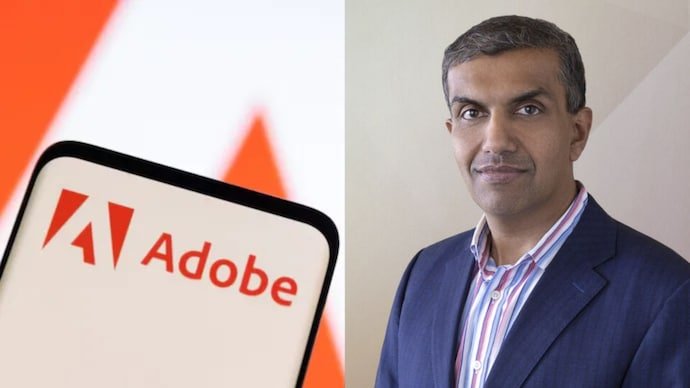
Adobe has named Anil Chakravarthy as its next president and chief executive officer, placing an Indian-origin technology executive with extensive experience in enterprise software, digital transformation and Artificial Intelligence at the helm of the company.
Chakravarthy will formally take over from Shantanu Narayen on December 1, 2026, and will also join Adobe’s board of directors. Narayen, who has led the company for more than 18 years, will move into the role of executive chair and work with his successor during the leadership transition.
The succession comes at a critical moment for Adobe. The company remains one of the world’s leading providers of creative and digital-experience software, but artificial intelligence is rapidly changing the competitive landscape. New AI-powered tools are challenging traditional software workflows, while investors are closely watching whether Adobe can turn its AI investments into sustained growth.
Narayen has strongly endorsed Chakravarthy, describing him as an experienced transformational leader with a deep understanding of Adobe’s business. The outgoing CEO also highlighted Chakravarthy’s work building products that use AI to improve customer experiences and credited him with helping integrate major acquisitions into Adobe’s portfolio.

For Chakravarthy, the promotion represents the culmination of a long technology career that has taken him from engineering and consulting roles to senior leadership positions at companies including Symantec and Informatica before he joined Adobe in 2020.
Who is Anil Chakravarthy?
Anil Chakravarthy is a technology executive with experience spanning enterprise software, cybersecurity, cloud data management, digital transformation and customer-experience technology.
He joined Adobe in January 2020 as executive vice president and general manager of the company’s Digital Experience business. At the time, Adobe said he brought decades of experience in product innovation and technology leadership.
Before joining Adobe, Chakravarthy was the chief executive officer of Informatica, the enterprise cloud data-management company, from 2015 to 2020. He joined Informatica in 2013 and previously served as its executive vice president and chief product officer.
Earlier in his career, Chakravarthy held a range of senior roles at Symantec and worked in enterprise Security and product management at VeriSign. He began his professional career at management consulting firm McKinsey & Company.
His career has therefore covered several technology cycles, from enterprise security and software to cloud computing, data management and AI-powered customer experiences.
An IIT Varanasi graduate with MIT degrees
Chakravarthy’s academic background combines Indian engineering Education with advanced studies in the United States.
He holds a Bachelor of Technology in Computer Science and Engineering from the Institute of Technology, Varanasi, the institution now known as IIT (BHU) Varanasi. He later earned a master’s degree and PhD from the Massachusetts Institute of Technology.
That educational path has become a notable part of his profile as he prepares to lead one of the world’s best-known software companies.
His technical training also matches the direction Adobe is taking. The company is moving toward software increasingly shaped by artificial intelligence, automation and real-time data, making an executive with experience across engineering and enterprise technology particularly relevant to its next phase.
How Chakravarthy rose through Adobe
Chakravarthy’s responsibilities at Adobe expanded significantly after he joined the company.
In September 2020, he also took responsibility for Adobe’s worldwide field operations across its portfolio. In December 2021, he was promoted to president of Digital Experience and worldwide field operations.
His current role is president of Adobe’s Customer Experience Orchestration business and worldwide field operations. The division focuses on helping businesses combine data, content and customer interactions to deliver personalised experiences across digital channels.
The role has given Chakravarthy exposure to both product development and the commercial side of Adobe’s operations, including enterprise sales, professional services and customer success.
That combination of technical and business responsibilities is likely to be important as he takes control of the wider company.
Shantanu Narayen praises Chakravarthy’s leadership
Narayen has described Chakravarthy as an “experienced transformational leader” who operates with values, integrity and a deep understanding of Adobe’s business.
Adobe said Chakravarthy has a record of building and delivering products aimed at creating new categories and serving a broad customer base.
Narayen specifically pointed to his leadership in developing Adobe CX Enterprise, GenStudio and Brand Visibility. These products use AI and customer data to help companies create content, understand brand visibility and deliver more personalised digital experiences.
Chakravarthy was also involved in scaling Adobe Experience Platform and launching newer products, including CX Enterprise Coworker.
His role extended beyond product creation. Adobe said he helped champion the acquisitions of Workfront and Semrush and supported their integration into the company’s portfolio.
Those experiences could prove valuable in the CEO role because Adobe needs to combine organic product development with a rapidly evolving ecosystem of AI companies and technologies.
Why the CEO change comes at a crucial time for Adobe
Adobe’s leadership transition comes as artificial intelligence is reshaping the software industry.
Generative AI has changed how people create images, videos, documents and digital content. Companies that once relied on specialised software workflows are increasingly experimenting with AI systems that can perform tasks through simple natural-language instructions.
For Adobe, this creates both an opportunity and a threat.
The company has one of the largest installed bases of professional creative-software users in the world. Its products, including Photoshop, Illustrator, Acrobat and Premiere, occupy important positions across creative and business workflows.
But AI startups and competing software companies are attempting to reduce the complexity traditionally associated with professional creative work.
Tools powered by generative AI can create images, modify designs, generate video and automate parts of the production process that previously required significant human effort and technical expertise.
Adobe’s challenge is therefore to ensure that AI strengthens its ecosystem rather than making some of its traditional software workflows less valuable.
Chakravarthy has already been working on Adobe’s AI strategy
The incoming CEO is not new to Adobe’s artificial intelligence strategy.
Much of his recent work has involved products that combine AI with customer data and digital content. Adobe’s Customer Experience Orchestration business is built around helping companies understand customer behaviour and deliver personalised experiences using real-time information.
That includes technologies that allow organisations to analyse customer interactions, manage content and coordinate digital experiences across multiple channels.
Chakravarthy has also overseen products such as GenStudio, which is designed to help organisations manage and produce marketing content at scale.
His experience gives him a perspective on AI that differs from the narrower focus of a traditional creative-software executive. He has worked on the intersection of AI, data, enterprise workflows and customer engagement.
That could become central to Adobe’s future as the company tries to make AI useful not only for individual creators but also for large businesses.
Adobe’s AI strategy faces a difficult investor test
Adobe has invested heavily in integrating generative AI into its products and has repeatedly argued that AI can expand its addressable market rather than simply cannibalise existing software.
The company has introduced AI capabilities across its creative and digital-experience products and has reported demand for AI-powered tools.
In June, Adobe raised its annual profit outlook, with management pointing to continued strength in its business and demand for AI-related offerings.
But investors remain concerned about the pace and scale of the transformation.
The key question is whether AI will increase the value of Adobe’s ecosystem or gradually reduce the need for some of the specialised tools that have historically supported its business.
For example, an AI system can potentially automate tasks that once required a user to learn advanced features in Photoshop or other creative applications. That could make some workflows easier while also creating competitive pressure on subscription software.
Adobe’s response has been to embed AI into its existing products rather than treat AI as a separate business.
Adobe faces competition from new AI-powered rivals
The competitive Environment is changing rapidly beyond Adobe’s traditional rivals.
Companies such as Canva and Figma have expanded the market for easier-to-use creative and design tools, while a new generation of AI-native products is challenging the assumption that professional creative work must be performed through conventional software interfaces.
These competitors can move quickly because they do not necessarily carry the same legacy of desktop applications, complex workflows and existing customer expectations.
Adobe’s advantage is its huge installed customer base, extensive software ecosystem and decades of experience serving professional creators and enterprises.
Its challenge is ensuring that those advantages remain relevant when AI dramatically lowers the technical barrier to content creation.
Narayen’s 18-year Adobe era is coming to an end
Chakravarthy’s appointment marks the end of one of the longest leadership eras in the modern software industry.
Narayen became Adobe’s CEO in December 2007 and has led the company through a fundamental transformation.
Under his leadership, Adobe shifted from a business heavily dependent on packaged software toward a subscription-based cloud model. Products that were once purchased as traditional software licences became part of Creative Cloud and other recurring subscription offerings.
The transition helped turn Adobe into a major cloud-software company and created a more predictable recurring-revenue model.
Narayen has also overseen Adobe’s expansion into digital marketing and customer experience through businesses that complement its traditional creative-software franchise.
His decision to step down as CEO does not represent an immediate departure from the company. He will become executive chair, allowing him to remain involved in Adobe’s strategic direction while Chakravarthy assumes responsibility for day-to-day leadership.
Why Chakravarthy was an internal succession choice
Adobe considered internal and external candidates as part of its succession process before selecting Chakravarthy.
The decision to choose an executive already familiar with Adobe may reduce some of the risks associated with changing leadership during a period of major technological disruption.
Chakravarthy understands Adobe’s products, customers, sales organisation and AI strategy. He has also worked closely with Narayen and other members of the leadership team.
That continuity could help Adobe avoid a lengthy period in which a new CEO must learn the company’s business at the same time that the industry is changing rapidly.
At the same time, an insider appointment places pressure on Chakravarthy to demonstrate that he can take the company in a new direction rather than simply continue the existing strategy.
Adobe shares reflect investor concerns
Adobe’s stock performance has become an important part of the leadership story.
Shares declined about 25% in 2024 and another 21% in 2025, according to market data cited in reports. The stock was also down roughly 18% in 2026 before the CEO announcement.
The declines reflect broader concerns affecting software companies viewed as vulnerable to AI disruption, as investors reassess whether existing software business models can maintain pricing power as AI tools become more capable.
Adobe shares fell roughly 1.7% in after-hours trading following the succession announcement.
The market reaction suggests that investors are focused less on the symbolism of the leadership change and more on what Chakravarthy’s appointment means for Adobe’s ability to navigate AI competition.
A successful CEO transition will ultimately require measurable improvements in growth, profitability and product adoption rather than simply a change in leadership.
What Chakravarthy will need to prove as CEO
The incoming CEO faces several interconnected challenges.
The first is monetising AI. Adobe needs to demonstrate that customers are willing to pay for AI-enabled products rather than expecting advanced AI features to become standard at no additional cost.
The second is defending Adobe’s core creative franchise. Photoshop, Illustrator, Premiere and Acrobat remain highly recognised products, but their long-term value will depend on how effectively Adobe incorporates AI without undermining the professional workflows that make them valuable.
The third is maintaining enterprise growth. Adobe’s Digital Experience business has become an increasingly important part of the company, and Chakravarthy’s experience in customer-experience technology could be an advantage.
The fourth is controlling costs while continuing to invest in AI Infrastructure and research. Building frontier AI capabilities and integrating them across a large software portfolio can require substantial resources.
Finally, Chakravarthy will need to restore confidence among investors who have become increasingly concerned about the impact of AI on established software companies.
His business experience could become a key advantage
One of Chakravarthy’s strongest assets is the range of businesses he has already managed.
At Informatica, he helped lead a major transition toward cloud and subscription services. At Adobe, he has managed a large software operation while overseeing products focused on data, AI and customer experience.
He has also worked in cybersecurity and enterprise software, giving him experience with markets in which technology changes quickly and customers make sophisticated purchasing decisions.
That breadth could prove valuable as Adobe increasingly becomes an AI and enterprise technology company rather than simply a creative-software company.
Narayen’s endorsement also suggests that Adobe views Chakravarthy as someone who understands not only the technology but also how the business needs to evolve.
What happens to Shantanu Narayen?
Narayen will become executive chair when Chakravarthy takes over on December 1.
He has said he intends to work closely with the incoming CEO to ensure a smooth transition and support Adobe’s ongoing transformation.
His continued role gives Adobe a degree of leadership continuity at a time when the company is making significant technological and strategic changes.
It also means Chakravarthy will have access to the executive who led Adobe through its transition to cloud subscriptions and helped build the company’s modern business model.
Why the appointment matters beyond Adobe
Chakravarthy’s appointment is significant beyond the immediate leadership change because it places an executive with Indian engineering roots at the head of another major US technology company.
Indian-origin executives have become increasingly prominent in global technology leadership, and Chakravarthy’s career adds another example of an engineer trained in India progressing through Silicon Valley’s technology industry into the top job at a major multinational.
But his appointment ultimately rests on his business and technology record rather than his educational background.
His experience running Informatica, managing Adobe’s Digital Experience organisation and developing AI-focused products is what makes him relevant to Adobe’s current challenge.
Can Chakravarthy lead Adobe through the AI disruption?
The central test of Chakravarthy’s tenure will be whether Adobe can use AI to strengthen its competitive position instead of allowing AI-native rivals to weaken it.
The company’s strategy has several advantages. Adobe already has a massive professional customer base, a deep library of creative tools and a strong enterprise footprint. Embedding AI into those products gives the company an opportunity to make existing workflows faster and more powerful.
But AI also changes the economics of software.
When users can generate images, edit video, create presentations or produce marketing material with simple instructions, they may need fewer specialised skills and potentially fewer standalone applications.
Adobe therefore has to convince customers that its ecosystem remains valuable precisely because AI is integrated into it.
Chakravarthy’s background makes that mission particularly relevant. He has spent much of his Adobe career working on the intersection of technology, data, AI and customer experience.
A new chapter for Adobe begins on December 1
Anil Chakravarthy’s appointment marks a major leadership transition for Adobe, but the larger story is about the company’s next technological era.
Narayen leaves the CEO role after more than 18 years during which Adobe reinvented itself around subscriptions, cloud services and digital experiences. Chakravarthy inherits a very different challenge: keeping that transformation moving while artificial intelligence changes what software can do.
His background gives him experience across cloud software, cybersecurity, enterprise technology, AI and customer experience. His academic path, from IIT Varanasi to MIT, complements a career built through leadership positions at Informatica, Symantec, VeriSign, McKinsey and Adobe.
Now he must turn that experience into a strategy capable of satisfying customers and investors at the same time.
Adobe’s future will depend on whether it can make AI a growth engine rather than a threat to its established products. Chakravarthy will take over with the advantage of knowing the company from the inside, but also with the pressure of leading it through one of the most disruptive periods in software history.
When he becomes CEO on December 1, the transition will formally close Narayen’s long tenure at the top. But it will also begin a new test for Adobe: whether an executive who helped build its AI-powered customer-experience business can successfully lead the entire company into an AI-first future.
For breaking news and live news updates, like us on Facebook or follow us on Twitter and Instagram. Read more on Latest Technology on thefoxdaily.com.






COMMENTS 0