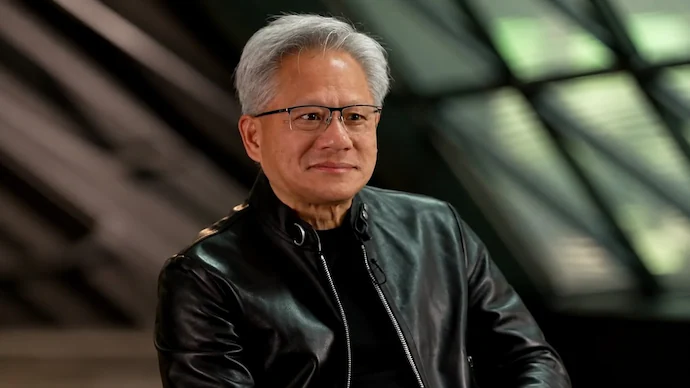
Nvidia CEO Jensen Huang has become one of the most influential executives in the global Artificial Intelligence industry. His company’s graphics processing units (GPUs) power data centres, advanced AI models and computing infrastructure worldwide. That position has also placed Nvidia at the centre of growing technological and geopolitical competition between the United States and China.
Now, reports about Huang’s alleged relationship with a Chinese business executive suspected of working for Beijing’s intelligence service have raised new questions about corporate security, technology transfers and the risks surrounding the international AI chip supply chain.
According to reporting by The New York Times, US intelligence information circulated among senior policymakers in the Trump administration last spring. The memo reportedly identified Alice Huang, a business executive associated with Singapore-based data centre company Megaspeed, as someone recruited by China’s Ministry of State Security (MSS) to gather information about Jensen Huang.
A separate report by the Financial Times said US officials believed Jensen Huang and Alice Huang had a romantic relationship. The allegations have not been established through a public court finding, and the available reporting does not demonstrate that Nvidia’s chief executive knowingly shared classified information or that Alice obtained sensitive company secrets.
The issue has also reached Capitol Hill. Republican leaders of three influential US House committees have requested a closed-door briefing with Jensen Huang on November 18, 2026, to discuss his interactions with Alice Huang and Nvidia’s safeguards against foreign espionage.
What US intelligence reportedly knows about the alleged relationship
The latest reports describe an intelligence assessment that was shared with a limited group of senior Trump administration officials during the spring. According to people briefed on the information, US intelligence agencies suspected that Alice Huang had been recruited by China’s Ministry of State Security to collect information about Nvidia’s chief executive.
The Financial Times subsequently reported that American officials believed the relationship between the two was romantic. This is a significant detail beyond the earlier description of a close personal or business relationship. However, the underlying intelligence has not been publicly released, and the full nature of the alleged relationship remains unclear.
The reported operation was allegedly intended to help Beijing understand Nvidia’s technology, business strategy and position in the American AI industry. Intelligence officials reportedly considered whether a close relationship with Huang could provide access to information about the company’s plans or influence its approach to the Chinese market.
There is an important distinction between an intelligence assessment and a proven espionage offence. The allegations have been described by media organisations citing people familiar with classified information. They have not been tested in a public criminal trial, and no publicly available evidence establishes that Jensen Huang passed confidential information to China.
Why would China target Nvidia’s CEO?
Nvidia occupies a strategically important position in the global AI economy. Its processors are widely used to train and operate advanced artificial intelligence systems, including large language models, scientific computing applications and cloud-based AI services.
Access to advanced chips has become a major point of disagreement between Washington and Beijing. The US government has introduced export restrictions on certain high-performance semiconductors and related technologies to limit China’s ability to obtain computing resources that could support advanced military and strategic capabilities.
These restrictions have created commercial challenges for Nvidia, which has historically served customers in China as well as other international markets. The company has sought permission to sell certain products to Chinese customers, while US policymakers have debated how much advanced computing technology should be available to Beijing.
In this environment, intelligence about Nvidia’s product roadmap, customer relationships, supply arrangements and discussions with US officials could be valuable to a foreign government. An operation targeting a senior executive could potentially seek business information, identify influential industry contacts or understand how export restrictions affect the company’s commercial decisions.
The reports suggest that China’s intelligence service may also have been interested in influencing Nvidia’s position on access to advanced processors. However, there is no publicly established evidence that Alice Huang successfully persuaded Jensen Huang or Nvidia to change company policy or US export-control decisions.
Who is Alice Huang?
Alice Huang is described in media reports as a Chinese business executive who worked with Megaspeed, a Singapore-based data centre company. She is not related to Jensen Huang, despite sharing the same surname.
According to reporting about the intelligence assessment, Alice Huang had professional connections with senior figures in the technology and semiconductor industries. These reportedly included executives associated with Nvidia and Gigabyte. Her participation in industry conferences and private business dinners is also part of the reporting about her access to influential technology executives.
Such events are common in the technology sector. Semiconductor companies regularly meet customers, distributors, cloud providers, investors and data centre operators to discuss products and commercial opportunities. The presence of an executive at a conference or dinner does not, by itself, establish involvement in espionage.
The concern described by US intelligence sources is that Alice Huang may have used professional access and personal relationships to gather information for Beijing. The specific information she allegedly collected, the methods used and the extent of any intelligence transfer have not been fully disclosed publicly.
What is Megaspeed, and why is it under scrutiny?
Megaspeed is a Singapore-based company operating in the data centre and AI infrastructure sector. Companies in this business purchase computing equipment, build facilities and rent processing capacity to customers that need large amounts of computing power without operating their own data centres.
The company’s activities have attracted attention because of concerns about the movement of advanced AI chips through international supply chains. US authorities have scrutinised Megaspeed over suspicions that its business arrangements may have helped Chinese companies obtain access to processors restricted from direct export to China.
According to the source material cited in The New York Times report, a Malaysian sister company associated with Megaspeed purchased at least $4.8 billion worth of advanced AI equipment between approximately June 2024 and February 2026. The reported purchases included Nvidia processors and other technology, based on trade records obtained from ImportGenius.
The scale of the reported purchases has drawn attention because advanced AI chips are expensive and subject to detailed export-control requirements. Large equipment orders can serve legitimate data centre expansion projects, but authorities may also examine whether the final destination and actual users match the declared commercial purpose.
Reports have also described Megaspeed-linked data centres in Southeast Asia as providing computing capacity to Chinese technology companies, including Alibaba. Such arrangements have raised questions about whether restricted computing capabilities could become accessible to Chinese customers through facilities located outside mainland China.
However, the distinction between selling a physical processor to a restricted destination and providing access to computing capacity through an overseas data centre is important. The two arrangements can involve different legal and regulatory questions. The existence of a data centre serving an international customer does not automatically establish an export-control violation.
There is also no publicly established finding that Nvidia knowingly participated in an illegal transfer of its processors through Megaspeed. Nvidia has said it monitors deployments of its GPUs and has disputed suggestions that its products were improperly diverted to China.
China’s Ministry of State Security: The agency at the centre of the allegations
China’s Ministry of State Security is the country’s principal civilian intelligence and counterintelligence organisation. Established in 1983, it is responsible for activities involving national security, foreign intelligence and counterespionage.
The MSS operates in a different political and institutional environment from intelligence agencies in democratic countries. Its responsibilities include monitoring perceived threats to China’s political system, gathering intelligence abroad and countering foreign intelligence operations.
The agency has become increasingly visible in China’s public security messaging. In 2023, it launched an official account on WeChat and encouraged citizens to report suspected foreign espionage activities. Chinese officials have also highlighted the role of artificial intelligence and emerging technologies in national security, cybersecurity and military competition.
In the Nvidia case, the reported intelligence assessment suggests that the agency may have been interested in understanding the American AI chip industry through access to a prominent business executive. If substantiated, such an operation would illustrate how intelligence gathering can extend beyond traditional government and military targets to include private-sector leaders and technology companies.
Nevertheless, the reported allegations concern a specific suspected operation. They should not be treated as proof that every Chinese technology executive or business operating in Singapore is connected to the MSS.
What Nvidia has said about Jensen Huang’s interactions with Alice
Nvidia has pushed back against suggestions that Jensen Huang’s meetings with Alice Huang were unusual. Company spokesperson John Rizzo has said that interactions between the CEO and the business executive were consistent with normal customer relationships.
Nvidia has also stressed that its chief executive regularly meets thousands of customer executives as part of his responsibilities. The company says its regional cloud customers receive ordinary business information rather than sensitive Nvidia trade secrets or information relevant to US national security.
The company’s position is important because Nvidia operates through a broad international network of customers, cloud providers, distributors and technology partners. Meetings with executives from those businesses are a routine part of maintaining commercial relationships.
However, the company’s assurances do not independently settle every question raised by the intelligence reporting. Congressional lawmakers are seeking additional information about the nature of Huang’s interactions with Alice and the company’s procedures for identifying and managing potential foreign intelligence risks.
China’s government has also rejected the espionage allegations as unsubstantiated. Alice Huang has not publicly provided her account of the claims in the reporting available so far. The CIA and White House have not publicly confirmed the specific intelligence assessment.
Singapore rejects claims that it investigated Alice Huang
The allegations have also brought attention to Singapore, where Megaspeed operates. A clarification from Singapore’s Ministry of Home Affairs on October 31 addressed claims in a Wall Street Journal report concerning Alice Huang and her alleged links to Chinese intelligence.
The ministry said neither the Singapore government nor its officials had told the newspaper that Alice Huang was suspected of being a Chinese intelligence asset or that authorities had investigated her personal connections with Jensen Huang. It specifically stated that no investigation had been conducted in respect of Alice Huang on the matters described in the article.
Singapore’s statement also clarified that investigations into Megaspeed were ongoing. The Singapore Police Force said it could not comment further on that investigation at the time. The government separately emphasised that Singapore does not automatically enforce unilateral export controls imposed by foreign jurisdictions, while making clear that it does not condone companies deliberately using Singapore to circumvent or violate other countries’ export rules.
This distinction matters. An ongoing investigation involving a company is not the same as a confirmed investigation into an individual over espionage allegations. Singapore’s clarification means that claims about its authorities investigating Alice Huang should not be presented as an established fact.
US lawmakers request a closed-door briefing from Jensen Huang
The controversy has moved beyond intelligence reporting and into congressional scrutiny. On November 4, 2026, three Republican committee leaders requested that Jensen Huang participate in a closed-door briefing scheduled for November 18.
The request came from Brian Mast, chairman of the House Foreign Affairs Committee; John Moolenaar, chairman of the House Select Committee on China; and Rick Crawford, chairman of the House Permanent Select Committee on Intelligence.
The lawmakers want to discuss Huang’s reported interactions with Alice Huang and Nvidia’s security procedures for protecting its business against espionage by foreign adversaries. Their letter raised concerns about China’s potential access to sensitive American technology and information.
The closed-door format reflects the national security dimension of the issue. Some information relevant to intelligence assessments, export controls and corporate security may not be suitable for public discussion. A private briefing could allow lawmakers to ask questions without disclosing sensitive details.
The request is not the same as a public criminal accusation or a finding that Nvidia violated US law. It is a congressional request for information about reported contacts and the company’s security practices. What Huang tells lawmakers, and whether further details are released afterward, could help clarify the extent of the concerns.
Why the case matters for the global AI industry
The allegations highlight a challenge facing technology companies that operate across international markets while developing products with national security implications. Advanced AI processors are commercial products, but their computing capabilities can also be relevant to military research, intelligence operations and strategic infrastructure.
As a result, governments increasingly examine not only where chips are shipped but also who ultimately uses them, where computing services are delivered and how equipment is transferred between companies.
Data centres in Southeast Asia have become particularly important to this debate. They can serve customers across multiple countries, allowing businesses to access computing resources without physically importing every processor into their own territory. This model supports legitimate international cloud services, but it can also complicate efforts to enforce restrictions on advanced computing technology.
The reported Megaspeed transactions therefore raise questions that extend beyond one executive’s personal relationships. Regulators and companies must consider how to verify end users, monitor equipment deployments and identify potential diversion risks without disrupting legitimate international technology trade.
The case also illustrates why corporate security cannot be limited to protecting computer networks and confidential files. Senior executives can be approached through business meetings, industry events, investment discussions and personal relationships. Companies operating in sensitive technology sectors may need to consider these human and organisational risks alongside conventional cybersecurity measures.
What remains unconfirmed?
Despite the growing attention, several important questions remain unanswered. The intelligence memo described in media reports has not been made public, and the underlying evidence has not been independently examined through a public legal process.
- The nature of the relationship: The Financial Times reported that US officials believed Jensen Huang and Alice Huang had a romantic relationship, but the details have not been publicly established.
- Evidence of espionage: Reports describe Alice Huang as a suspected Chinese intelligence recruit, but the full intelligence evidence and alleged methods of information collection remain undisclosed.
- Access to confidential information: There is no publicly established finding that Alice obtained Nvidia trade secrets, classified information or sensitive US national security material.
- Chip diversion: Concerns about Megaspeed’s equipment purchases and computing services have been reported, but they do not by themselves prove that Nvidia knowingly supplied restricted processors to China illegally.
- Singapore’s role: Singapore has denied that its government or officials said Alice Huang was under investigation for the alleged intelligence links. It has separately confirmed that investigations into Megaspeed were ongoing.
- Congressional findings: The requested November 18 briefing may provide lawmakers with additional information, but the request itself does not establish wrongdoing.
What happens next?
The November 18 congressional briefing is likely to be an important next development in the controversy. Lawmakers are seeking explanations about the reported relationship, the information available to Nvidia’s leadership and the company’s approach to protecting sensitive technology from foreign intelligence operations.
Any further assessment will depend on what evidence US authorities can substantiate and whether additional information becomes available through congressional oversight or official investigations. Nvidia’s response, Singapore’s clarification and China’s rejection of the allegations also form part of the public record that must be considered.
For now, the case remains a developing intelligence and corporate security controversy rather than a publicly proven espionage offence involving Jensen Huang. Its wider significance lies in the growing difficulty of protecting strategically important AI technology in an industry built around global customers, international data centres and cross-border business relationships.
For breaking news and live news updates, like us on Facebook or follow us on Twitter and Instagram. Read more on Latest Technology on thefoxdaily.com.






COMMENTS 0