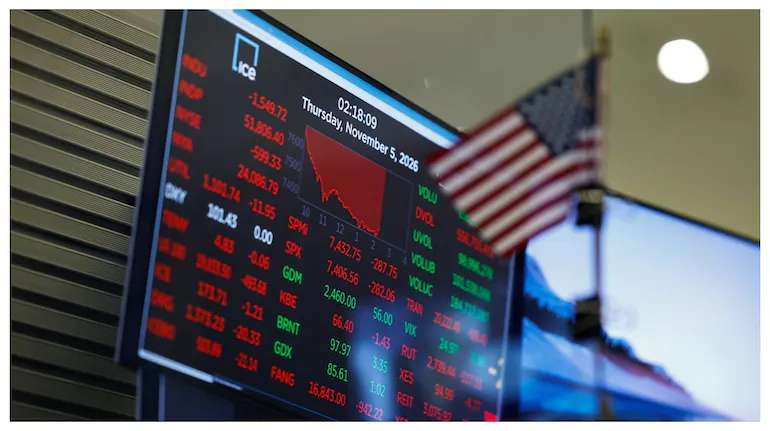
Wall Street is facing a major test as growing concerns over Artificial Intelligence (AI) investments trigger a sharp selloff across global financial markets. US stocks have lost approximately $5.7 trillion in market value since their October 6 peak, highlighting the scale of the reversal in a market rally that had been heavily driven by expectations surrounding AI.
Investors are increasingly questioning whether technology companies can generate sufficient returns from the enormous amounts of money being invested in AI infrastructure. High stock valuations, rising corporate debt and uncertainty over future earnings have added to market anxiety. Political developments following the Democrats’ sweep of Congress have introduced another concern, with investors assessing the possibility of restrictions on data-centre expansion.
The sharp market movements this week have exposed how vulnerable crowded investment positions can become when sentiment changes. Even defensive sectors that had attracted investors during the earlier rotation struggled to avoid the broader selloff.
Key Highlights
- US stocks lost approximately $5.7 trillion in market value between the October 6 peak and Thursday’s close.
- The Nasdaq 100 suffered a $2.3 trillion wipeout on Thursday.
- High AI valuations, rising debt and uncertain investment returns are driving investor concerns.
- Political uncertainty has increased concerns about potential restrictions on data-centre expansion.
- Oil price declines could provide some relief from inflation, while forced selling and leveraged positions continue to influence market volatility.
Wall Street Loses $5.7 Trillion as AI Selloff Intensifies
The latest market downturn represents one of the most significant reversals in the current AI investment cycle. According to an index tracking total US equity market capitalisation, the stock market lost $5.7 trillion in value between its October 6 peak and Thursday’s close.
The selloff accelerated after months of growing concerns about the sustainability of the AI-driven rally. Investors had continued to pour money into technology companies and businesses connected to AI infrastructure, but questions about valuations and future profitability became increasingly difficult to ignore.
Market movements were particularly dramatic during the week. US stocks experienced a sharp rally on Wednesday, followed by a $2.3 trillion decline in the Nasdaq 100 on Thursday. Semiconductor stocks recovered on Friday, demonstrating how quickly sentiment was changing across the technology sector.
At Thursday’s close, 57% of Nasdaq 100 constituents had fallen at least 20% from their respective highs. This was a larger proportion than when the index itself entered a bear market in March 2022.
AI Investment Concerns Put Technology Valuations Under Pressure
Artificial intelligence has been one of the biggest drivers of stock market gains, supporting technology valuations and encouraging companies to commit billions of dollars to data centres, chips and computing infrastructure.
However, investors are now questioning whether the expected financial returns can justify the scale of these investments. Building AI infrastructure requires substantial capital expenditure, while the commercial benefits may take time to emerge.
Rising debt adds another layer of uncertainty. Companies investing heavily in infrastructure may face greater financial pressure if revenue growth fails to match expectations or borrowing costs remain elevated.
Joe Gubler, a portfolio manager at Causeway Capital Management, which oversees approximately $76 billion, warned that not every company investing heavily in capital expenditure would emerge as a winner.
His comments reflect a growing distinction among investors between companies that can turn AI spending into sustainable profits and those that may struggle to justify their investments.
Political Uncertainty Adds Pressure to the AI Trade
Political developments in Washington have introduced another source of uncertainty for technology investors. The Democrats’ sweep of Congress has raised concerns about possible restrictions on the rapid expansion of data centres.
Data centres are essential to the development and operation of large-scale AI systems. They require significant investment in computing equipment, electricity and supporting infrastructure. Any regulatory changes affecting their construction could influence the pace and cost of future AI expansion.
The political shift has therefore added another risk to an investment theme already facing questions about valuations, debt and profitability.
Investors are also assessing the wider policy environment. President Donald Trump faces new political constraints following the midterm election results, potentially limiting the scope for fiscal support. The administration’s response to market weakness has also become part of the broader investment debate.
Nasdaq 100 Rout Exposes the Risks of Crowded Positions
The latest selloff was not driven solely by investors changing their views on AI. Market positioning and trading strategies also contributed to the intensity of the decline.
Hedge funds, leveraged investors and automated trading strategies increased selling pressure as markets moved lower. Even retail investors, who have often bought stocks during market declines, participated in the selling at a pace rarely seen since the pandemic.
Andrew Lapthorne, head of quantitative research at Societe Generale, linked much of the market turbulence to crowded positions involving AI and oil. As these trades reversed, investors were forced to sell Technology Stocks they had previously favoured and cover positions in defensive assets they had bet against.
Such rapid changes can create additional volatility. Investors using leverage may face margin calls when asset prices move against them, forcing them to sell holdings regardless of their long-term investment outlook.
Hedge Funds Reduce Leverage as Market Volatility Increases
Data from Morgan Stanley show that hedge funds have reduced gross leverage from its June peak by the largest amount in more than a decade.
Reducing leverage can help investment firms limit exposure during periods of market uncertainty. However, when several investors attempt to cut risk simultaneously, the resulting selling can amplify price declines.
Morgan Stanley’s quantitative strategists believe the liquidation process may be approaching exhaustion. Nevertheless, they anticipate the possibility of another market low following a temporary recovery.
This suggests that even if immediate selling pressure begins to ease, investors may continue to face unstable market conditions as portfolios adjust to changing expectations.
Investors Search for New Market Leaders Beyond Big Tech
The market rotation away from expensive growth stocks had started before the latest selloff. Investors were increasingly moving towards less expensive sectors, including utilities and consumer staples, as concerns about technology valuations grew.
In October, growth stocks underperformed value shares by 10 percentage points, marking their largest monthly performance gap since 2001. This followed a particularly strong period for growth stocks just one month earlier.
However, Thursday’s market rout exposed the limitations of this defensive strategy. Even sectors that had attracted investors as alternatives to Big Tech struggled when selling spread across the wider market.
The shift in investor preferences also affected other asset classes. Equities moved from outperforming US Treasuries by five percentage points to recording their weakest relative performance since early 2025 over the subsequent two months. A popular momentum strategy also surrendered almost all its September gains in October.
Some Investors Avoided the AI Selloff
Although the broader market experienced significant losses, some investors had already reduced their exposure to expensive and popular technology stocks before the downturn.
Jeff Muhlenkamp exited almost all AI holdings in his fund before the latest market rout. His portfolio, valued at approximately $275 million, remained roughly flat for November and outperformed the S&P 500 for the year.
His investment approach focused on selling assets considered expensive and moving capital towards less popular investments trading at lower valuations.
This highlights how differences in portfolio positioning can produce sharply different results during periods of changing market momentum.
Falling Oil Prices Offer Some Relief from Inflation
Despite the pressure on technology stocks, falling oil prices have provided a potential positive development for the wider economy. Oil prices have declined sharply amid hopes that the Iran war could move towards an end.
Lower energy prices can reduce inflationary pressure on households and businesses by easing fuel, transportation and production costs. However, these benefits may take time to reach consumers and influence broader economic conditions.
The decline in oil prices also contributed to changing investment positions across financial markets. As investors reassessed their exposure to energy and technology assets, the reversal of crowded trades added to market swings.
Federal Reserve Rate Expectations Add to Market Uncertainty
Monetary policy remains another important factor shaping investor sentiment. Strong US employment data have reinforced expectations that the Federal Reserve could increase interest rates again in December.
The central bank remains focused on inflation, limiting the possibility of immediate monetary support for financial markets. Higher interest rates can increase borrowing costs and place pressure on companies that depend on future earnings growth to justify their valuations.
This creates an additional challenge for technology businesses planning large AI infrastructure investments. Higher financing costs could make some projects less attractive, particularly when expected returns remain uncertain.
BlackRock Sees a More Deliberate Pace for AI Spending
Rick Rieder, chief investment officer of global fixed income at BlackRock, said the aggressive pace of AI spending may become more deliberate.
His comments reflect the possibility that companies could reassess the speed of their infrastructure investments as financial markets demand clearer evidence of commercial returns.
A slower pace of spending would not necessarily mean that AI development is ending. Instead, companies may become more selective about capital allocation, project timelines and the expected profitability of new infrastructure.
For investors, the central question is increasingly whether AI-related businesses can convert massive investment commitments into sustainable earnings and cash flows.
What the $5.7 Trillion Market Rout Means for Investors
The market decline highlights the risks of investing in sectors where valuations depend heavily on expectations of future growth. AI remains a major technological development, but the latest volatility shows that strong long-term prospects do not eliminate short-term financial risks.
Investors are likely to pay closer attention to corporate debt, capital expenditure plans, cash flow generation and the commercial returns from AI products and services.
Market participants will also monitor political developments, Federal Reserve decisions and oil prices as they assess the direction of equities. The interaction between these factors could determine whether the recent rebound develops into a more sustained recovery or another temporary pause in the selloff.
Conclusion
Wall Street’s $5.7 trillion market-value decline marks a major turning point in investor sentiment towards the AI investment boom. Concerns about high valuations, rising debt, uncertain returns and potential restrictions on data-centre expansion have combined to trigger a sharp reversal in technology stocks.
Although semiconductor shares rebounded on Friday and some investors believe forced selling may be nearing exhaustion, uncertainty remains high. The next phase of the AI market cycle will depend increasingly on whether companies can demonstrate that their enormous infrastructure investments are capable of delivering sustainable financial returns.
For breaking news and live news updates, like us on Facebook or follow us on Twitter and Instagram. Read more on Latest Business on thefoxdaily.com.






COMMENTS 0