Artificial Intelligence is changing the way people write, research and create content. From helping students understand difficult subjects to assisting professionals with everyday tasks, AI tools are becoming part of many people’s routines. For writers, however, the technology raises a more complicated question: can a machine improve a piece of writing without taking away the originality and personal experience that make it meaningful?
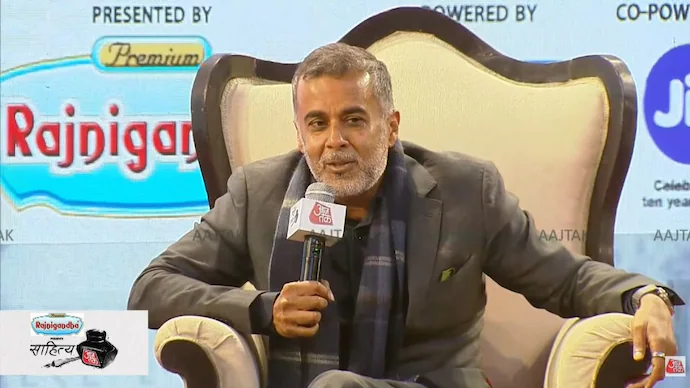
Author Chetan Bhagat addressed this question at Sahitya AajTak, where he discussed the growing influence of AI on the writing process and shared how he incorporates the technology into his own work. Rather than treating artificial intelligence as a tool that can write everything for him, Bhagat described using it as an assistant that helps identify weaknesses and improve the quality of his writing.
His approach reflects a distinction that is becoming increasingly important as generative AI tools become more accessible. AI can help writers examine their work, question their arguments and discover areas that need improvement. But the responsibility for deciding what belongs in a final piece, according to Bhagat, should remain with the human author.
How Chetan Bhagat Uses AI to Improve His Newspaper Columns
One of the ways Bhagat uses AI is to review and critique his newspaper columns. Instead of asking a chatbot to produce an entire article, he provides it with writing that he has already developed and asks for feedback.
He uses the technology to examine whether his arguments are convincing, whether important information has been left out and whether readers might disagree with particular points. This allows him to look at his work from perspectives that he may not have considered while writing the original draft.
For example, a writer who feels confident about an argument may overlook a counterpoint that could weaken it. An AI tool can be asked to identify possible objections, highlight unclear explanations or point out where additional context might be necessary. Such feedback can help the writer reconsider the structure and strength of the argument before publication.
This approach also changes the role AI plays in the creative process. Instead of becoming the primary author, the technology functions more like an additional reviewer. It can raise questions and suggest improvements, but the writer remains responsible for evaluating those suggestions.
Bhagat explained that AI does sometimes provide useful insights, but not every recommendation deserves to be accepted. A suggestion may sound convincing while being unsuitable for the writer’s argument, tone or intended message.
As he put it, “There’s always a human layer on top of AI.” The statement captures his belief that technology should support the writing process without taking control of the final creative decisions.
Why Writers Should Not Accept Every AI Suggestion
Generative AI tools can produce fluent sentences, organise information and offer alternative ways to express an idea. However, polished language does not automatically mean that the underlying argument is accurate, relevant or original.
An AI-generated suggestion may introduce an assumption that the writer does not agree with. It may also simplify a complicated subject, overlook an important qualification or recommend a change that makes the writing less personal. This is why reviewing AI feedback requires the same critical thinking that writers apply when assessing information from other sources.
Bhagat’s approach places editorial judgement at the centre of AI-assisted writing. A writer should consider whether a suggestion genuinely improves the work rather than accepting it simply because the technology has produced it.
This distinction is particularly important in opinion writing and newspaper columns. Such pieces often depend on the author’s interpretation of events, reasoning and individual perspective. If those elements are replaced by generic machine-generated language, the finished article may lose the voice that distinguishes one writer from another.
AI can help identify a missing argument or suggest a clearer explanation, but it cannot make the final editorial decision on behalf of the author. Writers must still check factual claims, examine the context and ensure that their conclusions accurately represent what they want to communicate.
Chetan Bhagat Warns Against Using AI as a Shortcut
Bhagat also discussed the risks of depending on AI simply to save time. He illustrated the problem through the example of students who ask artificial intelligence to complete their homework.
A student who submits an AI-generated assignment may receive a well-organised answer without having understood the subject. The immediate task might be completed, but the learning process that the assignment was intended to encourage has been skipped.
For Bhagat, this is an example of the difference between using technology to improve one’s abilities and allowing it to replace the effort required to develop those abilities.
He suggested that students should approach AI as a learning assistant instead. Rather than asking it to complete an assignment, they can use it to explain difficult concepts, clarify unfamiliar topics and break complicated ideas into easier steps.
Once they understand the subject, they should attempt the assignment themselves. This allows them to benefit from the technology while still developing their own knowledge and independent thinking.
Using AI to Learn Instead of Copying Answers
Bhagat’s advice can be applied to several common educational situations. A student struggling with a difficult topic could ask AI to explain it in simpler language, provide examples or describe the steps involved in solving a problem.
They could also ask follow-up questions when an explanation is unclear. This makes the interaction more like a discussion with a tutor than a request for a ready-made answer.
However, students should not assume that every AI response is correct. They still need to compare explanations with textbooks, classroom material and reliable educational sources. The aim should be to understand a subject well enough to explain it independently.
The same principle applies to professional writing. A journalist can use AI to identify gaps in a draft, but must verify information and make editorial decisions. A student can use it to understand a topic, but should produce their own assignment. In both cases, the value comes from learning and improving rather than outsourcing the entire task.
Why Human Experience Still Matters in Storytelling
Beyond the practical uses of AI, Bhagat raised a larger question about the nature of storytelling. He argued that writing cannot be separated from human experience because personal memories, emotions and individual perspectives influence the stories people create.
A writer’s childhood, relationships, personal struggles and observations of everyday life can shape the characters, situations and themes that appear in their work. These experiences give storytelling a personal dimension that goes beyond the arrangement of words or the construction of a plot.
Two writers can observe the same event and interpret it differently because their backgrounds and experiences are not identical. Their emotional responses, values and memories influence what they notice and how they communicate it.
This is one reason readers often connect with stories that feel personal and emotionally recognisable. A narrative can explore familiar experiences such as ambition, disappointment, friendship, family relationships or uncertainty while presenting them through an individual perspective.
AI can help organise ideas, suggest possible story structures and improve sentence clarity. It can also generate fictional scenarios based on instructions. But Bhagat’s argument is that these capabilities do not make it a replacement for the lived experiences that inform human creativity.
For writers, the challenge is therefore not simply to produce grammatically correct sentences. It is to develop a perspective, make meaningful observations and communicate emotions in a way that readers can connect with.
Can Artificial Intelligence Replace Human Creativity?
The growing use of generative AI has made this question increasingly relevant across the creative industries. AI tools can now assist with brainstorming, drafting, editing, summarising and rewriting. These capabilities can reduce the time required for certain tasks and make writing support more accessible.
However, the ability to generate text is not the same as having a distinct human perspective. A machine-generated passage may be coherent and stylistically polished, but writers still need to determine whether it communicates an authentic idea, reflects the intended context and adds something meaningful for the reader.
There are also practical limitations to consider. AI systems can produce inaccurate information, misunderstand a question or present an unsupported statement with confidence. Writers who rely on generated material without checking it risk introducing errors into their work.
Originality is another important consideration. If writers depend too heavily on similar prompts and automated suggestions, their work may begin to sound generic. Personal observations, independent research and individual judgement help prevent writing from becoming a collection of predictable phrases and familiar arguments.
Bhagat’s position does not suggest that writers should reject AI altogether. Instead, he sees value in using the technology while retaining control over the creative process. The distinction is between allowing AI to assist with writing and allowing it to determine what the writing should say.
How Writers Can Use AI Without Losing Their Original Voice
Bhagat’s comments at Sahitya AajTak offer a practical framework for writers who want to experiment with AI without becoming dependent on it. The technology can be useful at different stages of writing, provided the author remains actively involved.
1. Start With Your Own Ideas
Writers can begin with their own observations, research and arguments before turning to AI. Developing an initial draft independently helps establish the central message and personal voice of the piece.
2. Use AI as a Critical Reader
Instead of requesting a complete article, writers can ask AI to identify unclear arguments, missing context, weak transitions and possible objections. This can provide another perspective on the draft without replacing the author’s contribution.
3. Question the Feedback
Not every suggestion will improve a piece of writing. Authors should assess whether a recommendation is relevant, accurate and consistent with the purpose of the article. Suggestions that weaken the argument or change its intended meaning can be rejected.
4. Verify Information Independently
AI-generated factual claims should be checked against reliable sources. Names, dates, statistics, quotations and other important details need independent verification, particularly in journalism and academic writing.
5. Protect Your Individual Voice
Personal experiences, observations and interpretations are important parts of a writer’s identity. Editing for clarity should not mean removing every distinctive expression or replacing an individual style with generic machine-generated language.
6. Treat AI as a Learning Tool
Writers can ask AI to explain unfamiliar concepts, introduce alternative viewpoints or clarify complicated subjects. Using the technology to build knowledge can be more valuable in the long term than asking it to complete every task.
What Bhagat’s Advice Means for the Future of Writing
As AI tools become more common, the relationship between technology and creative work is likely to remain an important discussion. Writers, students and professionals are already exploring ways to use automated assistance while maintaining responsibility for the material they produce.
Bhagat’s experience illustrates one possible approach: use AI to question and strengthen your work rather than treating it as a substitute for original thinking. This approach recognises that technology can make parts of writing more efficient without removing the need for research, judgement and creativity.
It also highlights why the ability to evaluate information may become increasingly important. When AI can produce an answer within seconds, users need to know how to question that answer, identify possible errors and decide whether it actually addresses the problem.
For emerging writers, this means that learning the fundamentals of storytelling, observation, research and clear communication remains important. AI may assist with the process, but developing a recognisable voice still requires practice and independent effort.
The Final Word
Chetan Bhagat’s comments at Sahitya AajTak offer a perspective on how writers can work with artificial intelligence without surrendering their creative independence. His own use of AI focuses on reviewing newspaper columns, identifying weaknesses in arguments and finding areas where additional information or a different perspective may be needed.
His message to students and writers is similar: technology should help people become better at what they do, not remove the learning and effort involved in developing their abilities. Asking AI to complete an assignment or produce an entire article may save time, but it can also reduce opportunities to practise independent thinking.
Ultimately, Bhagat believes that human experiences, emotions and perspectives remain central to meaningful storytelling. AI can assist with editing, feedback and idea development, but the writer must retain control over the final work. In an era of increasingly capable writing tools, the ability to think independently and communicate an authentic perspective remains essential.
For breaking news and live news updates, like us on Facebook or follow us on Twitter and Instagram. Read more on Latest Lifestyle on thefoxdaily.com.






COMMENTS 0