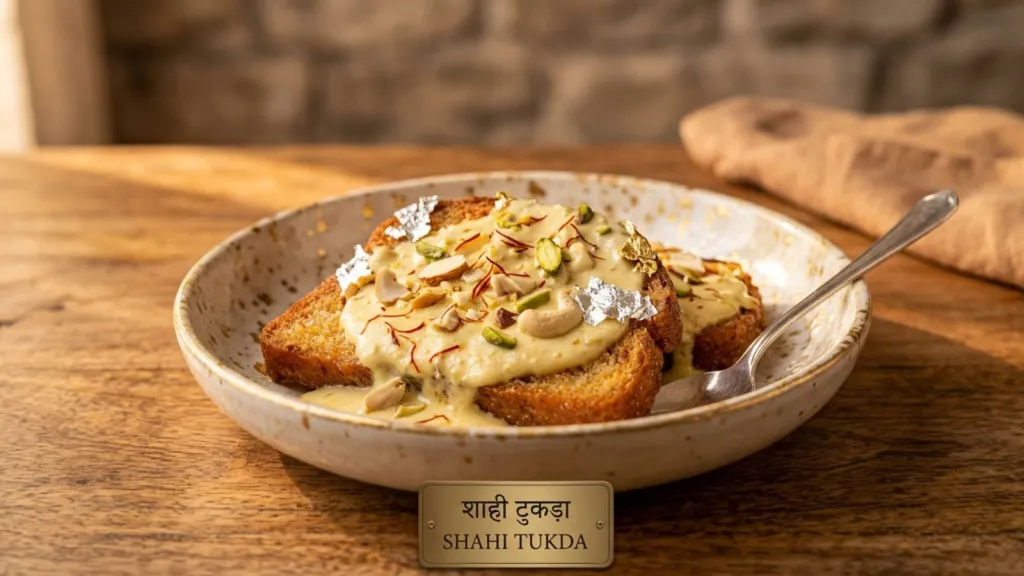
Some of India’s most memorable desserts begin with surprisingly simple ingredients. Shahi Tukda is one such creation. Made with bread, ghee, milk and sugar, this rich dessert transforms everyday staples into a dish associated with celebrations, hospitality and royal-style dining. Its appeal lies in the contrast between crisp, golden bread and creamy, fragrant milk, finished with nuts and traditional spices.
Often linked with Mughal and Awadhi culinary traditions, Shahi Tukda has remained popular because it combines familiar flavours with an indulgent presentation. Saffron, cardamom, rose, almonds and pistachios give the dessert its distinctive character, while the preparation allows cooks to adjust its texture and sweetness according to preference.
Over time, the recipe has travelled beyond traditional kitchens. Contemporary chefs are experimenting with different varieties of bread, lighter milk preparations and new flavour combinations. Yet the central idea remains unchanged: turn a modest ingredient into something special through careful cooking and thoughtful layering.
What is Shahi Tukda? Understanding the royal Indian dessert
Shahi Tukda is a traditional Indian bread-based dessert in which slices or pieces of bread are fried or toasted in ghee, sweetened and served with thickened milk, commonly prepared as rabri. The dish is usually garnished with chopped nuts and aromatic ingredients such as cardamom and saffron.
The name offers a clue to its identity. The word shahi means royal, while tukda refers to a piece or portion. Together, the words suggest a royal piece of dessert, reflecting the richness associated with its traditional preparation.
Although recipes differ between households and regions, the basic components create a recognisable combination of textures and flavours:
- Bread: Provides the base and becomes crisp when fried or toasted.
- Ghee: Adds richness and helps develop a golden exterior.
- Sweetener: Sugar syrup or another sweet preparation gives the bread its characteristic sweetness.
- Rabri: Thickened milk provides a creamy contrast to the crisp bread.
- Aromatic ingredients: Saffron, cardamom and rose contribute fragrance.
- Nuts: Almonds and pistachios add texture and a finishing touch.
The dessert is particularly appealing because each component plays a different role. The bread offers structure, the milk adds softness, and the nuts introduce crunch. The spices and floral aromas bring the elements together without requiring an elaborate list of ingredients.
The history of Shahi Tukda: How leftover bread became a royal indulgence
The exact origin of Shahi Tukda is not firmly established, but the dessert is commonly associated with Mughal and Awadhi culinary traditions. Its history is often explained through stories about resourceful cooking, royal kitchens and the transformation of everyday food into elaborate preparations.
Neelam Sircar, chef and co-founder of Dilli Mithai Co, notes that several accounts surround the dish’s beginnings. One popular narrative describes how leftover or stale bread was fried in ghee, soaked in sugar syrup and finished with thickened milk. What might otherwise have been discarded became a rich dessert through a combination of cooking techniques and flavourful additions.
This account highlights an important feature of traditional food cultures: the ability to make the most of available ingredients. Bread that had lost some of its freshness could acquire a new texture when fried. Sweet syrup brought moisture and flavour, while thickened milk transformed the preparation into something considerably more indulgent.
However, this popular origin story should be understood as a culinary narrative rather than a definitively documented account of the dessert’s invention. Its precise beginnings remain uncertain.
Why Mughal and Awadhi food traditions matter
Shahi Tukda’s association with Mughal and Awadhi cuisine reflects the broader influence of rich, carefully prepared food on the culinary identity of northern India. These traditions are often connected with elaborate meals, slow cooking, fragrant spices and preparations that balance sweetness, richness and aroma.
In this context, a dessert made with bread, milk, ghee and sugar fits naturally into a style of cooking that values both technique and presentation. The ingredients themselves may be familiar, but the way they are combined creates a more elaborate experience.
It is also important to distinguish culinary association from a confirmed historical record. The connection with royal food traditions is widely repeated, but the available account does not establish a specific royal kitchen, ruler or date as the definitive starting point of Shahi Tukda.
Shahi Tukda and its connection with Central Asian and Middle Eastern desserts
Shahi Tukda also has interesting parallels with bread-and-milk desserts found across Central Asia and the Middle East. The broader idea of combining bread with sweetened milk or syrup appears in different food traditions, demonstrating how similar ingredients can inspire distinct dishes across regions.
Chef Neelam Sircar points to these similarities while explaining how Shahi Tukda became rooted in the Indian subcontinent. Food traditions rarely develop in isolation. Ingredients, cooking methods and culinary ideas travel through trade, migration, cultural exchange and changing household practices.
Once an idea enters a new region, local ingredients and preferences can reshape it. The result may retain a recognisable foundation while developing its own identity. Shahi Tukda’s combination of fried bread and thickened milk reflects this kind of culinary evolution.
How Shahi Tukda became part of regional Indian food culture
Over time, the dessert became particularly associated with food cultures in Delhi, Lucknow and Hyderabad. Each region has its own culinary traditions, and the popularity of bread-based sweets illustrates how a common idea can take on different forms.
One notable relative is Hyderabad’s Double ka Meetha. The dessert shares the central concept of using bread as the foundation for a sweet preparation, often combining it with ghee, sugar and milk-based elements.
Double ka Meetha is widely recognised as a Hyderabadi dessert, while Shahi Tukda is associated with a broader north Indian and royal-style culinary tradition. Although the two are closely related in concept, they should not automatically be treated as identical dishes. Regional recipes, preparation methods and presentation can vary.
Their similarities reveal how food evolves through local interpretation. A familiar ingredient such as bread can become the foundation for several distinctive desserts, each shaped by the tastes and cooking practices of its region.
What makes traditional Shahi Tukda so special?
The appeal of Shahi Tukda is not simply its sweetness. Its identity comes from the interaction of texture, temperature and aroma. A well-prepared portion should offer more than a soft piece of bread covered in milk. It should bring together crispness, creaminess and the fragrance of carefully chosen ingredients.
The importance of the bread
Bread forms the foundation of the dessert, so its texture matters. When fried in ghee, it develops a golden exterior and a richer flavour. The bread can then absorb sweetness while retaining some of its structure.
Too much liquid, however, can make the bread excessively soft. The balance between absorption and crispness is one of the most important considerations in preparing the dish.
Traditional recipes often use ordinary bread, but the choice of loaf can influence the final result. Bread with a denser texture may hold its shape differently from a softer variety. This is one reason contemporary chefs are exploring alternatives such as brioche and milk bread.
Why rabri is central to the dessert
Rabri gives Shahi Tukda much of its richness. Prepared by slowly reducing milk, it develops a thick consistency and concentrated dairy flavour. When paired with sweetened bread, it creates the creamy element that distinguishes the dessert.
The consistency is important. A very thick preparation can make the dessert feel heavy, while a thinner one may soak into the bread too quickly. The ideal texture depends on the style of serving and how much crispness the cook wants to preserve.
Cardamom and saffron are frequently used to add fragrance. Rose can introduce a floral note, while almonds and pistachios provide a contrasting crunch.
How chefs are giving Shahi Tukda a contemporary makeover
Traditional desserts are increasingly finding space on modern restaurant menus, but updating them does not necessarily mean abandoning their original character. For Chef Sircar, the more interesting approach is to understand what makes a dish memorable and refine that experience without changing its identity simply for appearance.
Shahi Tukda offers considerable room for experimentation because its main components can be adjusted without losing the basic idea of bread, sweetness and creamy milk.
New bread choices bring different textures
One of the most noticeable changes is the use of alternative breads. Brioche, milk bread and artisanal loaves are being explored in contemporary versions of the dessert.
Brioche can contribute a soft, buttery texture, while milk bread offers a tender crumb. Artisanal loaves may provide a firmer structure, depending on the variety. These choices change how the bread absorbs the milk preparation and how the dessert feels when eaten.
Such variations demonstrate that the bread is not merely a base. It is an important part of the dessert’s overall flavour and texture.
Lighter rabri and controlled sweetness
Another area of experimentation is the milk component. Traditional rabri is rich and dense, but modern interpretations may use a lighter, silkier preparation to create a less heavy finish.
Sweetness can also be adjusted. Rather than allowing syrup and rabri to make every bite equally sweet, chefs can control the quantity of each component. This helps the flavours of the bread, milk, spices and nuts remain distinct.
The aim is not necessarily to make the dessert low-calorie. It is to create a more balanced eating experience while retaining the indulgence associated with Shahi Tukda.
Flavours that complement the original recipe
Contemporary versions may incorporate pistachio, saffron, rose, coffee, citrus or caramel. These additions can introduce new dimensions, but their success depends on restraint.
For example, citrus can bring freshness to a dessert that is otherwise dominated by dairy and sweetness. Coffee may add a deeper flavour, while rose and saffron reinforce the aromatic character of the traditional preparation. Pistachio can contribute both flavour and texture.
These ingredients work best when they support the original dessert rather than overwhelm it. Shahi Tukda should remain recognisable even when its presentation or flavour profile changes.
Modern presentation: From a generous serving to an individual dessert
Presentation has become another way of reinterpreting Shahi Tukda. Traditional servings can be generous, with bread covered in thick rabri and finished with nuts. Contemporary restaurants may instead serve smaller individual portions with carefully arranged layers.
Chef Sircar describes an approach that combines crisp bread, warm rabri, roasted nuts and controlled sweetness. The intention is to create a contrast between crisp and creamy textures, while allowing the aromas to emerge gradually.
Smaller portions can also make it easier to manage the balance of ingredients. Rather than allowing the bread to become completely soaked, the cook can add the milk preparation in a controlled quantity and serve the components while their textures are still distinct.
Temperature can influence the experience as well. Warm rabri creates a comforting contrast with crisp bread, while a chilled version can feel more refreshing. The choice depends on the desired style of dessert.
Can Shahi Tukda be made healthier?
Shahi Tukda is traditionally an indulgent dessert because it combines fried bread, ghee, sugar and thickened milk. However, people who want to moderate its richness can make changes to the ingredients and cooking method.
These adjustments can reduce the amount of added fat or sugar, although they do not automatically make the dessert a low-calorie or universally healthy food. The goal is to retain the familiar flavours while making the preparation lighter.
Use toasted or air-fried bread instead of deep-frying
One suggested change is to replace deep-frying with lightly toasting the bread on a pan or using an air fryer. Whole wheat or multigrain bread can be used as an alternative to regular white bread.
A small amount of ghee can still be added to provide flavour and help the bread develop a crisp exterior. This approach reduces the need for a large quantity of cooking fat, although the final nutritional value will depend on the amount used.
Prepare lighter rabri with reduced milk
Traditional rabri can be rich because milk is reduced over time and may be combined with additional dairy ingredients. A lighter version can be prepared using low-fat milk, simmered slowly until it thickens naturally.
This method helps maintain the creamy character of the dessert without relying on full-fat cream or condensed milk. The consistency may differ from traditional rabri, but careful simmering can still produce a satisfying milk-based topping.
Adjust the sweetener without losing flavour
Another option is to reduce the quantity of refined sugar. Small amounts of jaggery, dates or honey can be used to provide sweetness, depending on the recipe and personal preference.
These ingredients should not be treated as automatically sugar-free or calorie-free alternatives. They still contribute sugars and energy. The more useful change is to control the total amount of sweetener rather than assuming that a different sweetening ingredient makes the dessert suitable for unlimited consumption.
Retain the traditional aroma with spices and nuts
Cardamom, saffron and rose petals can help preserve the familiar fragrance of Shahi Tukda even when the recipe is modified. Their aromatic qualities make the dessert feel recognisable without requiring excessive sweetness.
Chopped almonds, pistachios and walnuts can provide texture and make the topping more substantial. Nuts also contribute nutrients, but portion size remains important because they are energy-dense foods.
Use hung curd carefully for a creamy variation
Chef Sircar’s suggested lighter approach also includes adding a little homemade hung curd to the reduced milk mixture. Hung curd can contribute a creamy consistency and some protein, offering an alternative way to modify the texture.
However, it may introduce a slight tang that differs from the flavour of conventional rabri. It should therefore be added carefully and adjusted according to taste. The mixture should also be handled and stored safely, particularly if the dessert is prepared in advance.
A simple approach to assembling a lighter Shahi Tukda
A lighter version can follow the same basic structure as the traditional dessert while changing how its components are prepared.
- Choose the bread: Use whole wheat or multigrain bread and cut it into manageable pieces.
- Prepare the base: Lightly toast the bread in a pan with a small amount of ghee or air-fry it until crisp.
- Make the milk topping: Simmer low-fat milk until it thickens, stirring regularly to prevent it from sticking.
- Add fragrance: Mix in a small amount of cardamom and saffron. Rose petals can be added for aroma.
- Adjust sweetness: Use a modest quantity of jaggery, dates or honey according to preference.
- Prepare the garnish: Chop almonds, pistachios and walnuts into small pieces.
- Assemble the dessert: Arrange the toasted bread and add the milk mixture in a controlled quantity so the bread absorbs the flavour without becoming excessively soggy.
- Serve as preferred: Enjoy it slightly warm or chilled, depending on the desired texture.
The result will not be identical to the traditional ghee-fried version, but it can preserve the dessert’s defining combination of bread, sweetened milk, aromatic spices and nuts.
Why Shahi Tukda continues to hold its place in Indian cuisine
The lasting popularity of Shahi Tukda comes from its ability to combine simplicity with indulgence. Its central ingredients are familiar, yet the preparation turns them into a dessert that feels celebratory. The contrast between crisp bread and creamy rabri gives it a distinctive identity, while saffron, cardamom and nuts add the aromas and textures associated with festive Indian sweets.
Its regional associations also reveal how food traditions develop over time. Stories connected with Mughal and Awadhi kitchens, similarities with bread-and-milk desserts elsewhere, and its relationship with Hyderabad’s Double ka Meetha all point to the movement and adaptation of culinary ideas.
Today, chefs are exploring new breads, lighter milk preparations, controlled sweetness and modern plating. These changes show that traditional desserts can evolve without losing the qualities that made them popular in the first place.
Whether prepared in a traditional style or given a contemporary interpretation, Shahi Tukda remains a reminder that an extraordinary dessert does not always need complicated ingredients. Sometimes, the right technique, a little patience and a thoughtful combination of familiar flavours are enough to turn an ordinary piece of bread into a royal indulgence.
Disclaimer: This article is based on information available in the public domain and inputs shared by the expert consulted. Ingredient substitutions and lighter preparation methods may change the nutritional value and taste of the dessert.
For breaking news and live news updates, like us on Facebook or follow us on Twitter and Instagram. Read more on Latest Lifestyle on thefoxdaily.com.


COMMENTS 0