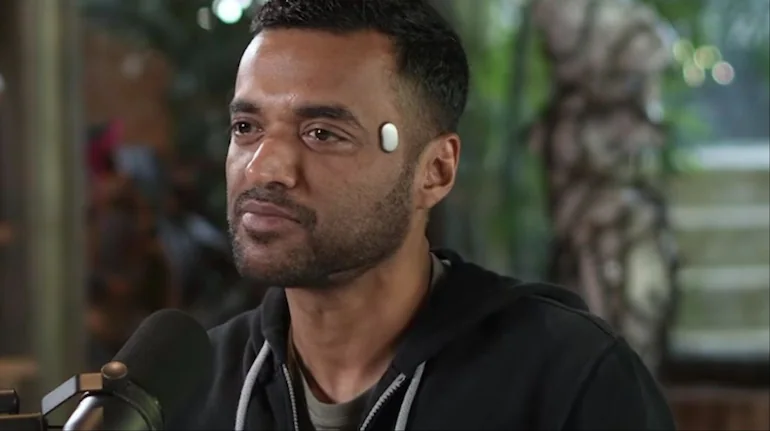
Deepinder Goyal, the founder of Temple and former chief executive of Eternal, has introduced an unusual wearable device that aims to change how people interact with Artificial Intelligence. Called Temple, the device is designed to listen to its wearer without using a conventional microphone, camera or screen.
Goyal describes it as the world’s first “roomdeaf voice AI companion”, referring to its ability to detect the vibrations generated by the user’s voice while filtering out surrounding conversations and environmental sounds. The concept is built around a simple idea: users should be able to interact with an AI companion without speaking into a smartphone or exposing nearby conversations to a microphone.
The wearable is also being developed as a personal memory assistant and health-tracking device. Its proposed features include voice-based note-taking, reminders, sleep monitoring, heart-rate measurements and other wellness insights.
Temple 01, the first version of the device, is scheduled to begin shipping in early 2027. Goyal has described the project as an ambitious attempt to develop a new category of personal technology rather than simply another AI-powered accessory.
What Is Temple? Deepinder Goyal’s Microphone-Free AI Wearable
Temple is a compact wearable designed to attach to the side of the user’s head, near the temple. Unlike conventional voice assistants that depend on microphones to capture spoken commands, it uses motion sensors to detect vibrations produced when the wearer speaks.
According to Goyal, these vibrations can be converted into text, allowing the device to recognise the user’s voice without recording surrounding conversations through a traditional microphone.
He calls this approach “roomdeaf audio”. The idea is to make the device responsive to its owner while reducing its ability to pick up conversations happening nearby.
Goyal explained that Temple does not have a microphone but can still detect the user’s speech. This is intended to address a privacy concern associated with voice-enabled devices: conventional microphones may capture sounds and conversations beyond the intended interaction.
However, the technology’s real-world performance will depend on how accurately it can distinguish the wearer’s speech from other vibrations and noise. Independent testing will be important to establish how well the system works in crowded or noisy environments.
How Does Temple Work Without a Microphone?
Temple’s central technology relies on motion sensors rather than conventional audio recording. When a person speaks, the movement of their vocal system generates vibrations that can travel through surrounding tissues. Temple is designed to detect these vibrations and process them into text.
This approach differs from standard voice recognition systems, which generally capture sound waves through microphones before converting speech into digital information.
The device is designed to activate through a double tap. Once activated, a small vibration indicates that it is listening. Another vibration signals that the interaction has been processed.
This feedback system allows users to interact with Temple without looking at a display or taking out their smartphones. The wearable is intended to remain available throughout the day, making voice-based interactions more discreet.
Goyal believes the technology could be particularly useful in environments where conventional voice assistants are inconvenient or where recording surrounding conversations raises privacy concerns.
Temple’s Design: A Wearable Attached Near the Temple
Temple is designed to be attached to the side of the head using medical-grade adhesive tapes called Grips. These attachments are intended to keep the device in place during everyday activities.
According to Goyal, the adhesive system is being developed for continuous, multi-day use. The wearable is expected to remain attached during activities such as:
- Everyday movement and routine activities.
- Exercise and workouts.
- Showering and swimming.
- Sleeping and overnight health monitoring.
The company expects users to recharge the device approximately once a week. This would allow Temple to operate as an always-available companion without requiring daily charging, although actual battery performance will need to be assessed after the commercial product becomes available.
Its location near the temple also distinguishes it from conventional wearables such as smartwatches and fitness bands, which are generally worn around the wrist.
Temple as a Personal Memory and Reminder Companion
Beyond recognising speech, Temple is being developed to help users remember important information and manage everyday activities. Goyal wants the device to function as a personal memory companion that can capture thoughts and observations as they occur.
Users will be able to dictate ideas, save everyday observations and create reminders without reaching for a phone. This could be useful when someone is walking, exercising, working or involved in an activity where using a smartphone is inconvenient.
Some of the proposed functions include:
- Voice-based notes: Users can capture ideas and personal observations through spoken interactions.
- Personal reminders: The device can help remember birthdays, anniversaries and other important dates.
- Medication alerts: Users can set reminders to take prescribed medicines.
- Message notifications: The wearable can notify users when someone replies to a message.
- Personal observations: Users can record everyday experiences and information they want to remember later.
Notifications are expected to be delivered through vibrations rather than a conventional screen. This design supports Temple’s objective of providing useful assistance without requiring users to constantly interact with a phone.
Goyal has also made it clear that Temple is not intended to replace every function of a smartphone or operate as a universal digital assistant. The company wants to concentrate on tasks that suit a screen-free wearable. For example, it is not being designed to carry out activities such as shopping on behalf of users.
Health Tracking Features: Heart Rate, Sleep and VO2 Max
Health monitoring is another major part of Temple’s development strategy. Goyal said the device is being designed to capture health signals from its position near the superficial temporal artery, a blood vessel located near the side of the head.
He believes this placement could allow Temple to collect certain health measurements that conventional wrist- and finger-based wearables may find difficult to monitor.
According to Goyal, the device already supports several health-related metrics, including:
- Heart rate (HR): Monitoring the number of heartbeats per minute.
- Heart rate variability (HRV): Measuring variations in the time between successive heartbeats.
- Sleep tracking: Monitoring sleep-related patterns and providing information about rest.
- VO2 max: Estimating the body’s maximum capacity to use oxygen during intense physical activity.
These measurements could help users understand aspects of their daily activity, recovery and sleep. However, the accuracy and usefulness of the readings will depend on the device’s sensors, algorithms and validation process.
Additional Health Features Under Development
Temple’s proposed health capabilities extend beyond conventional heart-rate and sleep tracking. The company is working on several additional features intended to provide a broader picture of everyday health and behaviour.
These include automatic chewing detection for calorie tracking, snoring-pattern monitoring, sleep-position tracking and jaw-clenching detection.
Rapid eye movement (REM) sleep tracking is also being developed to provide more detailed sleep insights. Another planned capability is continuous monitoring of core body temperature.
Goyal also referred to research breakthroughs in an area he called “Entropy”. He said the company was validating its findings before sharing further details.
At this stage, these capabilities should be understood as features under development rather than confirmed functions available in the first commercial version. Their clinical or health-related significance will depend on further testing and validation.
How Temple Plans to Protect User Privacy
Privacy is central to Temple’s product positioning. The absence of a conventional microphone and camera is intended to reduce the collection of information from people and conversations surrounding the wearer.
Goyal said the device is designed to capture the user’s voice through vibrations rather than recording the surrounding environment. This could make it more suitable for settings where conventional voice assistants may raise concerns about unintended audio recording.
Potential use cases include boardrooms, concerts and crowded public spaces. In these environments, the ability to interact with a personal AI device without recording nearby conversations could be an important distinction.
Goyal also said Temple conversations would be end-to-end encrypted and inaccessible to model companies and even the company’s own team. He added that Temple would not use personal user data for advertising or sell it to advertisers.
These are significant privacy commitments, but users will need more technical information to understand how the system handles voice processing, stored information, encryption keys and third-party services. Independent security assessments and clear privacy documentation will be important in establishing how these promises work in practice.
Why Deepinder Goyal Left Eternal to Build Temple
Temple represents a new entrepreneurial direction for Goyal, who previously led Eternal, the company associated with food delivery platform Zomato and quick-commerce business Blinkit.
According to Goyal, the idea began as a weekend project while he was working on developing a health wearable. An engineering breakthrough during that process encouraged him to pursue the concept more seriously.
The development eventually became the foundation for Temple, prompting Goyal to return to building a new technology venture full-time.
Before unveiling the device, he had addressed questions on social media about why he left Eternal, a company he described as having a valuation of approximately $35 billion.
Goyal presented Temple as a long-term technology project with ambitions extending beyond a conventional wearable. He described the team as ambitious enough to believe it could build something with a broader role in the future of personal technology.
His decision signals a shift from the consumer internet and delivery businesses associated with his earlier career towards hardware, artificial intelligence and health technology.
Temple 01 Launch Date: When Will the AI Wearable Ship?
Goyal has confirmed that the first version of the device, called Temple 01, is scheduled to begin shipping in early 2027.
The initial version is expected to include both AI and health-related features. Rather than presenting Temple 01 as a finished platform, Goyal described it as the starting point for a longer development process.
The company intends to continue improving the device through research and development, potentially adding capabilities as the technology evolves and its performance is validated.
However, several important commercial details remain unclear, including the final price, availability across different countries, detailed technical specifications and the complete list of features that will be included at launch.
Until these details are announced, consumers should treat the early 2027 shipping timeline as the company’s stated plan rather than an indication that the device is already available for purchase.
Can Temple Replace Smartphones and Smartwatches?
Temple enters a growing market for AI-powered personal devices, where technology companies are exploring alternatives to traditional smartphone interfaces. The idea of a wearable that can understand speech, remember information and monitor health without requiring a screen has considerable appeal.
Its biggest potential distinction is the combination of microphone-free voice interaction and health tracking in a device worn near the head. If the technology works as intended, it could offer a different experience from smartwatches, wireless earbuds and conventional voice assistants.
However, replacing established devices will not be easy. Smartwatches already offer mature health-monitoring features, while smartphones remain central to communication, navigation, entertainment and digital services.
Temple’s success will depend on several factors, including speech recognition accuracy, battery life, comfort, adhesive reliability, health measurement quality and privacy safeguards. Its ability to deliver useful everyday assistance without becoming intrusive will also matter.
Deepinder Goyal’s Temple Is an Ambitious Bet on Personal AI
Temple reflects Goyal’s attempt to imagine a different relationship between people and artificial intelligence. Instead of asking users to open an application, look at a screen or speak into a microphone, the device is designed to remain attached to the body and respond through subtle interactions.
Its proposed combination of voice-based memory assistance, reminders, health tracking and privacy-focused design makes it more than a conventional fitness wearable. At the same time, many of its most ambitious capabilities still need to be demonstrated through real-world testing.
Temple 01 is expected to ship in early 2027, giving the company time to refine the hardware and validate its features. Whether it becomes a new category of personal technology or remains a specialised wearable will depend on how effectively it solves everyday problems for users.
For now, Goyal’s announcement introduces an ambitious vision: an AI companion that can listen to its owner without a traditional microphone, help preserve personal memories and monitor aspects of health without demanding constant attention.
For breaking news and live news updates, like us on Facebook or follow us on Twitter and Instagram. Read more on Latest Technology on thefoxdaily.com.






COMMENTS 0