
For many companies, discipline is treated as one of the foundations of a productive workplace. Clear goals, measurable performance and well-defined processes can make an organisation easier to manage. But Zoho founder and chief scientist Sridhar Vembu argues that there is a hidden cost when companies push discipline too far.
In a post on X, Vembu described a tension between two fundamentally different approaches to organisational culture. One relies on employees following goals and instructions established by senior leadership. The other encourages employees to make decisions themselves, challenge colleagues and take initiative even when there is no clear direction from the top.
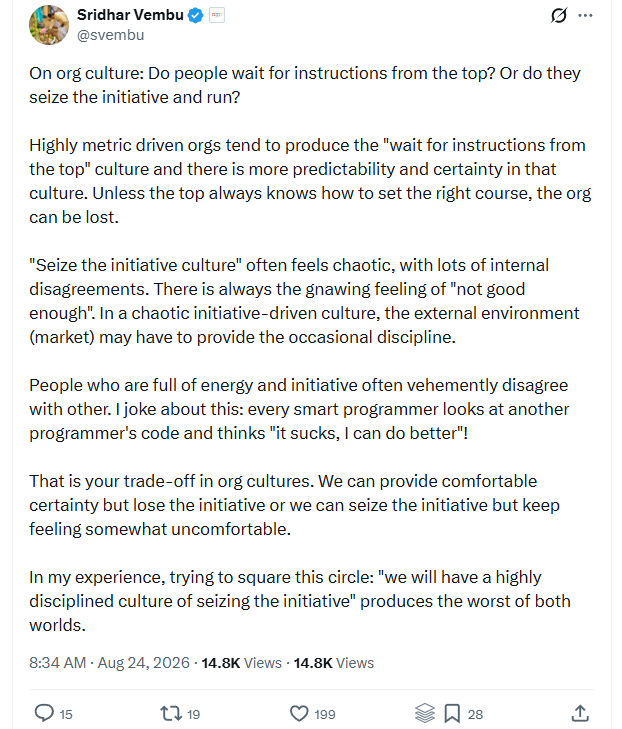
Vembu’s argument is that neither model is perfect. A highly controlled organisation can become predictable but dependent on senior decision-makers. An initiative-driven organisation can produce more independent thinking but also more disagreement, uncertainty and internal friction.
His warning is particularly relevant to Technology companies, where employees are often expected to solve problems that management cannot fully anticipate. For software developers, engineers and researchers, initiative can be difficult to preserve if success is reduced to following instructions and meeting predefined metrics.
At the same time, Vembu’s comments come as Zoho faces rising costs associated with memory and Artificial Intelligence. He says higher memory prices and AI token costs are making Business increasingly difficult and could force software companies to rethink assumptions that have shaped programming for decades.
Why Vembu thinks workplace discipline can backfire
Vembu’s central argument is not that discipline is inherently bad.
The problem begins when discipline becomes synonymous with employees waiting for instructions.
In one organisational model described by Vembu, senior leaders establish goals, employees follow those objectives and performance is evaluated using metrics. Such a system can create consistency. Everyone knows what is expected, managers can measure outcomes and the organisation can coordinate large numbers of people without constant debate.
But there is a weakness.
If employees become accustomed to waiting for instructions, they may become less willing to act independently when circumstances change. A worker may focus on completing the assigned target rather than asking whether the target itself still makes sense.
That creates a form of organisational dependence on senior management.
If the leadership makes the right decisions, the system can work efficiently. If leadership makes a major mistake, however, a workforce trained primarily to follow instructions may be less likely to challenge it.
For a technology company operating in a rapidly changing market, that can become especially important. Problems often emerge before management has had time to establish a formal process for dealing with them.
The alternative is an organisation built around initiative
The second model Vembu describes is almost the opposite.
Instead of waiting for directions, employees are expected to take ownership, make decisions and challenge one another. Such an organisation can generate more ideas because responsibility is distributed across the workforce rather than concentrated at the top.
But independence has a price.
Employees may disagree more often. Teams can question each other’s decisions. People may have different ideas about what constitutes good work, creating uncertainty over whether they are moving in the right direction.
Vembu says that this kind of Environment can create a persistent feeling among employees that their work is “not good enough”.
That does not necessarily mean the model is ineffective. Disagreement can be a sign that people are thinking seriously about their work rather than simply accepting instructions.
The challenge is making sure that disagreement produces better decisions instead of becoming a source of endless conflict.
Why programmers are a useful example
Vembu used programmers to illustrate the tension.
His observation was that “every smart programmer” can look at another programmer’s code and think they could have done it better.
The example captures something fundamental about technical work. Software Development is rarely a simple process in which there is one universally accepted answer. Two experienced developers can examine the same problem and reach different conclusions about architecture, performance, Security or maintainability.
That disagreement can be productive.
A developer WHO is willing to question existing code may identify a vulnerability, simplify a complicated system or find a more efficient solution. But the same instinct can also create friction if every disagreement becomes a personal battle over whose approach is superior.
That is the cultural trade-off Vembu is describing.
A company that eliminates disagreement in the name of discipline may also eliminate some of the initiative that produces Innovation. A company that encourages unrestricted initiative may create an environment where employees spend too much time challenging each other instead of completing the work.
Why “disciplined initiative” can become the worst of both worlds
Vembu’s most provocative point is his warning about trying to combine the two models.
He argues that attempting to create “a highly disciplined culture of seizing the initiative” can result in “the worst of both worlds”.
The apparent contradiction is easy to understand.
Imagine telling employees that they must independently take responsibility, challenge assumptions and make decisions, while simultaneously imposing rigid processes for how they should behave and how those decisions should be measured.
Employees can end up carrying responsibility without having genuine freedom.
They are expected to show initiative, but only within a tightly controlled framework. They are encouraged to think independently, yet their performance may still be judged primarily through predefined metrics.
That can produce an uncomfortable organisational culture where employees are simultaneously responsible for outcomes and constrained in how they pursue them.
Vembu’s argument therefore raises a broader management question: how much control does a company need before control begins to undermine the behaviour it wants from employees?
Metrics can improve performance but also change behaviour
Metrics are not inherently problematic.
Companies need ways to determine whether products are improving, customers are being served and resources are being used effectively. Without measurable objectives, an organisation can struggle to distinguish productive activity from activity that merely looks busy.
The problem emerges when the metric becomes the objective.
An employee who is rewarded for hitting a specific number may naturally optimise for that number. If the metric does not capture the full value of the work, the employee can succeed according to the measurement while failing to solve the underlying problem.
This is particularly relevant in creative and technical roles.
A programmer’s contribution may not be fully represented by the number of lines of code written. A researcher cannot necessarily be evaluated by how many experiments are completed. A software engineer who spends days simplifying a system may appear less productive than someone constantly adding features, even if the simpler system is ultimately more valuable.
Vembu’s criticism of highly metric-driven cultures appears to focus on this broader risk: measurement can provide clarity while also encouraging employees to optimise for what management can easily observe.
Zoho is facing a very different kind of pressure
Vembu’s discussion about Workplace Culture comes at a challenging time for technology companies.
He has also been warning about rising costs for computing hardware and artificial intelligence.
In a separate post on X, Vembu said that memory prices and AI token prices had made business “very difficult”. He added that Zoho had held back from raising prices but that maintaining that position was becoming increasingly difficult.
Memory has become an increasingly important component of modern computing infrastructure because AI workloads require substantial amounts of high-performance memory.
According to data cited by Tom’s Hardware in the report shared by Vembu, average prices for some DDR5 memory kits rose dramatically between August 2025 and August 2026. Average prices for some kits increased from roughly $90 to about $425 over that period.
A 128GB DDR5-6400 kit was cited at around $3,399, compared with a previous low of $329.
These figures illustrate why hardware costs have become a concern for software companies. Software businesses do not necessarily manufacture memory themselves, but they depend on servers, computers and cloud infrastructure that contain it.
When underlying infrastructure becomes more expensive, companies have several choices: absorb the additional cost, raise prices, reduce usage or improve efficiency.
None of those choices is straightforward.
AI is making the memory problem more important
The connection between memory costs and artificial intelligence is particularly significant.
AI systems require substantial computing resources, and the infrastructure supporting those systems relies heavily on memory and other high-performance components.
At the software level, AI services also generate costs each time users interact with models. Those costs are commonly associated with processing AI tokens, making usage volume an important consideration for businesses offering AI-powered features.
For a company such as Zoho, which provides a broad portfolio of software products, the economics of adding AI capabilities are therefore more complicated than simply developing a model or integrating an AI tool.
The company must consider the continuing cost of operating those features at scale.
If customers use AI functions heavily, the value of those functions needs to justify the infrastructure and processing costs associated with them.
That creates a new version of the productivity challenge Vembu has been discussing: companies need to encourage innovation while also making sure the economics of that innovation work.
Vembu says the memory crunch could change programming itself
Vembu’s concerns extend beyond hardware prices.
He argues that the current memory environment could force software developers to reconsider some assumptions built into programming languages and development practices.
For decades, falling computing and memory costs encouraged developers to prioritise convenience and developer productivity without always treating memory consumption as a critical constraint.
Vembu’s view is that this era may be ending.
He has argued that programming languages were designed for a period when memory was effectively cheap enough to be treated as abundant. With memory becoming more expensive, he believes developers will need to pay greater attention to efficiency.
That could mean renewed interest in memory-efficient programming languages, better compilers and development tools capable of producing efficient code without making software development unnecessarily difficult.
The challenge is finding the right balance.
Making developers manually manage every aspect of memory could improve efficiency but also increase development time and the possibility of programming errors. Modern software engineering has deliberately moved toward abstractions that allow developers to work at a higher level.
Vembu’s argument suggests the industry may need smarter tools rather than simply returning to older, more cumbersome programming practices.
Why efficient code matters more in the AI era
Software efficiency has always mattered, but AI can magnify the consequences of inefficiency.
A small inefficiency in an application used by a few people may have a negligible cost. The same inefficiency multiplied across millions of users and large-scale cloud infrastructure can become expensive.
AI systems can intensify that effect because they often require significant computational resources for every interaction.
That makes optimisation valuable not only for performance but also for operating costs.
For businesses, the question is increasingly becoming whether developers can build AI-powered features that are useful without consuming disproportionate amounts of computing resources.
Vembu’s comments therefore connect two issues that may initially seem unrelated: workplace culture and software efficiency.
Both involve trade-offs between freedom, convenience and constraints.
The common thread in Vembu’s arguments
There is a broader idea connecting Vembu’s comments about employees, programming and rising technology costs.
He is questioning what happens when an organisation assumes that resources are effectively unlimited.
In workplace culture, treating discipline as the solution to every organisational problem can consume employee initiative. In software, treating memory as effectively free can encourage inefficient programming practices. In AI, treating computing and token costs as secondary can make it difficult to build sustainable products.
In each case, the easy assumption eventually encounters a constraint.
The solution is not necessarily to abandon discipline, abstraction or AI investment. Instead, companies need to understand where each approach stops being useful.
A disciplined organisation still needs people who can challenge bad decisions. A software language still needs to protect developers from unnecessary complexity while encouraging efficient execution. An AI product still needs to deliver enough value to justify the cost of running it.
What Vembu’s comments mean for technology companies
For technology businesses, these issues are becoming increasingly connected.
AI is changing what software companies build, how developers work and how much infrastructure they need. At the same time, higher infrastructure costs are forcing businesses to think more carefully about efficiency.
That may increase the value of engineers who can do more than simply follow established processes.
Companies may need employees capable of identifying waste, challenging assumptions and finding alternative solutions. But giving employees that freedom also requires managers to tolerate disagreement and accept that not every decision will be uniform.
That is precisely where Vembu’s workplace argument becomes relevant.
A company cannot demand initiative while treating every deviation from a prescribed process as a failure. Nor can it encourage unlimited experimentation without providing some mechanism for resolving disagreements and setting priorities.
The difficult part of management is finding the boundary between the two.
Discipline is not the problem; how discipline is used is
Vembu’s comments should not be read as an argument that companies should abandon structure.
Every large organisation needs some degree of coordination. Employees need to understand the company’s objectives, teams need to work together and leaders need mechanisms for determining whether resources are being used effectively.
The more interesting question is what happens inside that structure.
If employees are encouraged to question assumptions and make responsible decisions, discipline can provide a framework rather than a cage. If discipline becomes primarily about compliance, however, employees may learn that the safest strategy is simply to wait for instructions.
For technology companies operating in rapidly changing markets, that distinction can matter enormously.
The same principle applies to the software and AI cost pressures Vembu has highlighted. Businesses cannot control every external cost, but they can decide how efficiently they use the resources available to them.
The challenge ahead for Zoho and the wider software industry
Zoho is now navigating two pressures at once.
Internally, Vembu is arguing that organisations need to preserve employee initiative rather than assuming that stricter discipline automatically produces better performance.
Externally, the company is dealing with higher memory and AI-related costs that threaten to make software operations more expensive.
Those challenges reinforce the importance of efficiency and decision-making.
As AI becomes more deeply embedded in software products, companies will need to decide which AI features genuinely create value, how much computing power those features require and how much customers are willing to pay for them.
At the same time, they will need employees who can identify problems before they become expensive.
That is perhaps the strongest lesson behind Vembu’s comments. A company can create rules, metrics and processes to make work more predictable, but it cannot completely automate judgement.
When the environment changes quickly, someone still has to notice that the old assumptions no longer work.
For Vembu, that is why employee initiative matters. And with memory and AI costs rising, the ability to question assumptions may be becoming just as important in technology economics as it is in workplace culture.
For breaking news and live news updates, like us on Facebook or follow us on Twitter and Instagram. Read more on Latest Technology on thefoxdaily.com.






COMMENTS 0